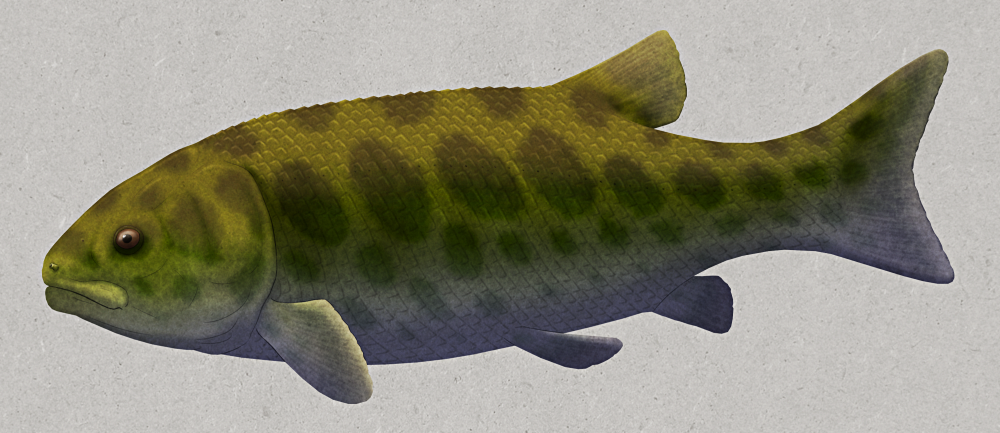
About 15cm long (~6″), it had a large hump on its back shaped like a backwards shark fin. Its deep body was wider at the base, giving it a triangular shape when viewed from the front similar to some modern tropical fish – and suggesting it may have had a similar sort of ecology as a slow but highly maneuverable swimmer feeding on small seabed invertebrates.
First discovered in Jurassic-aged fossil deposits in Europe in the 1830s, this genus was quickly turned into a notorious wastebasket taxon for any similar-looking fossil fish. Over time dozens of different Lepidotes species were named, many of them rather dubious, from locations all around the world and spanning a time period of over 100 million years.
Lepidotes gigas
But despite Lepidotes being a wastebasket for almost two centuries, it wasn’t until surprisingly recently that any real progress began to be made on cleaning it all up.
In the early 2010s a large-scale review of ginglymodian relationships found that many “Lepidotes” species were either invalid or polyphyletic, belonging in completely different genera or families. True Lepidotes were restricted down to just the original type speciesLepidotes gigas and a few of its closest relatives, all from the early Jurassic of Europe, while some other forms were moved into the newer genera Scheenstia and Callipurbeckia. Since then some other “Lepidotes” have also been reclassified, creating new names like Macrosemimimus, Occitanichthys, and Quasimodichthys.
There’s still work needing to be done on untangling all these Lepidotes-like fish – Scheenstia might actually now represent several different lineages, for example – but at least Lepidotes itself is now in a much better situation than it was just a couple of decades ago.