Postschizotherium

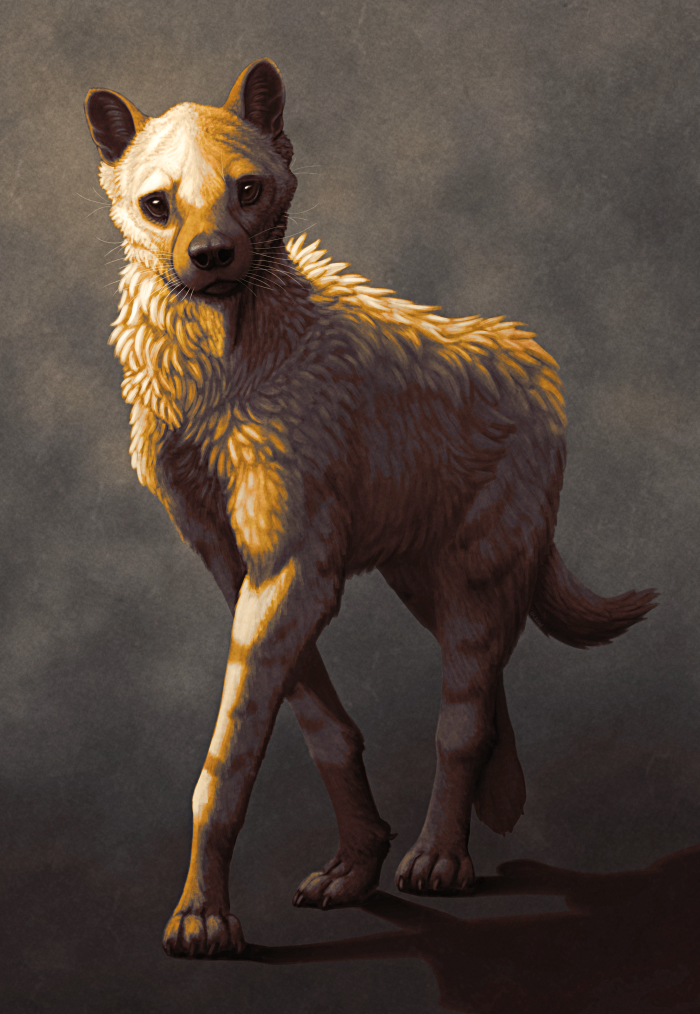
Postschizotherium intermedium was a large hyrax that lived during the late Pliocene and early Pleistocene, about 2.5-2.2 million years ago, in what is now northern China.

About 1.5m long (~5′), it had very high-set and sideways projecting eye sockets similar to those of modern hippos, indicating it probably had a similar sort of semi-aquatic lifestyle. The shape of its skull also suggests it may have had a short tapir-like trunk.

Much like modern hippos or capybaras Postschizotherium probably spent much of its time wallowing in bodies of water, and emerging onto land to graze on grasses. Its habitat would have been humid forest and grasslands, alongside other animals such as large horses and bovines, one of the last chalicotheres, woolly rhinos, beavers, macaques, bears, big cats, early lynxes, and scimitar-toothed cats.

Continue reading “Postschizotherium”

Ubaghsicystis

Ubaghsicystis segurae was an echinoderm that lived during the mid Cambrian, about 506-497 million years ago, in what is now Spain. Similar fossils are also known from Morocco, Mexico and Canada, suggesting this genus was quite widespread in marine continental shelf habitats at the time.

It was part of an extinct group known as eocrinoids, which were the earliest known echinoderms to develop stalked bodies and specialized feeding appendages — but despite the name and similar body plan, their resemblance to crinoids was due to convergent evolution rather than any direct relation.

Its globular body was only about 5mm in diameter (~0.2″), with a long stalk at least twice that length ending in a small disc that attached it to the substrate. The upper half of its body was dotted with small holes (called epispires) that probably served a respiratory function, and unlike most other eocrinoids it seems to have had just two slender flexible feeding appendages.

It would have been a suspension feeder, using tube feet to catch food particles floating around in the water, then move it down to its mouth positioned at the base of the two “arms”.

Continue reading “Ubaghsicystis”

Luoxiongichthys

Luoxiongichthys hyperdorsalis was an early ginglymodian ray-finned fish, related to the ancestors of modern gars, living during the Middle Triassic (~244 million years ago) in coastal  tropical marine waters covering what is now southwestern China.

About 15cm long (~6″), it had a large hump on its back shaped like a backwards shark fin. Its deep body was wider at the base, giving it a triangular shape when viewed from the front similar to some modern tropical fish – and suggesting it may have had a similar sort of ecology as a slow but highly maneuverable swimmer feeding on small seabed invertebrates.

Continue reading “Luoxiongichthys”

Austriadactylus

Austriadactylus cristatus was an early pterosaur that lived during the Late Triassic, about 215 million years ago, in what is now Austria and Italy.

It’s one of the most basal (“primitive”) pterosaurs currently known, with its long tail lacking the stiffening bony rods seen in other early “rhamphorhynchoid-grade” forms.

It had a wingspan of around 1.2m (~2′), and a bony crest on its snout that grew taller towards the front. Its jaws contained a mix of two different tooth types – a few long pointed teeth and numerous smaller three-pointed teeth – with wear patterns that suggest its diet primarily consisted of hard-shelled invertebrates.

Continue reading “Austriadactylus”

Megabalaena

Megabalaena sapporoensis was a member of the balaenid baleen whale lineage, related to modern right whales and bowhead whales. Living in marine waters covering what is now northern Japan during the late Miocene, about 9 million years ago, it helps to fill in a significant gap in the fossil record of this group.

Known from a partial skeleton about 12.7m long (~42′), it was much larger than earlier balaenids, but smaller than modern forms. It also had a narrower flipper shape compared to its modern relatives, a less arched jaw, and its neck vertebrae were only partially fused.

Modern right whales are slow-swimming ram feeders, but since Megabalaena was less specialized for this particular filter feeding style it’s unclear what its ecology was.

Continue reading “Megabalaena”

Dimacrodon

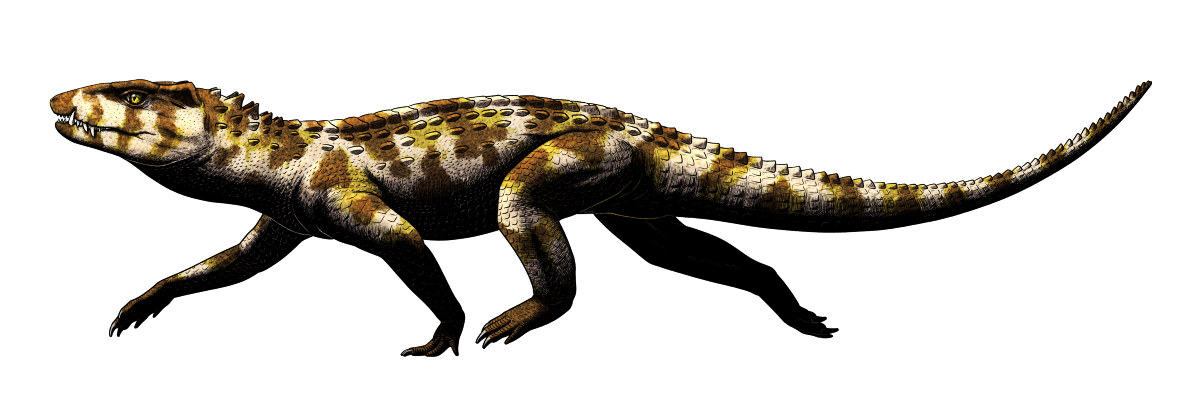
Dimacrodon hottoni was a synapsid that lived during the mid-Permian, about 272 million years ago, in what is now Texas, USA.

Known only from incomplete skull material, it had a thin bony crest on its forehead and a long snout with unusually toothless jaw tips — which had a rough bone texture suggesting there was a small keratinous beak there.

Its full body proportions aren’t known, but since its skull measured around 50cm (~1’8″) it was probably at least 2.5-3m long (~8-10′).

When its fossil remains were first discovered in the mid-20th century it was thought to be a dicynodont-like anomodont, but later examination in the 1990s suggested it was actually a more basal “pelycosaur-grade” synapsid, possibly a sphenacodont close to early therapsids. There hasn’t been any further study on Dimacrodon since then, though, so its exact evolutionary relationships remain very murky.

Its ecology is equally unclear, but its beak-like jaws suggest it may have been somewhat herbivorous. It would have lived around a coastal river delta in a semi-arid climate, alongside herbivorous caseids like Cotylorhynchus and Angelosaurus, predatory sphenacodontids like Dimetrodon, small lizard-like parareptiles and captorhinids, and aquatic temnospondyl amphibians.

Continue reading “Dimacrodon”

Xiphodracon

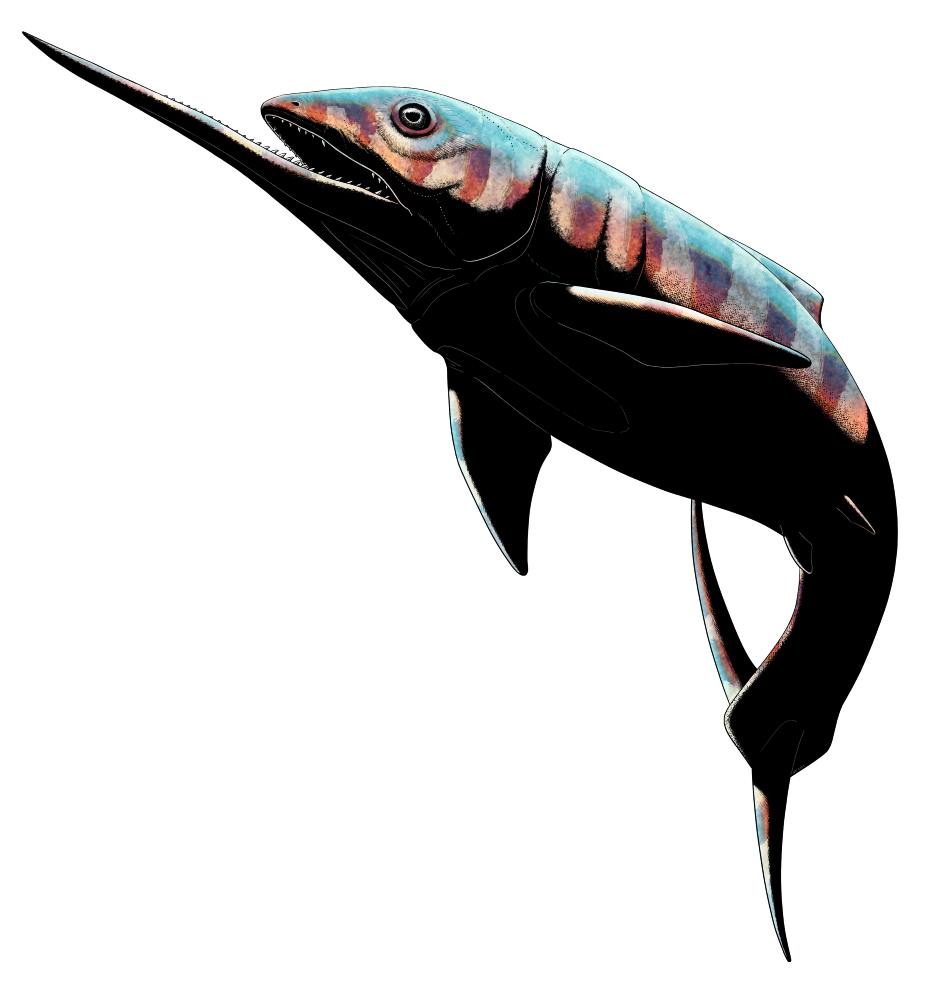
Xiphodracon goldencapensis was an ichthyosaur that lived in marine waters covering what is now the Jurassic Coast of the southern United Kingdom during the Early Jurassic, about 188 million years ago.

Around 3m long (~10′), it had fairly large eyes and a long narrow snout lined with small slender pointed teeth.

It was part of the leptonectid family, closely related to other long-snouted forms like Eurhinosaurus. Although currently only represented by a single fossil specimen, it’s actually the most complete ichthyosaur known from the Pliensbachian age of the Early Jurassic.

Preserved gut contents show that it primarily fed on fish, and also that its stomach was positioned on the left side of its body. The fossilized individual also suffered from multiple injuries during its life, including malformed teeth, a fractured clavicle, and avascular necrosis in its upper limb bones. It appears to have died after a bite to the skull from a predator – likely the larger ichthyosaur Temnodontosaurus – and additional bite marks on one hindlimb may be evidence of scavenger activity.

Continue reading “Xiphodracon”

Akidostropheus

Akidostropheus oligos was a small tanystropheid archosauromorph reptile that lived during the late Triassic, about 223-218 million years ago, in what is now Arizona, USA.

Only a few tiny isolated vertebrae have been discovered, so its full size and appearance isn’t known – making any reconstruction rather speculative – but it was probably around 30cm long (~12″). Like other tanystropheids it would have been a long-necked lizard-like animal, and may have had a similar build to the closely-related Tanytrachelos.

But despite the scarcity of material the few known vertebrae are unique among archosauromorphs, bearing elongated spikes with a surface texture that suggests they were covered with keratinous sheaths. The spikes were conical, sharp, and hooked on the neck and upper back, but became more flattened, straighter, and blade-like on the lower back and tail.

These structures were probably defensive in nature, especially considering that there’s direct fossil evidence for predators targeting the long necks of tanystropheids and decaptiating them.

Akidostropheus lived in a tropical floodplain environment around a meandering river system, but without more and better fossils it’s impossible to tell what its ecology was. Tanystropheids were a strange and diverse bunch, with both terrestrial and aquatic lifestyles, bipedal runners, and possibly even bizarre leg-gliders, so this spiky little Triassic weirdo could have been doing almost anything.

Continue reading “Akidostropheus”

Gigantspinosaurus

Gigantspinosaurus sichuanensis was an early stegosaur that lived during the mid-Jurassic, about 166 million years ago, in what is now southwestern China.

Around 4.5m long (~14’9″), it had relatively small back plates and a pair of enormous shoulder spikes. It’s unclear exactly how the shoulder spines were positioned in life, but based on how they were found articulated in a fairly complete skeleton they seem to have swept sideways and backwards, protecting Gigantspinosaurus’ flanks.

Skin impressions show a mosaic of polygonal scales with scattered “rosettes” made up of larger scales surrounded by a ring of smaller scales, with a rough ridged surface texture that may have reduced light glare – suggesting an overall more matte appearance rather than glossy.

The thigh bones of one specimen are pathological, showing evidence that these dinosaurs sometimes suffered from bone tumors.

Continue reading “Gigantspinosaurus”

Tulaneia

Tulaneia amabilia was an enigmatic Ediacaran animal that lived in what is now Nevada, USA just before the start of the Cambrian Period, about 540 million years ago.

Up to around 10cm across (~4″), its body was made up of a fan-shaped frill of airbed-like tubes, with tips that separated from each other and tapered to blunt points. Much like its close relative Ernietta it would have lived with its base buried in the seafloor sediment, and it was probably a suspension feeder catching organic particles in water currents.

One Tulaneia fossil specimen shows birfurcating tips, but it’s unclear whether this was a common feature of this species or a developmental anomaly in this particular individual.

Continue reading “Tulaneia”