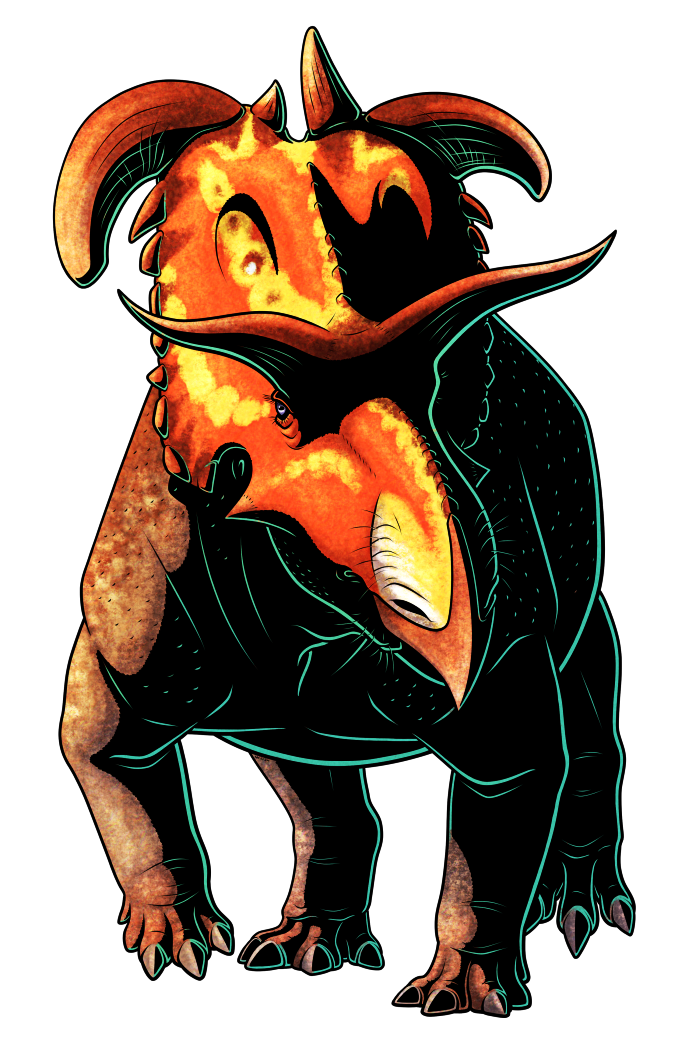
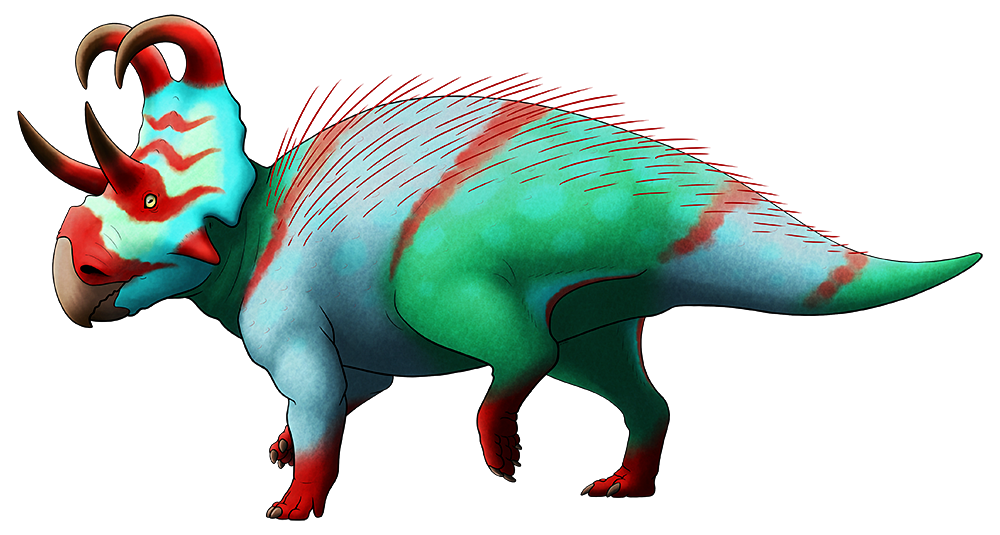
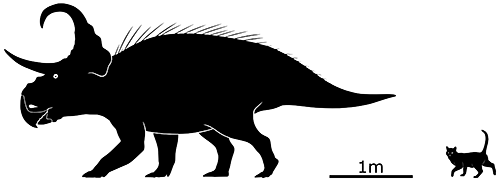
Lokiceratops rangiformis was a ceratopsian dinosaur that lived during the Late Cretaceous (~78 million years ago) in what is now Montana, USA. Estimated at about 6.7m long (~22ft), it was one of the largest known members of the centrosaurine branch of the ceratopsians.
It had a unique arrangement of ornamentation on its skull, with no nose horn, two long brow horns, and a pair of huge asymmetrical curving blade-like spikes on the top of its square frill – some of the largest known frill spikes of any ceratopsian.
(There’s also a possibility that it might not actually be a unique species. We know some other ceratopsians’ faces changed quite drastically as they aged, so Lokiceratops could instead represent a fully mature individual of Medusaceratops.)
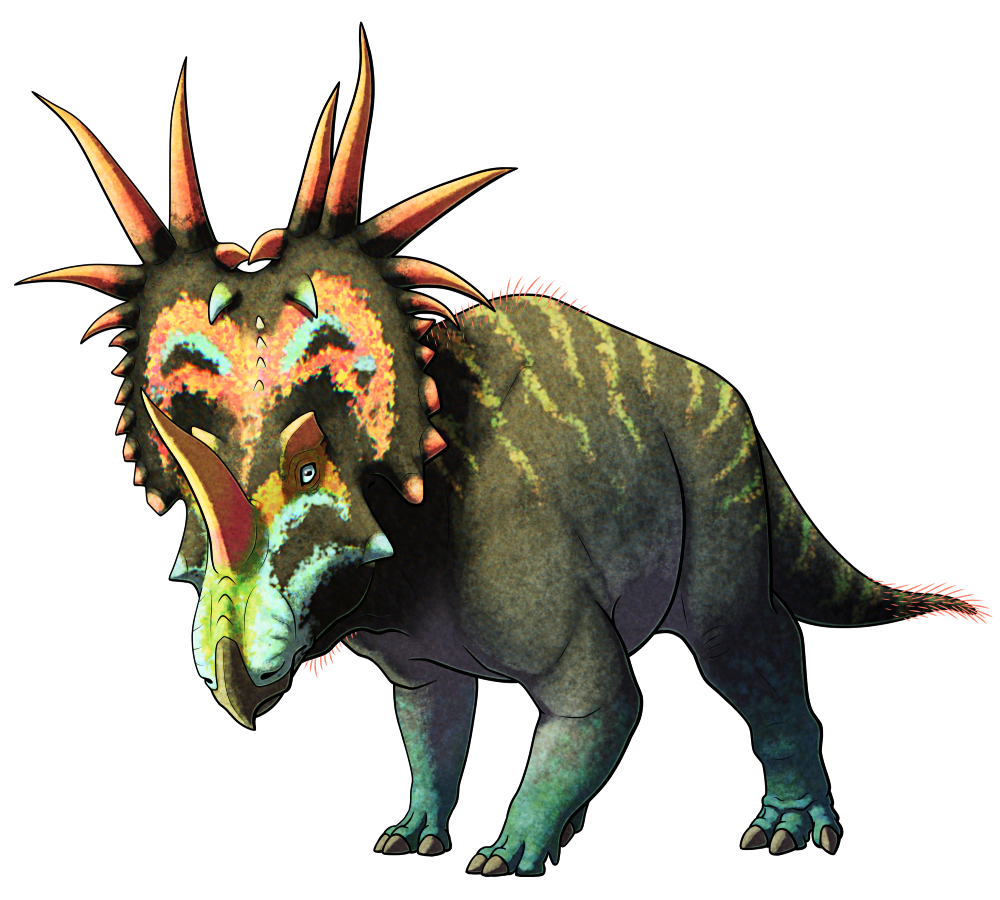
Styracosaurus albertensis was a ceratopsid dinosaur living during the late Cretaceous about 75 million years ago, in what is now Alberta, Canada. Around 5m long (~16′), it was one of the most elaborately ornamented horned dinosaurs, with a long nose horn and multiple elongated spikes on its frill.
There was actually quite a lot of variation in the frills of Styracosaurus, with varying numbers of long spikes and extra hook-like projections present on some individuals. But one recently-discovered specimen nicknamed “Hannah” is especially surprising – it had a noticeable amount of asymmetry in its skull. The left and right sides show different numbers and arrangements of spikes, so much so that if the two halves had been discovered separately they might have been identified as belonging to two completely different species.
Frill arrangements are often used to define different ceratopsids, so if this level of individual variation and asymmetry existed in other species, too, then we may need to reevaluate some of them.
At first much of this dinosaur’s anatomy was poorly understood, and at first it was misidentified as a hadrosaur. The skull remains were fragmentary and ceratopsians hadn’t yet been identified as a group, so Monoclonius‘ horns weren’t even recognized as being horns and a piece of the frill was initially misinterpreted as part of a breastbone.
Once the much better-preserved Triceratops was discovered in 1889, and the existence of ceratopsians was recognized, Monoclonius was re-examined and identified as a similar dinosaur – and three more species were quickly described within the genus, also based on very fragmentary fossils.
Monoclonius crassus
Then for a while afterwards every ceratopsid fossil that wasn’t clearly a Triceratops was then just dumped into Monoclonius, quickly turning the genus into a wastebasket full of dubious indistinct remains.
But then…
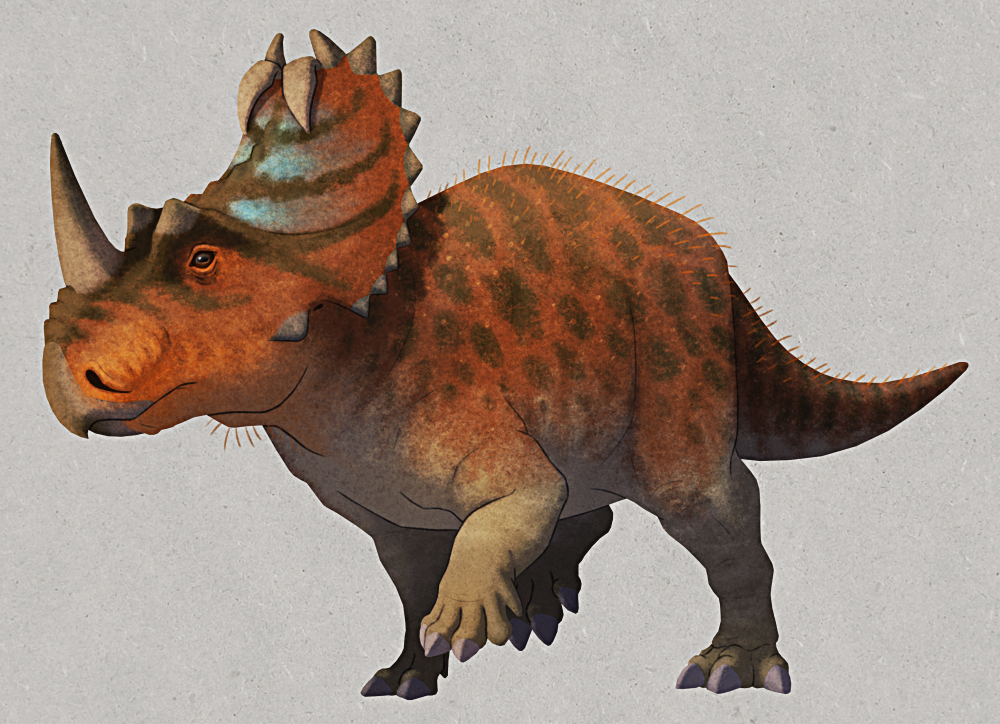
Centrosaurus apertus was named in 1904, from the similarly-aged Dinosaur Park Formation in southern Alberta, Canada. It had originally been one of the various species of Monoclonius, but was now claimed to be different enough to deserve its own separate genus name – and this started a decades-long controversy between several paleontologists.
Over the new few decades arguments went back and forth over whether Centrosaurus was actually valid or if it was just a junior synonym of Monoclonius. As more and better ceratopsid fossil material was discovered several other Monoclonius species were eventually split off into their own separate genera, too, creating Styracosaurus, Chasmosaurus, and the somewhat dubious Brachyceratops. But other new species also continued to be lumped into Monocloniusup until 1990, meaning that over its century of existence this wastebasket taxon had at one point or another contained at least 16 different species.
During the 1990s opinion began to turn against Monoclonius, increasingly regarding it as a dubious name. Its original type specimen was a chimera of multiple different individuals (and possibly multiple different species), and it just didn’t have any distinct enough anatomical features to distinguish it from other ceratopsids.
Centrosaurus, meanwhile, was further validated by the discovery of huge bonebeds containing thousands of individuals, making it into one of the best-known of all ceratopsians.
Today Monoclonius’ name remains attached to a few fossil specimens, but only the ones that are too indistinct to classify as anything else. Some “Monoclonius” have also turned out to actually be juveniles and subadults of other ceratopsians – it seems many young centrosaurines had a Monoclonius-like stage in their growth, before they went on to develop their own species’ distinctive horn and frill shapes.
So Monoclonius may never have been a distinct genus at all – it was just a bunch of different ceratopsian teenagers!
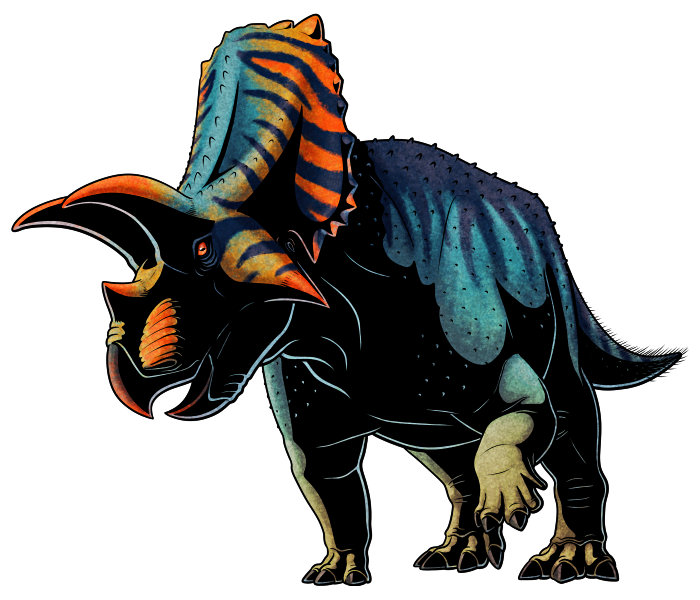
In the late 1990s a partial skeleton of a ceratopsian was discovered in New Mexico, USA. These remains were initially thought to belong to Torosaurus, but after more of the specimen was recovered in the mid-2010s it became clear the bones actually represented an entirely new species of horned dinosaur – officially named in 2022 as Sierraceratops turneri.
Sierraceratops lived during the Late Cretaceous, around 72 million years ago, in what at the time was the southern region of the island continent of Laramidia. About 4.6m long (~15′), it had fairly short chunky brow horns, long pointed cheek horns, and a relatively large frill.
We can’t go through this month without having an appearance from the most famous group of weird-headed dinosaurs: the ceratopsids!
Their distinctive-looking skulls were highly modified from those of their ancestors, with large bony frills extending from the back of their heads, various elaborate horns and spikes, enormous nasal cavities, large hooked beaks at the front of their snouts, and rows of slicing teeth further back.
And while typically depicted as purely herbivorous, ceratopsids’ powerful parrot-like beaks and lack of grinding teeth suggest they may actually have been somewhat more omnivorous – the Cretaceous equivalent of pigs – still feeding mainly on plant matter but also munching on carrion and opportunistically eating smaller animals when they got the chance.
Machairoceratops cronusi here lived during the late Cretaceous of Utah, USA, about 77 million years ago. Only one partial skull has ever been found belonging to an individual about 4.5m long (14’9″), but it wasn’t fully grown and so probably reached slightly larger sizes.
It had two long spikes at the top of its frill, similar to its close relative Diabloceratops but curving dramatically forward and downwards above its face. Whether they were purely for display or used in horn-locking shoving matches is unknown, but either way it was a unique arrangement compared to all other known ceratopsids.
About 6m long (19′8″), it had long brow horns and large curved spikes on its frill – an arrangement very similar in appearance to the centrosaurAlbertaceratops, and initially its fossils were misidentified as belonging to that particular ceratopsid. But in 2010 it was recognized as a different genus, and based on some partial frill remains it was classified as a very early chasmosaur (a different branch of the ceratopsids which includes Triceratops), related to other early forms like Mercuriceratops.
Its genus name was based on the snake-haired Medusa from Greek mythology, while its species name comes from the Norse trickster god Loki – both in reference to the years of confusion about the identity of Medusaceratops’ fossils, and the distinctive curved horns on the helmet of Marvel’s Loki.
And, true to its name, the confusion wasn’t over yet.
Recently more fossil material and a new study have shown it was still being misclassified. Now it seems like Medusaceratops was actually part of the centrosaur lineage all along, and was indeed a very close relative of Albertaceratops.
It also turns out that what were thought to be numerous Albertaceratops fossils found in the same location were all just even more Medusaceratops. Instead of a mixture of two different ceratopsids there’s a single big bonebed representing some sort of mass-mortality event of only this one animal.
Similar mass bonebeds have been found for other centrosaurs in the same area and around the same age. Perhaps there were frequent flash floods at the time, or they were attempting to migrate across fast-flowing rivers like some modern animals, but we still don’t actually know for certain why they died en masse so frequently.
Of course we’re ending this month with the most famous of the ceratopsians, the dinosaur superstar Triceratops (“three-horned face”).
Dating to the very end of the Cretaceous, between 68 and 66 million years ago, it was the most common ceratopsid in North America at the time, ranging from Alberta, Canada down to Colorado, USA. Two different species are currently recognized within the genus – T. horridus in the older part of that time range, and T. prorsus in the younger rock layers.
It was one of the very largest ceratopsians, with the biggest individuals reaching sizes of about 7.9-9m (26’-29’6”). Many fossil remains have been found, representing growth stages from juveniles to adults (with Torosaurus speculated to represent the most fully mature individuals), and a lot of variation in exact horn and frill shape is seen between different skulls. One specimen nicknamed “Yoshi’s trike” had some of the longest brow horns of any ceratopsid, with the bony cores alone measuring 1.15m long (3′9″).
Unusually for a chasmosaur, it had a very short and solid frill with no weight-reducing holes, suggesting the structure served a much more defensive role than in other ceratopsids. Damage to the frill bones in some specimens appears to have been caused by other Triceratops, giving support to the popular depiction of these dinosaurs locking horns in fights.
Tooth-marks from the equally-famous Tyrannosaurus have also been found on Triceratops bones. Not all of these predator-prey encounters were fatal, however, with some specimens showing evidence of healing around the damaged areas.
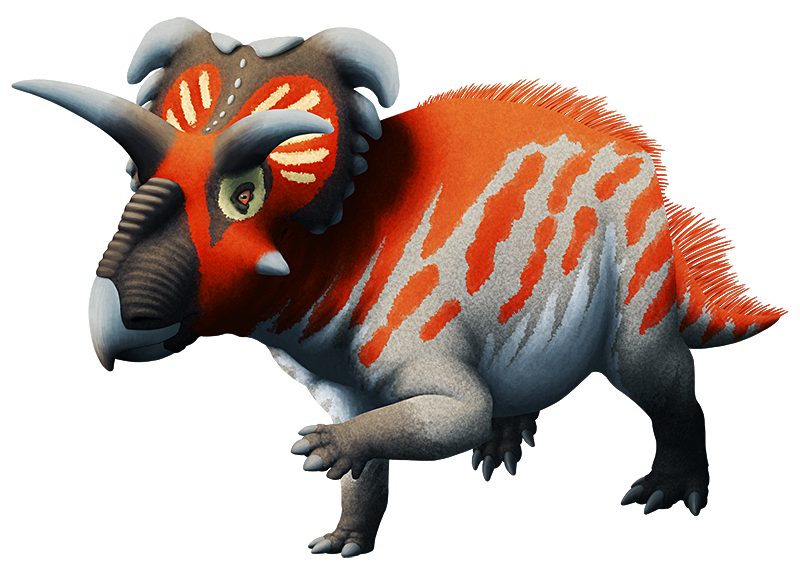
Fossilized skin impressions show that Triceratops was scaly – but with scales unlike those of any other known dinosaur, showing large polygonal scales interspersed with even bigger knobbly scales with odd “nipple-shaped” conical projections in their centers. It’s possible that the “nipples” may have supported larger structures (as I’ve illustrated above), but unfortunately no official scientific description of this skin has been published yet and details about it are vague.
And with this final entry, here’s the chasmosaur evolutionary tree:
Torosaurus (“perforated lizard”) was a particularly widespread member of the Triceratopsini, found across western North America. Fossils are known from Canada all the way down to New Mexico and Texas in the southern regions of the USA, although the southernmost specimens represent a second species within the genus, T. utahensis.
Living about 68-66 million years ago, it was one of the largest ceratopsids, reaching body lengths of around 7.5m (24’7″). The size and shape of its three horns varied between individuals, from short and straight to much longer and curving forwards.
It had one of the longest skulls of any known land animal, with some specimens’ heads measuring at least 2.5m long (8′2″). Around half of that length consisted solely of its frill, the shape of which was also quite variable – some were very flat while others curved upwards, and the top edge could be either rounded, straight, or have a “heart-shaped” notch.
In 2010 a study was published by John Scannella and Jack Horner, hypothesizing that Torosaurus wasn’t a unique genus and was actually the fully mature form of Triceratops. While poor media reporting briefly sent the internet into a panic about Triceratops “never existing”, further studies by other paleontologists have failed tocome up with the same results, and the debate doesn’t seem to have come to any overall consensus yet.
The Triceratopsini branch of the chasmosaurs first split off somewhere around 75 million years ago, with Titanoceratops being the earliest known member. But they don’t seem to have really diversified until several million years later, towards the very end of the Cretaceous 70-68 million years ago, around the time the centrosaurs had already mostly disappeared.
Regaliceratops (“royal horned face”) dates to about 68-67 million years ago, and is estimated to have measured around 5m long (16’4″). Known from a single near-complete skull discovered in Alberta, Canada, the fossil specimen was nicknamed “Hellboy” for both its stubby brow horns and the immense difficulty of removing it from the surrounding rock.
It had highly unusual ornamentation for a chasmosaur – a long nose horn, short brow horns, and large crown-like spikes ringing its relatively short frill – convergently resembling the sort of arrangement seen in many centrosaurs.
Vagaceratops (“wandering horned face”) was originally thought to be a species of Chasmosaurus, but was separated out into its own genus in 2010 after new studies suggested it was much more closely related to Kosmoceratops.
Measuring around 5m long (16’4”), it lived about 75 million years ago in Alberta, Canada – much farther north than its Utahn relative, inspiring its “wandering” genus name. It had a short nose horn, and brow horns reduced down to low bosses, along with a distinctive squared-off frill topped with a row of forward-curving spikes.
Ceratopsid forelimb posture has been a long-standing puzzle in paleontology. While the hindlimbs were clearly held straight under the body, the bones of the forelimbs are a lot more ambiguous, and various different arrangements have been proposed over the years from straight to heavily sprawled and lizard-like.
While the fully sprawled position mostly fell out of favor during the dinosaur renaissance, debate continued about whether ceratopsids had a fully straight forelimb posture or some sort of in-between arrangement with the elbows slightly bent out to the sides. In 2007, digital scans of Vagaceratops’ forelimb bones were used to model how it could have walked, suggesting the best fit was in fact the intermediate position.