Arsinoitherium

Arsinoitherium zitteli was a large herbivorous mammal living in what is now northern Africa during the late Eocene and early Oligocene, about 36-30 million years ago.

Despite looking like a double-horned rhino this resemblance was only superficial, and for most of the 20th century it was actually the only known representative of an entire order of mammals – the embrithopods – with its wider evolutionary relationships being unknown. Since the 1970s, however, more members of this group have been discovered and embrithopods are now understood to be afrotheres, a very early offshoot of the tethythere lineage, with their closest living relatives being modern elephants and sirenians.

Arsinoitherium was by far the most abundant embrithopod, with numerous fossil remains making it one of the most completely known African fossil mammals. It stood around 1.8m tall at the shoulder (6′), similar in size to modern white rhinos, and would have been a massively-built slow-moving animal with elephant-like columnar limbs.

Its pair of enormous nose horns (and smaller brow horns) were structurally more similar to those of bovids than rhinos, with large hollow bony cores that probably bore thick keratinous sheaths that would have increased their apparent size even more. Both males and females appear to have had these horns, and muscle attachments at the back of the skull suggest Arsinoitherium could powerfully swing its head upwards – possibly wrestling with each other in combat over territories, competing for mates, or in establishing dominance hierarchies.

Continue reading “Arsinoitherium”
Miosiren

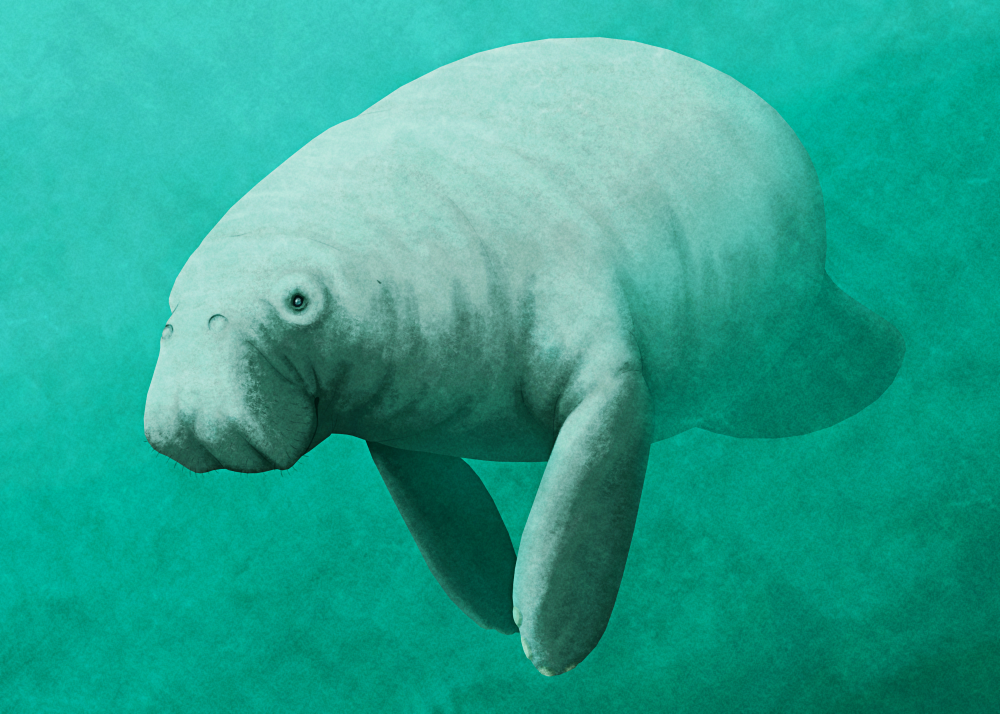
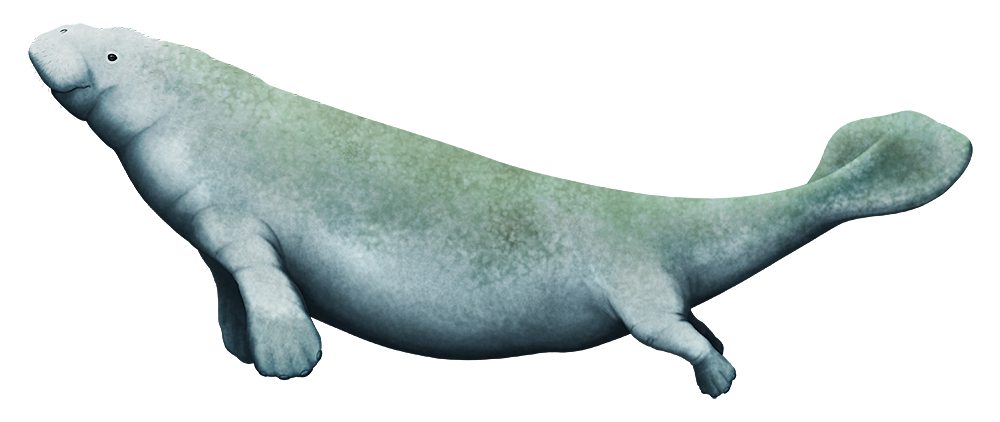
Miosiren kocki was a sirenian (sea cow) that lived during the early Miocene (~20-15 million years ago) in what is now the North Sea basin in northwestern Europe.

Similar in size to the very largest modern manatees, about 4-4.5m long (~13-14’10”), it has traditionally been classified as an early member of the manatee lineage – but a study in 2022 suggested it may instead represent a much earlier stem of the sirenian evolutionary tree, with its ancestors potentially having diverged around 34 million years ago.

It had unusually thickened bones in its skull, especially around the roof of its mouth, which would have given its jaws a very strong chewing force. Isotope analysis of its teeth show it was part of a marine algae-based food web, unlike the seagrass-based diets of other sirenians, so it may have been specialized to feed on a much tougher diet. Possibly it was eating something like calcareous algae, or more speculatively it might even have been crunching on hard-shelled algae-consuming marine invertebrates.

Continue reading “Miosiren”

Sobrarbesiren

Since the last couple of weeks have featured marine mammals, let’s have one more! This time not a cetacean but a member of the other group of fully aquatic mammals still alive today: the sirenians.

Although commonly known as “sea-cows” due to their herbivorous grazing habits, sirenians’ closest living relatives are actually modern elephants. They’re thought to have originated in Africa over 50 million years ago, starting off as pig-like or hippo-like semi-aquatic animals — but they must have been good swimmers capable of crossing oceans very early in their evolutionary history, since some of the earliest known sirenian fossils actually come from the other side of the Atlantic on the Caribbean island of Jamaica.

Sobrarbesiren cardieli here extends some of our knowledge of early four-legged sirenians to Europe, dating to the mid-Eocene about 42 million years ago. Hundreds of bones were found in Northeastern Spain, representing at least six different individuals and giving us a fairly complete idea of this species’ anatomy.

It was smaller than modern sea-cows, reaching about 2m long (6’6″), and seems to represent a transitional point between the semi-aquatic ancestral sirenians and fully aquatic later forms. It had a head very similar to its modern relatives, and probably a tail fin, but also still retained small functional hind limbs.

It was initially thought to still be somewhat semi-aquatic and capable of quadrupedal locomotion on land, but a later analysis of its hind limb bones suggests that it may actually have been much more aquatic than that. Its hind legs had a wide range of motion and were probably used for otter-like swimming, undulating the body while paddling, but might not have been capable of supporting its weight on land. So if Sobrarbesiren did still haul out of the water, it may have had to move more like a seal.