
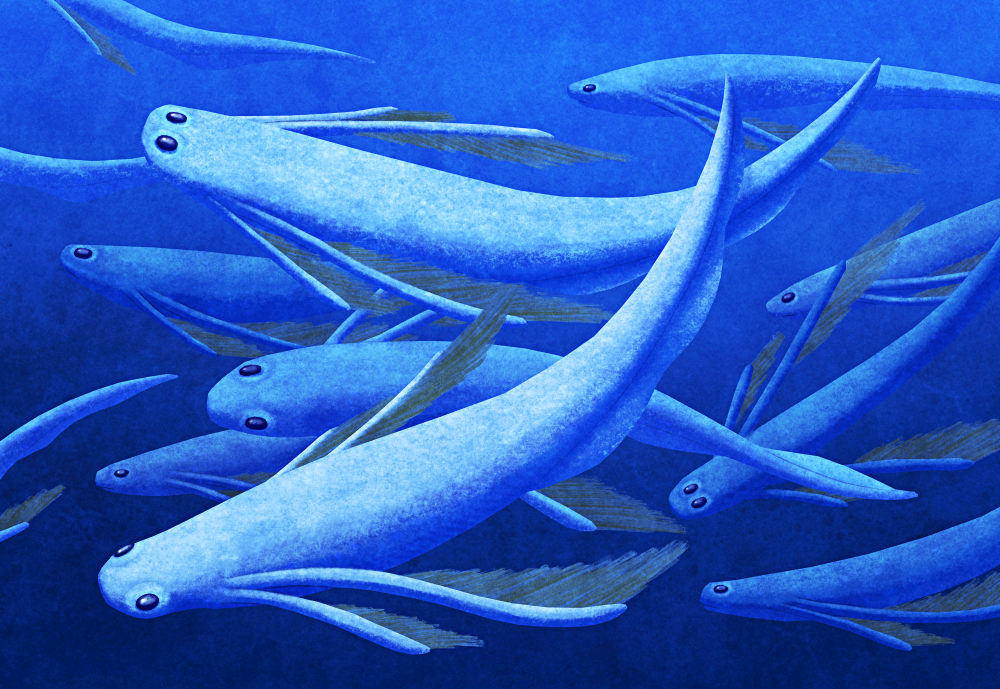
The enigmatic Esconichthys apopyris lived during the late Carboniferous, around 308 million years ago, in a lush tropical estuary covering what is now Illinois, USA.
Up to about 8cm long (~3″), it had a prominent pair of eyes, two pairs of elongated external gills bearing long feathery projections, a slender limbless body lined with muscle segments, and a single low fin running along the underside of its tail.
There also seem to have been two different body types that might represent separate species: the “flathead” form with wide-set eyes, and the “snubnose” form with close-set eyes.
Often nicknamed “blades”, “ghosts”, or “grasshoppers” by fossil collectors, specimens of this little animal are the most common vertebrates found in the Mazon Creek fossil beds — and yet we don’t actually know what it is. In the past it was proposed to be a larval lungfish or amphibian, but its anatomy doesn’t quite fit any known group.
References:
- Bardack, David. “A larval fish from the Pennsylvanian of Illinois.” Journal of Paleontology 48.5 (1974): 988-993. https://www.jstor.org/stable/1303297
- Bardack, David. “Fishes of the Mazon Creek fauna.” Mazon Creek Fossils. Academic Press, 1979. 501-528. https://doi.org/10.1016/B978-0-12-519650-5.50024-2
- RCFossils. “Mazon Creek Best Of The Best Esconichthys Apopyris Bardack, 1974.” The Fossil Forum, 03 Dec. 2019, https://www.thefossilforum.com/topic/100449-mazon-creek-best-of-the-best-esconichthys-apopyris-bardack-1974/
- Young, Andrew. “Mazon Creek Fossil Fauna – Tetrapods, Aistopods, and Larval Fish.” Andrew Young Art, https://www.andrewyoungart.com/mc-fa—tetrapods-and-blades.html
Also I love your drawings of these. Keep up the good work!