
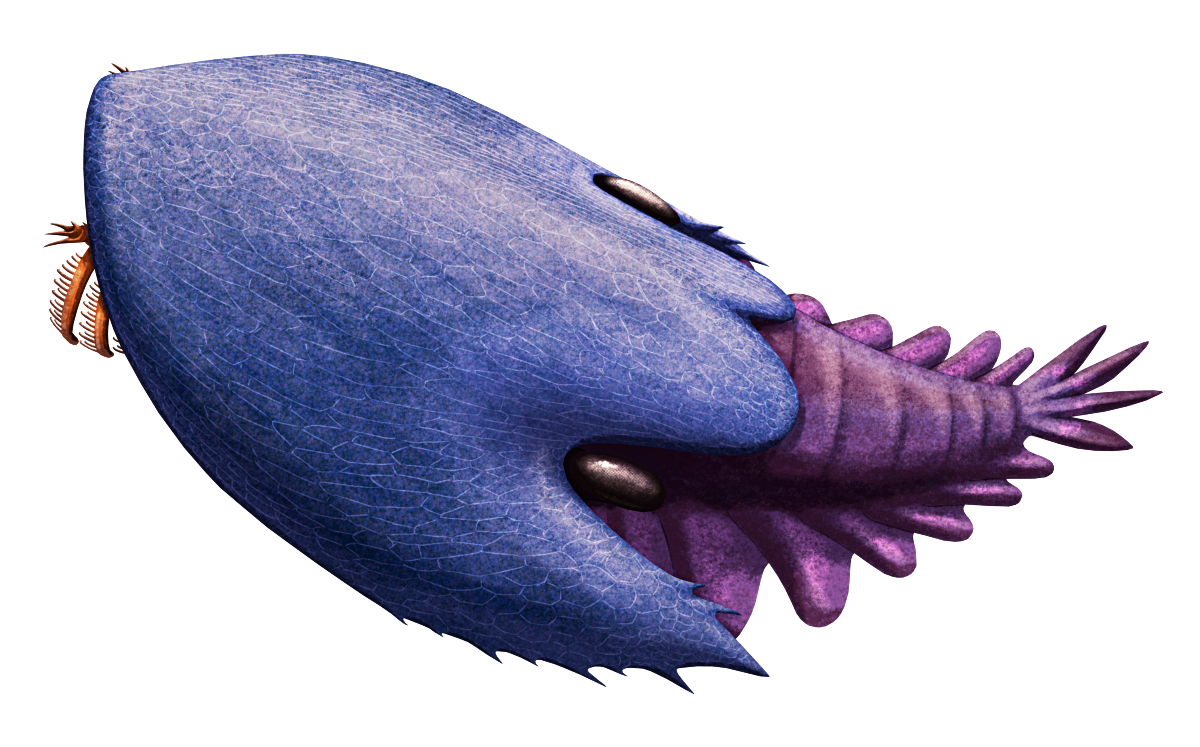
Cambroraster falcatus was a radiodont that lived during the Cambrian, about 508-505 million years ago, in what is now western Canada. Part of the hurdiid family of radiodonts, it reached sizes of up to 30cm long (~12″) – making it one of the largest animals known from the Burgess Shale fossil deposits.
Its distinctively-shaped massive head shield led to it being nicknamed “the spaceship” during collection and study of numerous fossil specimens. This was then referenced in its species name of “falcatus“, inspired by its resemblance to the fictional Millennium Falcon from the Star Wars franchise.
Its short frontal appendages bore long curved spiny blades that formed a basket-like structure. Originally these were thought to be used to sift through seafloor sediment, but more recently they’ve been proposed as filter-feeding structures instead.
References:
- Moysiuk, Joseph, and J-B. Caron. “A new hurdiid radiodont from the Burgess Shale evinces the exploitation of Cambrian infaunal food sources.” Proceedings of the Royal Society B: Biological Sciences 286.1908 (2019). https://doi.org/10.1098/rspb.2019.1079
- Sun, Zhixin, Han Zeng, and Fangchen Zhao. “Occurrence of the hurdiid radiodont Cambroraster in the middle Cambrian (Wuliuan) Mantou Formation of North China.” Journal of Paleontology 94.5 (2020): 881-886. https://doi.org/10.1017/S0016756820000187
- Wikipedia contributors. “Cambroraster” Wikipedia, 27 Sep. 2025, https://en.wikipedia.org/wiki/Cambroraster