Cambroraster

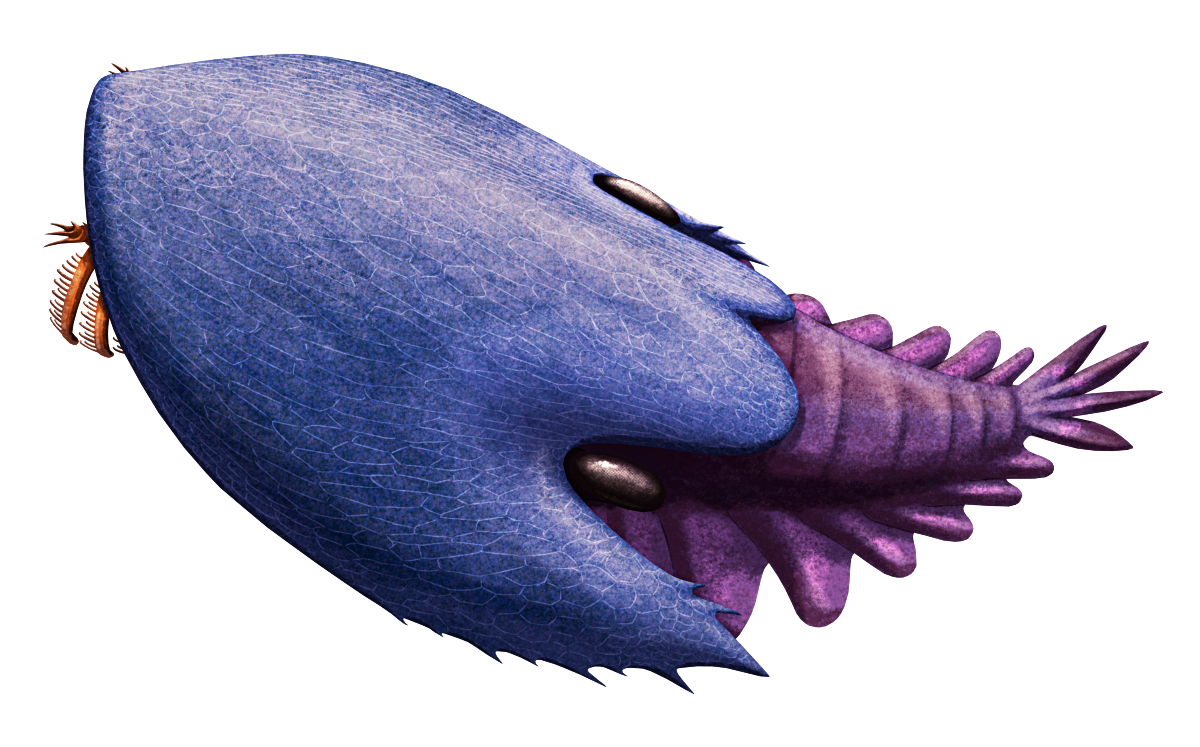
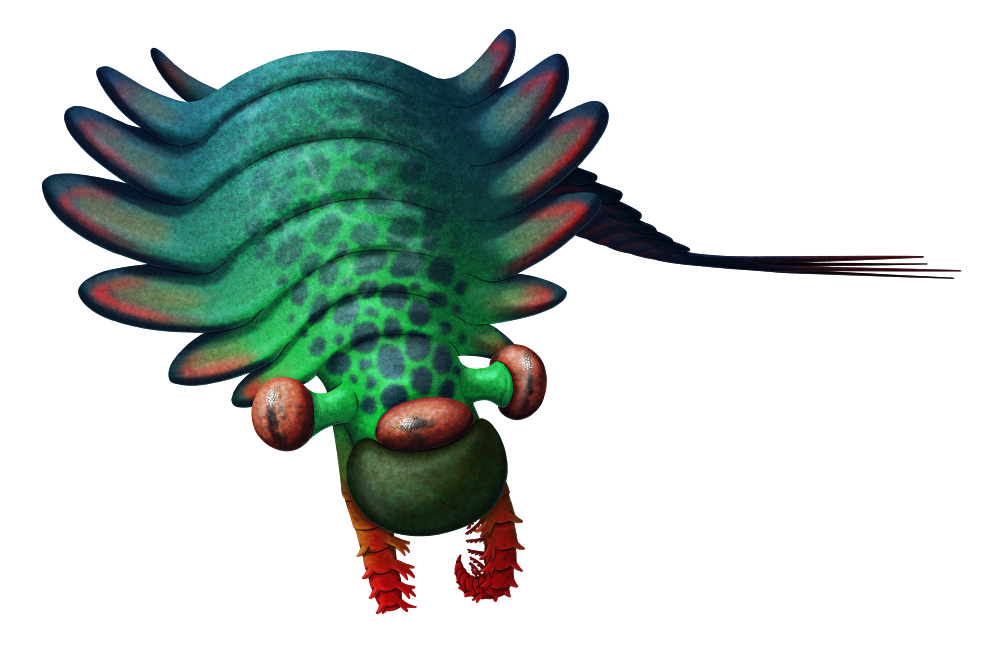
Cambroraster falcatus was a radiodont that lived during the Cambrian, about 508-505 million years ago, in what is now western Canada. Part of the hurdiid family of radiodonts, it reached sizes of up to 30cm long (~12″) – making it one of the largest animals known from the Burgess Shale fossil deposits.

Its distinctively-shaped massive head shield led to it being nicknamed “the spaceship” during collection and study of numerous fossil specimens. This was then referenced in its species name of “falcatus“, inspired by its resemblance to the fictional Millennium Falcon from the Star Wars franchise.

Its short frontal appendages bore long curved spiny blades that formed a basket-like structure. Originally these were thought to be used to sift through seafloor sediment, but more recently they’ve been proposed as filter-feeding structures instead.

Continue reading “Cambroraster”

Haikouichthys

Haikouichthys ercaicunensis was one of the earliest known vertebrates, living in what is now southwestern China during the Cambrian, around 518 million years ago.

About 2.5cm long (~1″), it had a streamlined body with a long fin along its back and tail. It lacked limbs and jaws, but it did have a flexible “upper lip” that could potentially have been used to manipulate food particles, either engulfing them on the seafloor or stirring them up into the water for filter-feeding.

And a recent study revealed a big surprise — it had four eyes! Along with its already-known large sideways-facing pair of eyes, it also had another smaller upwards-facing pair in the middle of its face, giving it a much wider field of vision and the ability to watch out for predators from multiple angles at once.

The extra pair of eyes may be the evolutionary precursors to the pineal complex in later vertebrates — represented in modern forms by the pineal gland and the parietal eye.

Continue reading “Haikouichthys”

Pygmaclypeatus

Pygmaclypeatus daziensis was a small early trilobitomorph arthropod that lived during the Cambrian, about 518 million years ago, in what is now southwestern China.

It had a wide flat carapace, about 14mm long (~0.5″), with a single pair of antennae, fourteen pairs of limbs, and a short segmented “tail”.

It also had an unusual arrangement of four eyes — one pair of fixed-in-place trilobite-like eyes on top of its headshield, and a second pair of crustacean-like mobile stalked eyes on the underside. Other four-eyed Cambrian arthropods are known, but Pygmaclypeatus is currently unique for having two completely different compound eye systems.

Its well-developed limbs with paddle-like branches indicate it could swim well, and probably also burrow into soft seafloor sediment. Its upper eyes seem to have been adapted to sensing motion in dim daylight conditions, suggesting they were used to keep a lookout for predators in shallow murky water. Its lower eyes were more sensitive, and may have been used to locate food items such as smaller soft-bodied invertebrates or organic detritus on the seafloor.

Continue reading “Pygmaclypeatus”

Mosura

Mosura fentoni was a small radiodont living during the mid-Cambrian, about 508 million years ago, in near-equatorial shallow marine waters covering what is now western Canada.

Sixty specimens have been discovered in the Burgess Shale fossil deposits, ranging from 1.5cm long juveniles (~0.6″) to 6cm long adults (~2.4″), giving us a detailed look at Mosura’s anatomy and life history. It had three eyes – two on the sides of its head on short stalks and one in the middle of its face – and a pair of grasping frontal appendages each with six long sickle-shaped spines.

Unusually for a radiodont its body was divided into distinct regions: a four-segment neck, a six-segment mesotrunk with large swimming flaps, and an abdomen-like posterotrunk with up to at least sixteen segments (fewer in juveniles), all bearing gills along their undersides.

Its vaguely moth-like shape led to it being nicknamed “sea-moth” by field collectors, and inspired its genus name – “Mosura” is the Japanese name of the fictional giant kaiju moth-monster Mothra.

With a very high proportion of respiratory surface area for its size, Mosura was probably an active and agile fast-swimming predator, possibly living in low-oxygen waters around the outer continental shelf. Its wide oval central eye may have helped it stay orientated during rapid maneuvers, keeping track of the horizon line similar to the median eyes of modern dragonflies.

Continue reading “Mosura”

Shishania

Shishania aculeata lived during the mid-Cambrian, around 512 million years ago, in shallow tropical waters covering what is now southwestern China.

Up to about 6cm in length (~2.4″), its spine-covered body was initially thought to be an early mollusc, but the discovery of more specimens has resulted in a new interpretation: instead of a slug-like creature, the fossils of Shishania might instead represent a flattened and ruptured chancelloriid.

Chancelloriids were an enigmatic group of Cambrian animals that had hollow bag-like bodies armored with numerous sharp star-shaped spines. They were historically classified as sponges due to their similar body plan and immobile filter-feeding lifestyle, and they’ve also been proposed to be relatives of halkieriid molluscs due to similarities in the microscopic structure of their spines – but currently it seems most likely that chancelloriids were actually their own separate lineage of early animals, closer related to eumetazoans than to sponges.

Shishania had much simpler spines than other chancelloriids, so it may represent an early stage of the evolution of these animals’ armor, showing that these structures were developed from scratch rather than adapted from a pre-existing ancestral feature.

Continue reading “Shishania”

Tuzoia

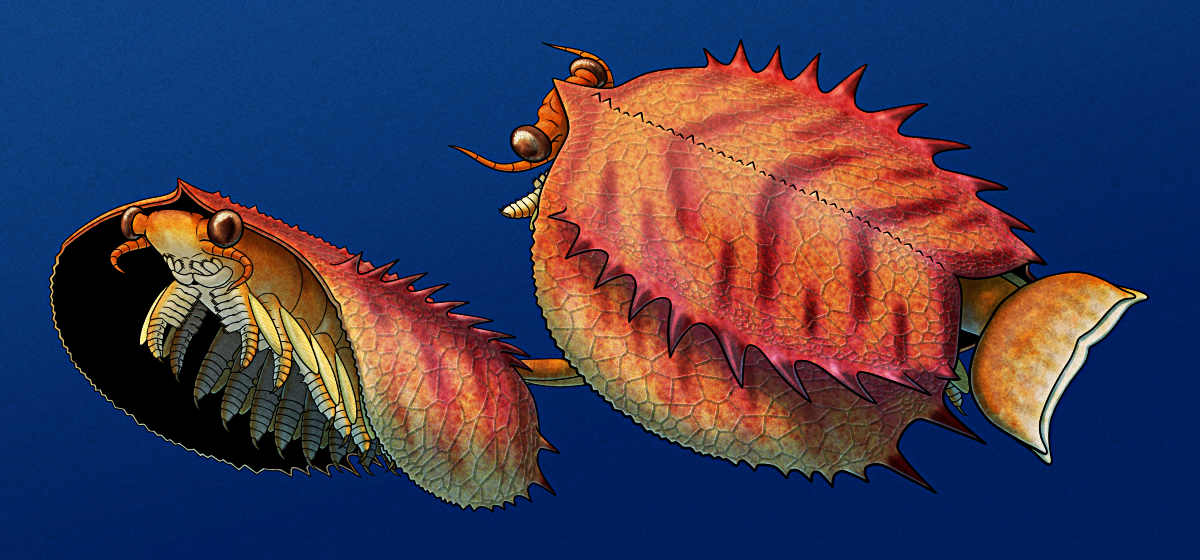
The tuzoiids were an enigmatic group of Cambrian invertebrates known mostly just from their spiny bivalved carapaces. Although hundreds of fossils of these arthropods were discovered over the last century or so, only vague fragments of the rest of their bodies have been found even in sites usually known for preserving soft tissue impressions.

…Until late 2022, when several new specimens from the Canadian Burgess Shale deposits (~508 million years ago) were described showing tuzoiid anatomy in exceptional detail, finally giving us an idea of what they looked like and where they fit into the early arthropod evolutionary tree.

Tuzoiids like Tuzoia burgessensis here would have grown up to about 23cm long (~9″). They had large eyes on short stalks, a pair of simple antennae, a horizontal fluke-like tail fan, and twelve pairs of appendages along their body – with the front two pairs at the head end being significantly spinier, and most (or all) of these limbs also bearing paddle-like exopods.

The large carapace enclosed most of the body, and was ornamented with protective spines and a net-like surface pattern that probably increased the strength of the relatively thin chitinous structure.

Together all these anatomical features now indicate that tuzoiids were early mandibulates (part of the lineage including modern myriapods, crustaceans, and insects), and were probably very closely related to the hymenocarines.

Tuzoiids seem to have been active swimmers that probably cruised around just above the seafloor, with their stout legs suggesting they could also walk around if they flexed their valves open. The arrangement of their spiny front limbs wasn’t suited to grabbing at fast-swimming prey, but instead may have been used to capture slower seafloor animals or to scavenge from carcasses.

Ursactis

Soft-bodied annelid worms only very rarely fossilize, so the group’s origins during the Cambrian Period are still rather poorly understood. So far about thirteen different species have been found in sites of exceptional preservation, showing that even very early on in their evolution these worms had already diversified into a wide range of ecologies including bottom-feeders, carnivores, swimmers, tube-builders, and even symbiotes sharing living space with early acorn worms.

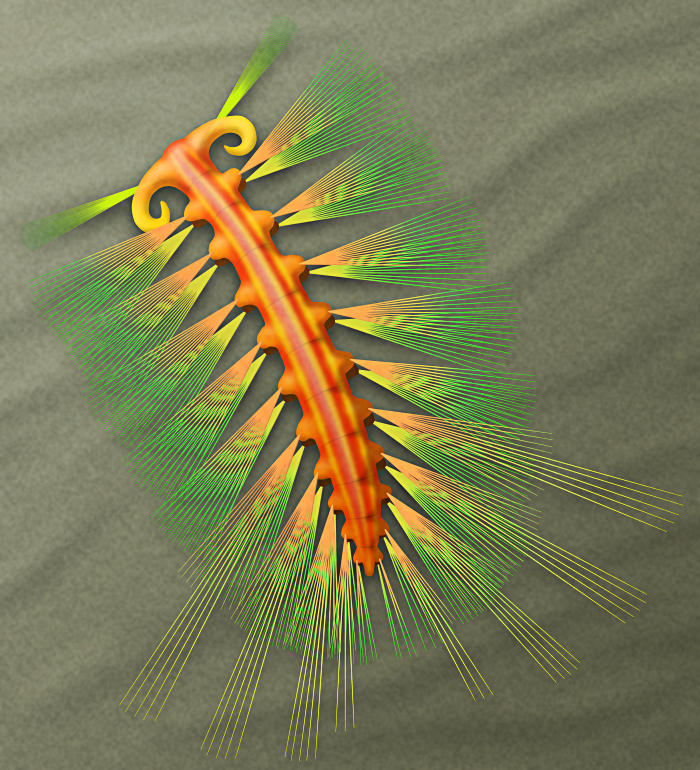
Ursactis comosa here adds a fourteenth species to the list. Found in a newly-discovered outcrop of the 508-million-year-old Burgess Shale fossil deposits in western Canada, it’s known from nearly 600 specimens clustered together in several large groups, making it the current best-known and most numerous of all Cambrian annelids.

Up to about 1.5cm long (~0.6″), it was a polychaete-like worm bearing bundles of long bristles. There was a pair of large sensory palps on its head, and its body was made up of an unusually small number of segments – just 10, with larger individuals just increasing the size of their segments instead of adding on additional ones like most modern annelids.

Unlike other Cambrian annelids it also shows some evidence of basic tagmatization, differentiating some of the rear segments of its body with much longer bristles.

The large numbers of Ursactis found preserved in one place suggests these worms were exhibiting some sort of swarming behavior. Since ages from juveniles to fully-grown adults are represented together, and their anatomy indicates they were crawling detritivores, they were probably all taking advantage of a particularly nutrient-rich patch of seafloor at the time they were abruptly buried in a mudslide.

Paucipodia

Lobopodians were some of the earliest known panarthropods, closely related to velvet worms, tardigrades, and the ancestors of all the true arthropods. They were small soft-bodied worm-like animals with multiple pairs of fleshy legs, and some species also bore elaborate spikes, armor plates, and fleshy bumps all over their bodies – with the spiny Hallucigenia being the most famous example.

But unlike its more charismatic relative Paucipodia inermis here didn’t seem to have any ornamentation at all.

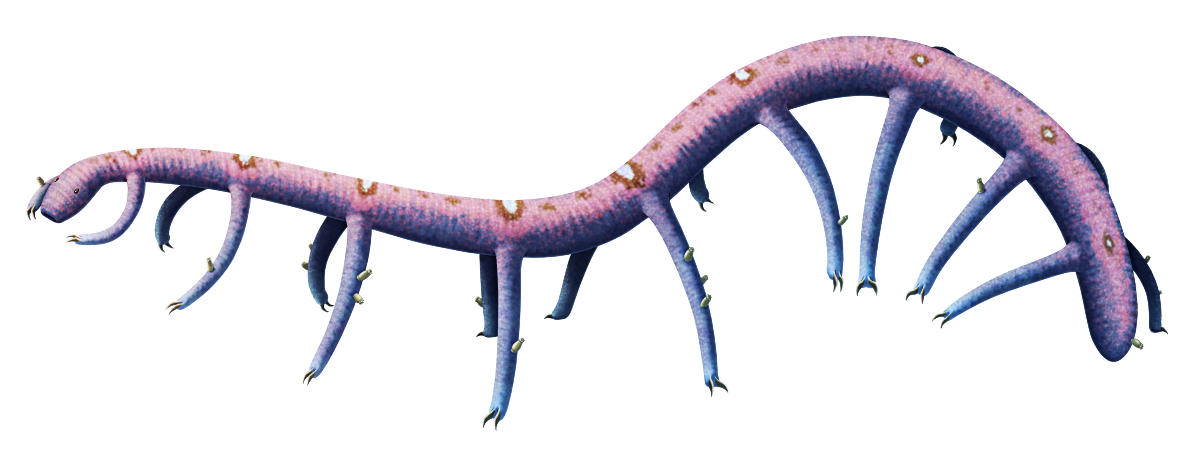
Known from the Chinese Chengjiang fossil deposits, dating to about 518 million years ago, Paucipodia lived in what was then a shallow tropical sea. Its 13cm long (~5″) tubular body had nine pairs of legs, with each foot tipped with a pair of hooked claws, and the inside of its mouth was ringed with tiny sharp teeth.

Several specimens have been found preserved in association with the weird gummy-disc animal Eldonia, which may indicate Paucipodia either preyed on them or scavenged on their carcasses.

Some Paucipodia fossils also have enigmatic tiny “cup-like” organisms attached to their legs. It’s currently unknown what exactly these were, or whether they were parasitic in nature or simply opportunistically “hitching a ride” similar to the Inquicus found on armored palaeoscolecid worms in the same fossil beds.

Stanleycaris

Radiodonts were early arthropods with specialized frontal appendages, disc-like mouths, complex compound eyes, and swimming flaps along the sides of their bodies. Once considered to be bizarre “weird wonders” of the Cambrian Explosion that represented a failed evolutionary experiment, we now know that they were actually a highly diverse and successful lineage that lasted for at least 120 million years.

While some radiodonts were the largest animals of their time periods, Stanleycaris hirpex here was one of the smallest known members of the group – although at around 10cm long (~4″) it was still respectably big compared to most other Cambrian animals.

Discovered in the Canadian Burgess Shale deposits (~508 million years ago), it was originally known only from isolated frontal appendages and mouthparts, and had been assumed to be a fairly typical member of the hurdiid family. But the recent discovery of over 200 new fossils, including some exceptionally well-preserved full body specimens, has catapulted it directly from being poorly-known into now being one of the most completely known of all radiodonts.

And it had a very big surprise for us, right in the middle of its face.

It turns out that Stanleycaris had a huge third eye, unlike anything ever seen in a radiodont before. A large unpaired eye was also part of the five-eyed arrangement in opabiniids and Kylinxia, and finding a similar example in radiodonts too raises the possibility that this sort of well-developed “median eye” may have been more widespread in early arthropods than previously thought.

Along with the third eye, some of the Stanleycaris specimens preserve fine internal details of its nervous system and show that its brain was made up of two segments instead of the three seen in modern arthropods. It also had gills positioned on its underside, unlike most other radiodonts which had them on their backs.

Retro vs Modern #09: Hallucigenia sparsa

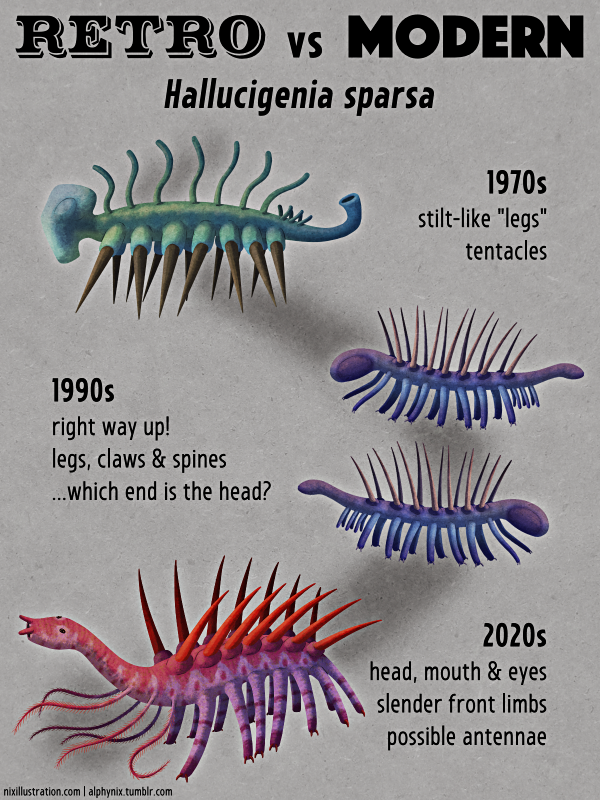
If just one single species had to represent how our reconstructions of prehistoric animals can drastically change, it would have to be Hallucigenia sparsa.


1970s

First discovered in the 1910s in the Canadian Burgess Shale fossil deposits, specimens of Hallucigenia were initially categorized as being a species of the early polychaete worm Canadia. It wasn’t until the 1970s that they were recognized as being something else entirely, and the first reconstruction of this tiny animal was bizarre.

It was depicted as a long-bodied creature with a single row of tentacles along its back, and several pairs of long sharp spines that were interpreted as being stilt-like “legs” used to walk. The tentacles were thought to catch food from the water and pass it forwards to the bulbous “head” – and at one point it was even proposed that all the tentacles had their own additional “mouths” at their tips!

It’s easy to look back on this version now and laugh at how ridiculous and obviously wrong it was, but it’s important to remember the historical context here. This was coming from a point when the incredible animal diversity of the Cambrian Explosion was only just starting to be understood, revealing a range of poorly-understood bizarre and alien-looking forms like Opabinia – “weird wonders” that were considered to be representatives of previously unknown ancient branches of life.

At the time, Hallucigenia‘s utter weirdness and impractical body plan seemed to almost make sense as a unique evolutionary “failed experiment” that had left no living relatives.


1990s

Discoveries of legged-and-armored lobopodian “worms” in the Chinese Chengjiang fossil deposits during the 1980s prompted a re-interpretation of Hallucigenia in the early 1990s. Speculatively reconstructing it as a lobopodian with the spines on its back and with the tentacles as a set of paired clawed legs started to make it seem a lot less alien and a lot more like a real velvet-worm-like animal – and just a year later the “missing” other half of the leg pairs was confirmed to be present in some of the fossil specimens.

But it was still unclear which end was actually the head, and whether the large blob-like structure was a real part of Hallucigenia‘s anatomy or just an artifact of the fossilization process.


2020s

New research in the mid-2010s finally settled the head problem and clarified a lot of Hallugicenia‘s anatomy, discovering that the slender elongated end had a pair of simple eyes and a mouth with a throat ringed with tiny teeth.

We now know Hallucigenia sparsa lived all around the world during the mid-Cambrian, about 518-508 million years ago, with body fossils known from Canada and China and isolated spines found in numerous other similarly-aged locations. Instead of an evolutionary dead-end “weird wonder” it was actually an early member of the vast arthropod lineage, just one of a highly diverse collection of successful Cambrian lobopodians, and its closest living relatives are probably velvet worms and tardigrades.

It grew up to about 5cm long (2″) and had seven pairs of long sharp defensive spines along its back, covered with a microscopic surface texture of tiny triangular “scales”. It had seven pairs of clawed walking legs, with most of its feet tipped with two claws each but the final two pairs having just one, and its body ended right at the final pair of limbs – the “blob” structure in some fossils was actually just an artifact the whole time, formed by Halligenia‘s innards being forcefully squeezed out during its burial in the seafloor sediment.

Its neck region bore three pairs of long delicate tendril-like limbs, which may have been covered in feathery hair-like structures for filter-feeding similar to some other lobopodians. A small pair of velvet-worm-like antennae may also have been present on its head, and could have been a sexually dimorphic feature.