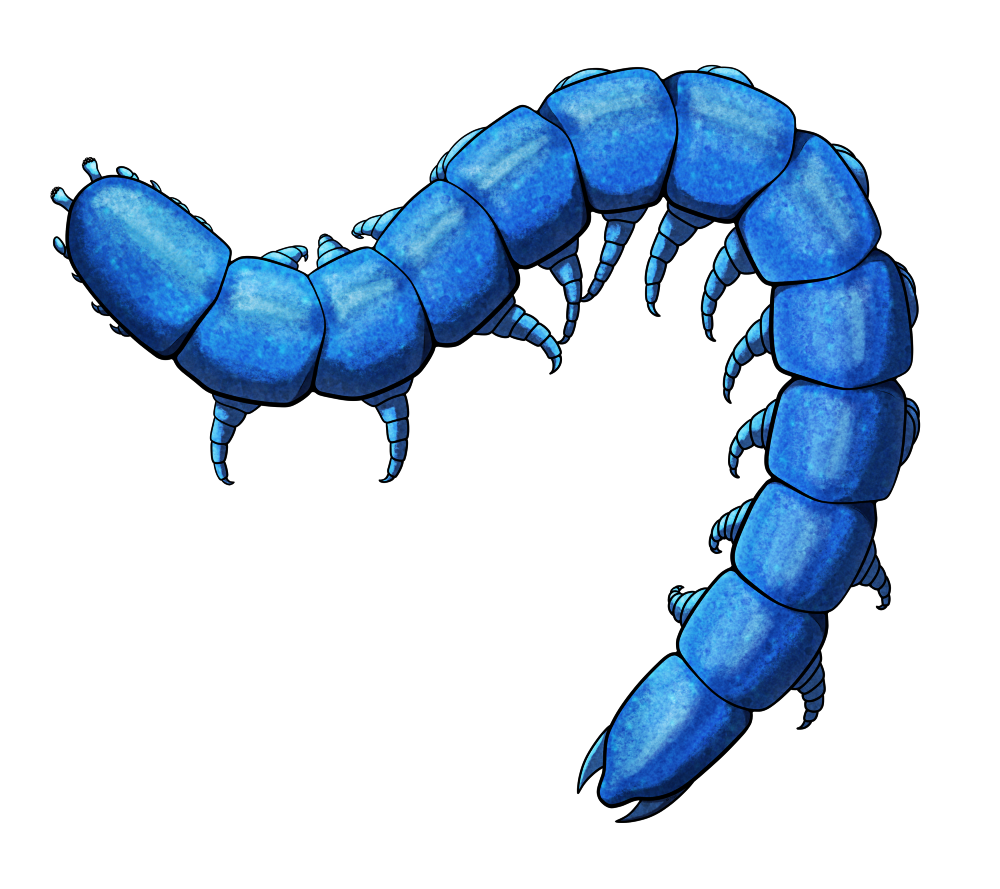
Waukartus muscularis was a small marine arthropod that lived during the early Silurian, about 437 million years ago, in an equatorial inland sea covering what is now Wisconsin, USA.
It was a member of the myriapods, related to modern centipedes and millipedes – but it represents a very early offshoot of this lineage, with its ancestors branching off sometime before the amphibious euthycarcinoids.
Growing up to about 3cm long (~1.2″), Waukartus had a head with four pairs of small appendages and what may be a pair of small stalked eyes, eleven body segments each with one pair of legs, and a telson with a pair of blade-like projections.
It appears to have been fully aquatic, but its unbranched limbs closely resemble those of terrestrial myriapods, suggesting that these arthropods initially evolved their walking legs for use on the seafloor and only later exapted them for land.
Continue reading “Waukartus”