
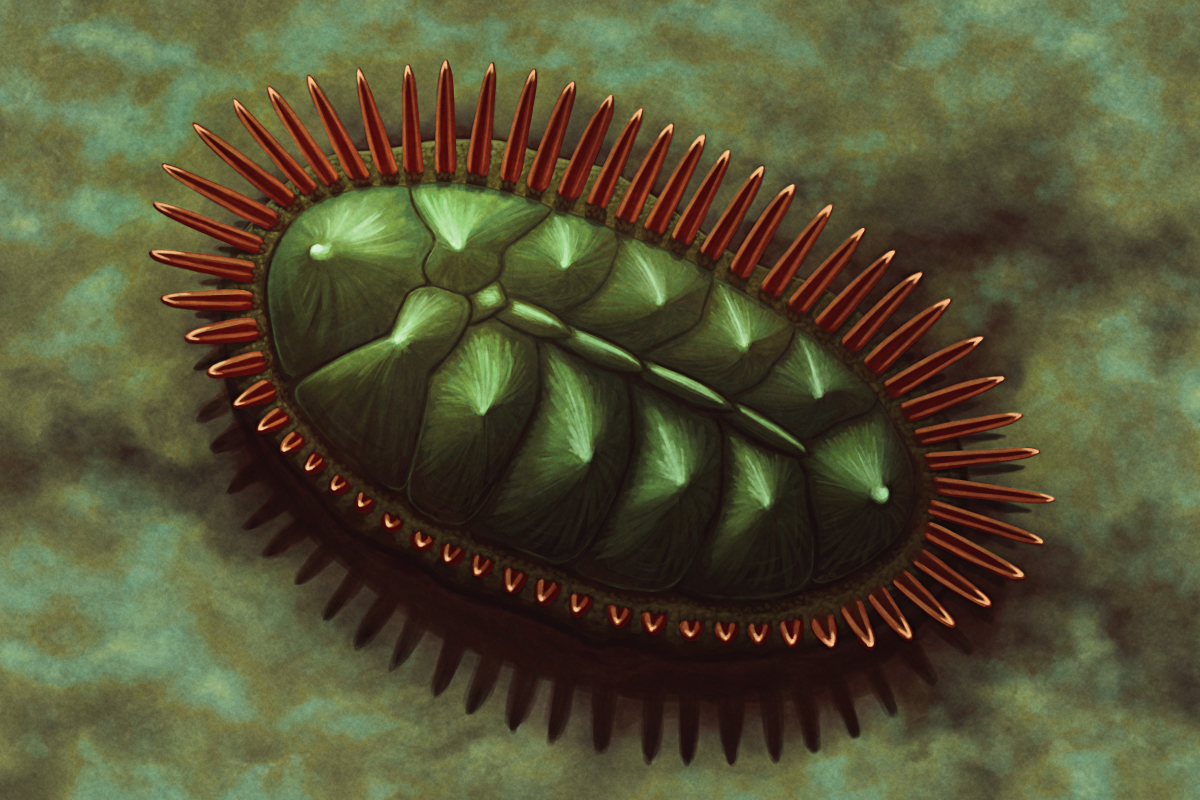
Polysacos vickersianum was a marine mollusc that lived during the early Carboniferous, around 345 million years ago, in what is now Indiana, USA.
It was part of a group known as multiplacophorans, which are usually considered to be close relatives of modern chitons — but may instead represent a much earlier branch of the aculiferan lineage that convergently evolved chiton-like anatomical features.
About 2.5cm long (~1″), Polysacos had seventeen shell plates surrounded by a fringe of long spines with concave upper surfaces. Like the modern chitons it resembled it was probably a grazer that scraped up algae from hard rocky surfaces.
References:
- Sutton, Mark D., et al. “New Silurian aculiferan fossils reveal complex early history of Mollusca.” Nature 637.8046 (2025): 631-636. https://doi.org/10.1038/s41586-024-08312-0
- Vendrasco, Michael J., Troy E. Wood, and Bruce N. Runnegar. “Articulated Palaeozoic fossil with 17 plates greatly expands disparity of early chitons.” Nature 429.6989 (2004): 288-291. https://doi.org/10.1038/nature02548
- Vinther, Jakob, et al. “The origin of multiplacophorans–convergent evolution in Aculiferan molluscs.” Palaeontology 55.5 (2012): 1007-1019. https://doi.org/10.1111/j.1475-4983.2012.01180.x
- Wikipedia contributors. “Chiton” Wikipedia, 01 Aug. 2026, https://en.wikipedia.org/wiki/Chiton
- Wikipedia contributors. “Polysacos” Wikipedia, 07 Mar. 2025, https://en.wikipedia.org/wiki/Polysacos