
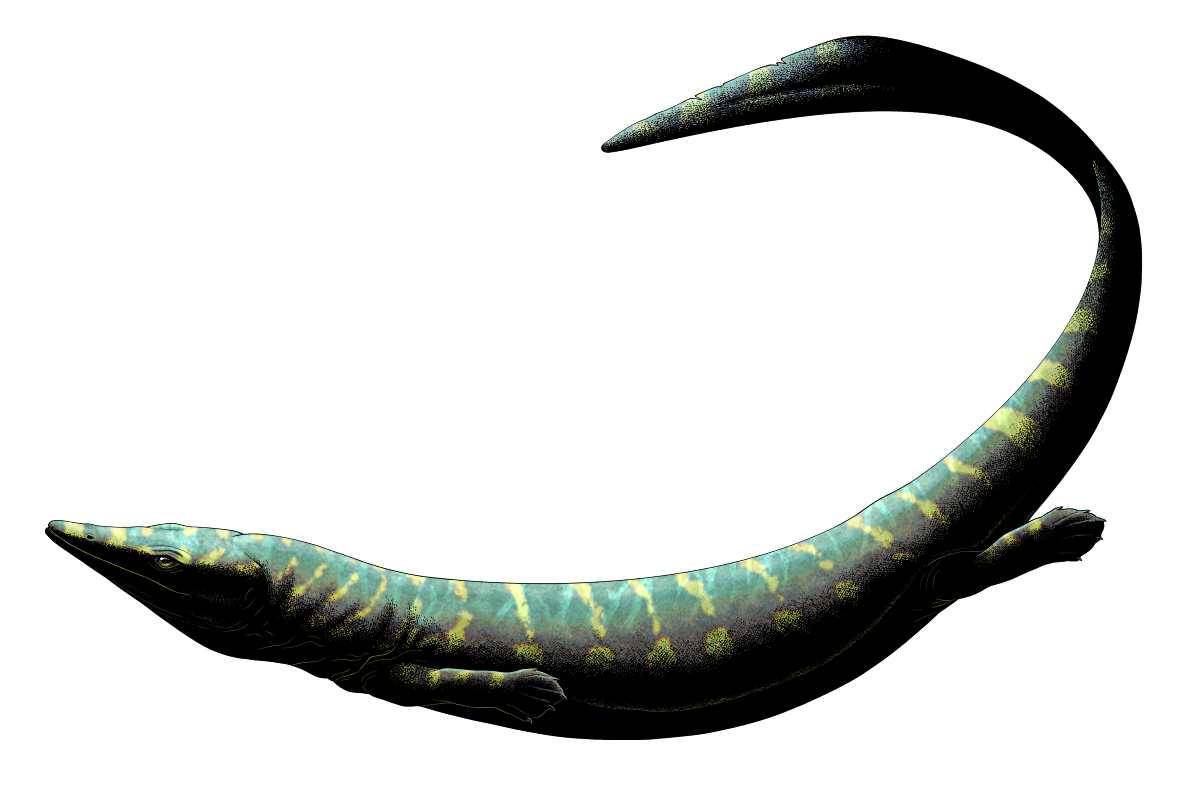
Garamaudo bauciensis was a mosasaur that lived during the Late Cretaceous, about 84 million years ago, inhabiting freshwater lakes and marshes in what is now southeastern France.
Its genus name comes from the Provençal expression “gara au maudo”, meaning “beware the cursed one”, referring to an aquatic serpentine monster of local legend.
Around 2.5m long (~8’2″), Garamaudo was a fairly “primitive” mosasaur, with limb anatomy closer to the legs of terrestrial lizards than the paddle-like flippers of later forms. It had increased bone density that would have helped control its buoyancy and aided it in diving — but this also would have made it unable to move around on land due to the increased fragility of its heavier bones.
It probably swam with an eel-like motion and may not have been particularly speedy or maneuverable, possibly relying on ambush predation to capture its prey.
It would have been one of the largest aquatic predators in its ecosystem, living alongside gars, turtles, small crocodilians, and some of the last known freshwater coelacanths.
References:
- Bardet, Nathalie, et al. “Garamaudo bauciensis, a new freshwater mosasaurid (Reptilia, Squamata) from the Santonian (Late Cretaceous) of Provence, southeastern France.” Peer Community Journal 6 (2026). https://doi.org/10.24072/pcjournal.804
- Cavin L, Buffetaut E, Dutour Y, Garcia G, Le Loeuff J, Méchin A, et al. “The last known freshwater coelacanths: New Late Cretaceous mawsoniid remains (Osteichthyes: Actinistia) from Southern France.” PLoS ONE 15.6 (2020): e0234183. https://doi.org/10.1371/journal.pone.0234183
- Wikipedia contributors. “Garamaudo” Wikipedia, 05 Oct. 2026, https://en.wikipedia.org/wiki/Garamaudo
- Wikipedia contributors. “Osteosclerosis” Wikipedia, 26 May 2025, https://en.wikipedia.org/wiki/Osteosclerosis