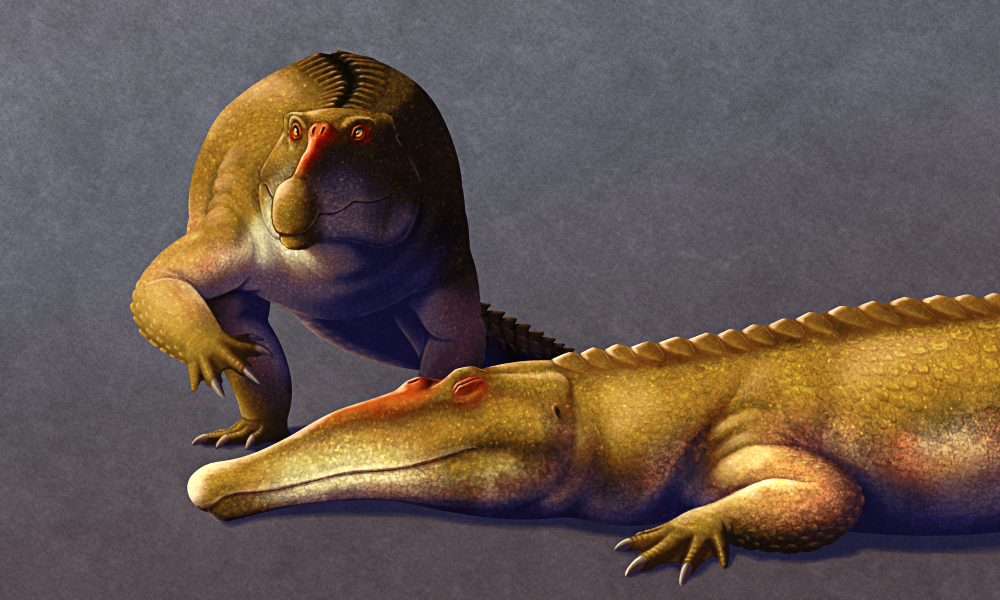
Smilosuchus gregorii lived in what is now the Southwestern United States during the Late Triassic, about 218 million years ago.
Despite looking a lot like a crocodilian it wasn’t very closely related to modern crocs at all, instead being a phytosaur — a lineage of early pseudosuchians (or possibly earlier-branching archosauriformes) that convergently evolved a crocodile-like lifestyle and appearance.
Around 6m long (~20′), it was armored with bony osteoderms and had long toothy jaws with tusk-like teeth at the tip. But unlike the crocodiles it resembled its nostrils were set high on its snout up near its eyes, and it probably had scaly lizard-like lips.
The high-set position of its nose and a fossil specimen surviving for some time with both of its hind legs compromised by osteomyelitis suggest that Smilosuchus was semi-aquatic. Based on fossil bones of large terrestrial animals like rauisuchids with phytosaur teeth stuck in them it was probably a croc-like ambush predator lunging at prey at the water’s edge — but it may also have been capable of walking around on land with an upright “high walk” gait.
Continue reading “Smilosuchus”