
Choristoderes were a diverse group of semiaquatic reptiles that originated in the mid-Jurassic, made it through the K-Pg mass extinction, and survived all the way until the Miocene in a lineage lasting over 150 million years.
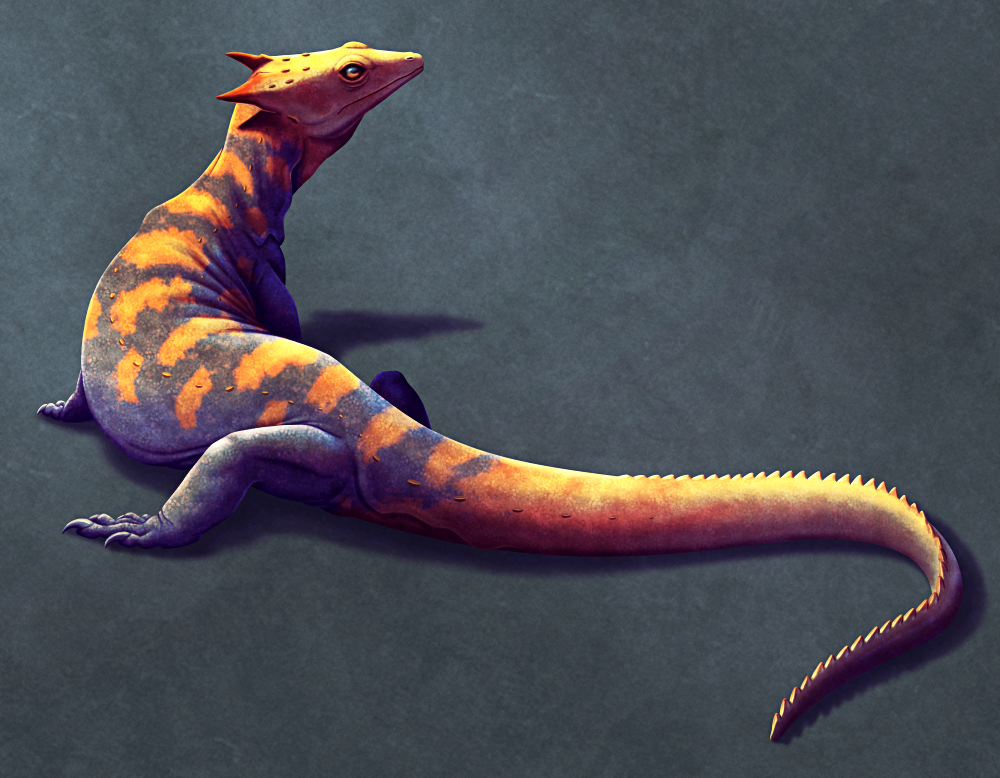
Their evolutionary relationships to other reptiles are somewhat mysterious, but Meilynodraco amonamarthi here might be helping to clear up a little bit of that confusion.
Living during the Late Jurassic, about 156 million years ago, in what is now Wyoming, USA, this 45cm long (~1’6″) choristodere would have resembled a lizard with horn-like projections at the back of its head.
Its skull anatomy confirms that choristoderes were saurian reptiles rather than earlier-branching neodiapsids — and along with evidence from fossilized embryos suggests a placement in the archosauromorphs, possibly even being closely related to sauropterygians.
References:
- Jiang, Baoyu, et al. “Extended embryo retention and viviparity in the first amniotes.” Nature Ecology & Evolution 7.7 (2023): 1131-1140. https://doi.org/10.1038/s41559-023-02074-0
- Scheyer, Torsten M., et al. “Neutron and X-ray computed tomography reveals new early-branching choristodere from the lower Morrison Formation of Wyoming, USA.” Royal Society Open Science 13.11 (2026). https://doi.org/10.1098/rsos.261553
- Wikipedia contributors. “Choristodera” Wikipedia, 20 Nov. 2026, https://en.wikipedia.org/wiki/Choristodera
- Wikipedia contributors. “Meilynodraco” Wikipedia, 18 Nov. 2026, https://en.wikipedia.org/wiki/Meilynodraco