Spectember 2026 #04: Flat Not-Fish

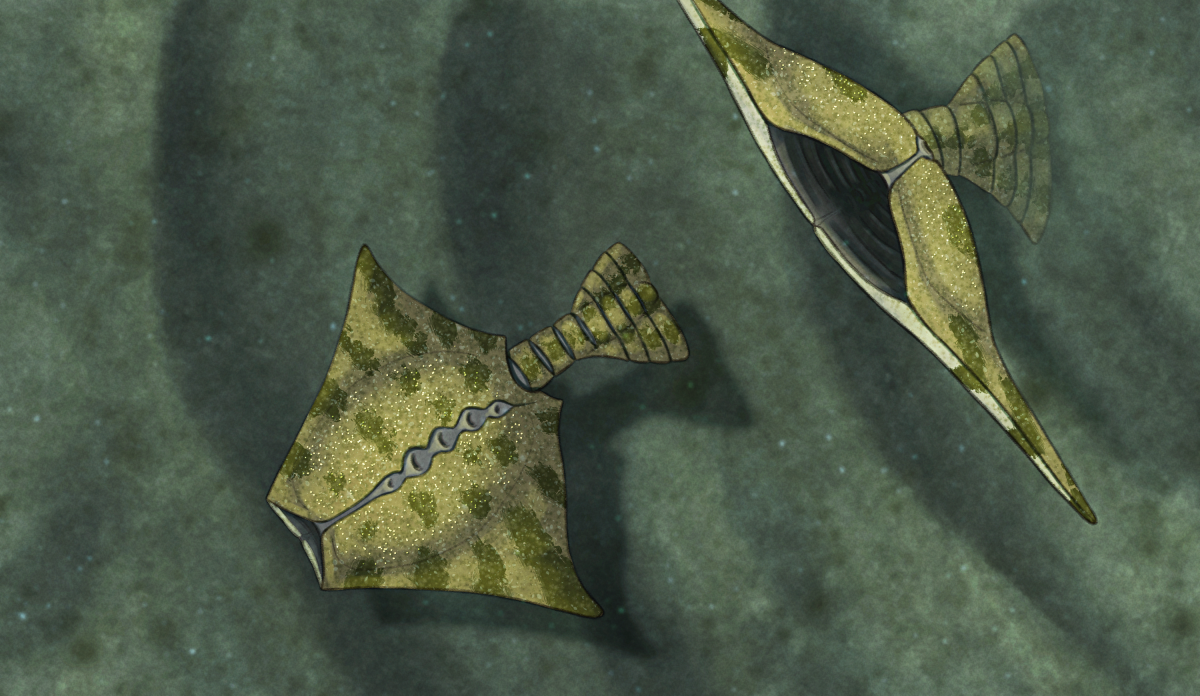
Xenoscapha rotatiolateralis is a late-surviving Late Cambrian vetulicolid, about 10cm long (~4″), that spends daylight hours resting on its side on the seafloor much like present-day flatfish — and this has resulted in a similarly asymmetrical “rotated” body plan. The right side of its body is flattened and now acts as its underside, while its left side is cryptically-colored and functions as the upper surface.

During the night it swims upwards to filter-feed on plankton, propelled by its paddle-like tail. Scattered spots in the left “upper” cuticle are light-sensitive, forming a simple distributed visual system similar to the aesthetes of chitons.

Spectember 2026 #03: Hydra-panosaur

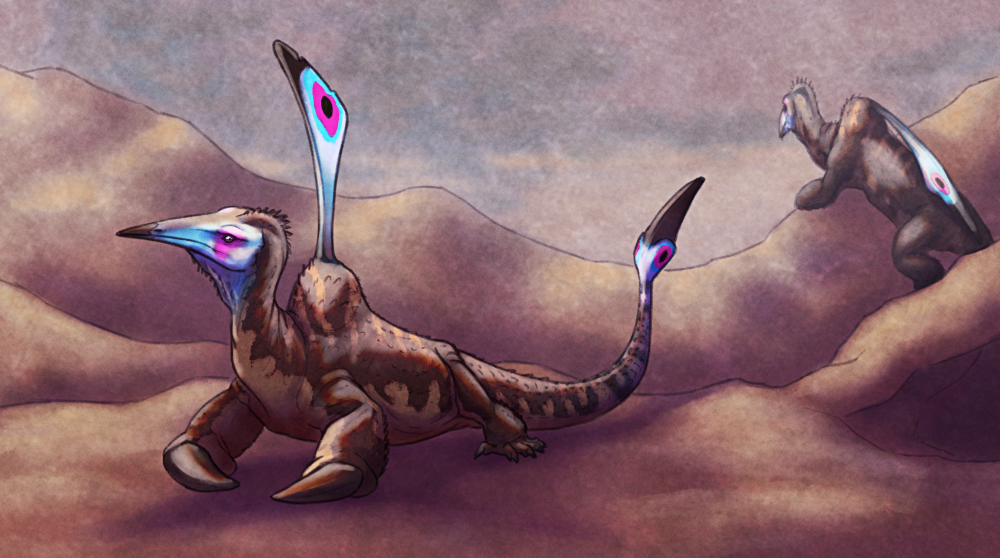
Hydramendax tricephalus is a large Late Triassic drepanosaur, around 1m long (~3’3″). Related to fossorial forms like Skybalonyx, it digs underground burrows using the massive singular claws on its hands — which are specialized to the point of having fully lost all the other digits — and spends its time on the ground rather than climbing around in trees.

No longer used for grip while climbing, its prehensile tail-claw has been repurposed as a “false head“, enlarged and vividly colored to startle and distract predators. A single Mirasaura-like crest plume with similar bold eyespot markings appears to serve as another decoy head, and also as a visual display structure, able to be raised and lowered atop its shoulder hump.

It primarily feeds on insects, using its claws to rip open rotting wood and its long birdlike jaws to probe inside — but it’s somewhat more omnivorous than its relatives and also eats roots and tubers unearthed while burrowing.

Spectember 2026 #02: Graptoflight

An especially bizarre member of the already strange graptolites, Attollograptus aeronauta is a late Silurian relative of the spiral-shaped cyrtograptids.

During their reproductive season these helical colonial animals develop a highly elastic membranous flotation bladder, expanding up to 1m in diameter (~3’3″), which fills with hydrogen gas produced by symbiotic bioluminescent bacteria in their body tissues.

The “balloons” originated as smaller buoy-like structures used to suspend the colony at the surface — as a semelparous species they die shortly after reproducing, so a passive means of holding the dying colony in place while releasing their larvae into the water column was advantageous. Over time the bladders grew gradually larger, and now they’re big enough to actually lift Attollograptus up into the air, safely out of reach of aquatic predators and into the otherwise unoccupied Silurian skies.

These “death flights” are spectacular but brief, usually lasting less than a day before too much of the hydrogen diffuses out of the membrane to maintain lift. (Or air pressure changes at higher altitudes make the “balloon” pop!) But it’s enough time for the winds to send them drifting long distances across the ocean, dispersing their offspring far and wide.

Spectember 2026 #01

It’s #Spectember once again, and looking at what’s left of the speculative evolution submissions you all gave me several years ago… I’m actually kind of burnt out on them at this point.

The ones that are left now are a bit too broad, or are just things I currently have no good ideas for — so I’m finally officially calling it quits on that particular batch of prompts. I still won’t be accepting new ideas for the time being; instead this year I’m just going to have some fun with my own concepts.

So! Let’s start off with…

Spectember 2026 #01: Cave Turtle

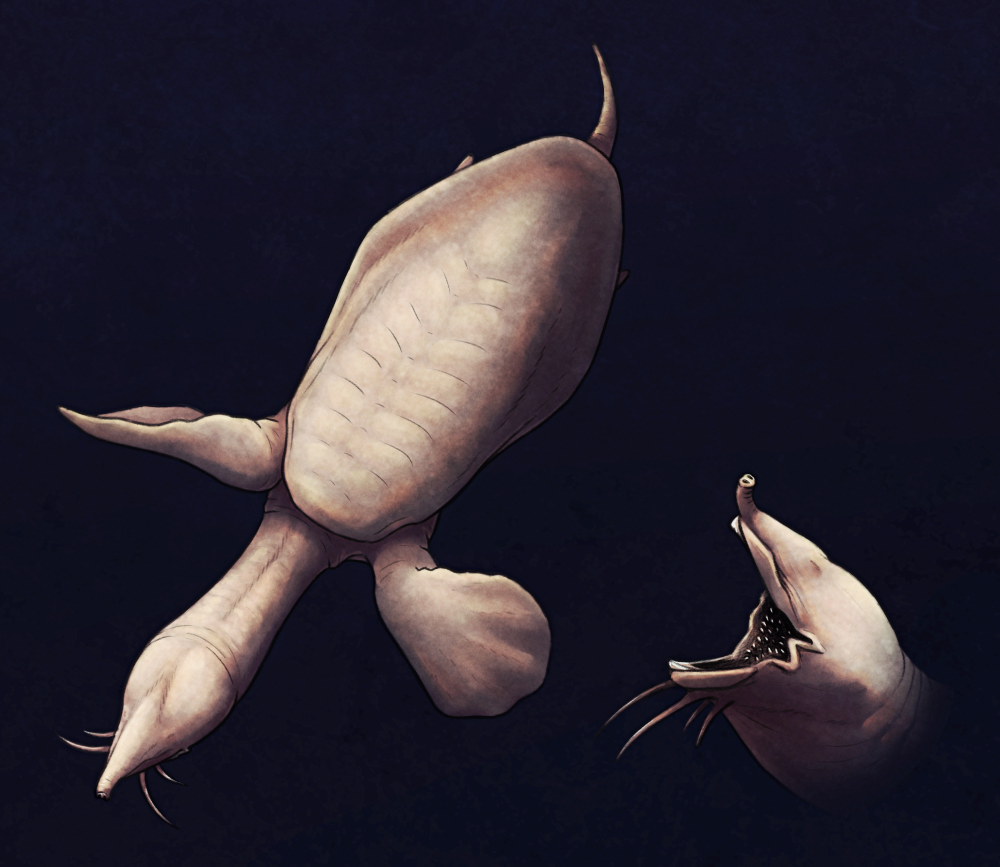
An illustration of a speculative cave-dwelling softshell turtle. It's pale and fleshy-looking, with no eyes, barbel whiskers on its lower jaw, large paddle-like front flippers, and tiny vestigial hindlimbs.

Voragochelys phantasma is a small turtle descended from present-day softshells, living exclusively in a single deep isolated cave system.

Only around 10cm long (2.5″), it’s completely pigmentless and blind, with tiny vestigial eyes covered by skin. A keen sense of smell and sensitive barbels on its jaw help it navigate in total darkness and locate prey such as smaller crustaceans and fish. It uses large paddle-like forelimbs to swim and haul itself over rocks, while its hindlimbs are highly reduced.

Like its present-day relatives it’s capable of absorbing some oxygen through its thin skin, and also via “pharyngeal breathing” — the inside of its mouth and throat are lined with numerous fleshy projections that massively increase the surface area and act like gills, allowing for gas exchange when water is pumped in and out. Its incredibly low metabolic rate means it can remain fully submerged almost indefinitely, sometimes barely moving for years at a time. 

Females lay small clutches of eggs once every decade or so in rock crevices just out of the water, and similarly to the present-day pig-nosed turtle their hatching is triggered by seasonal flooding.