
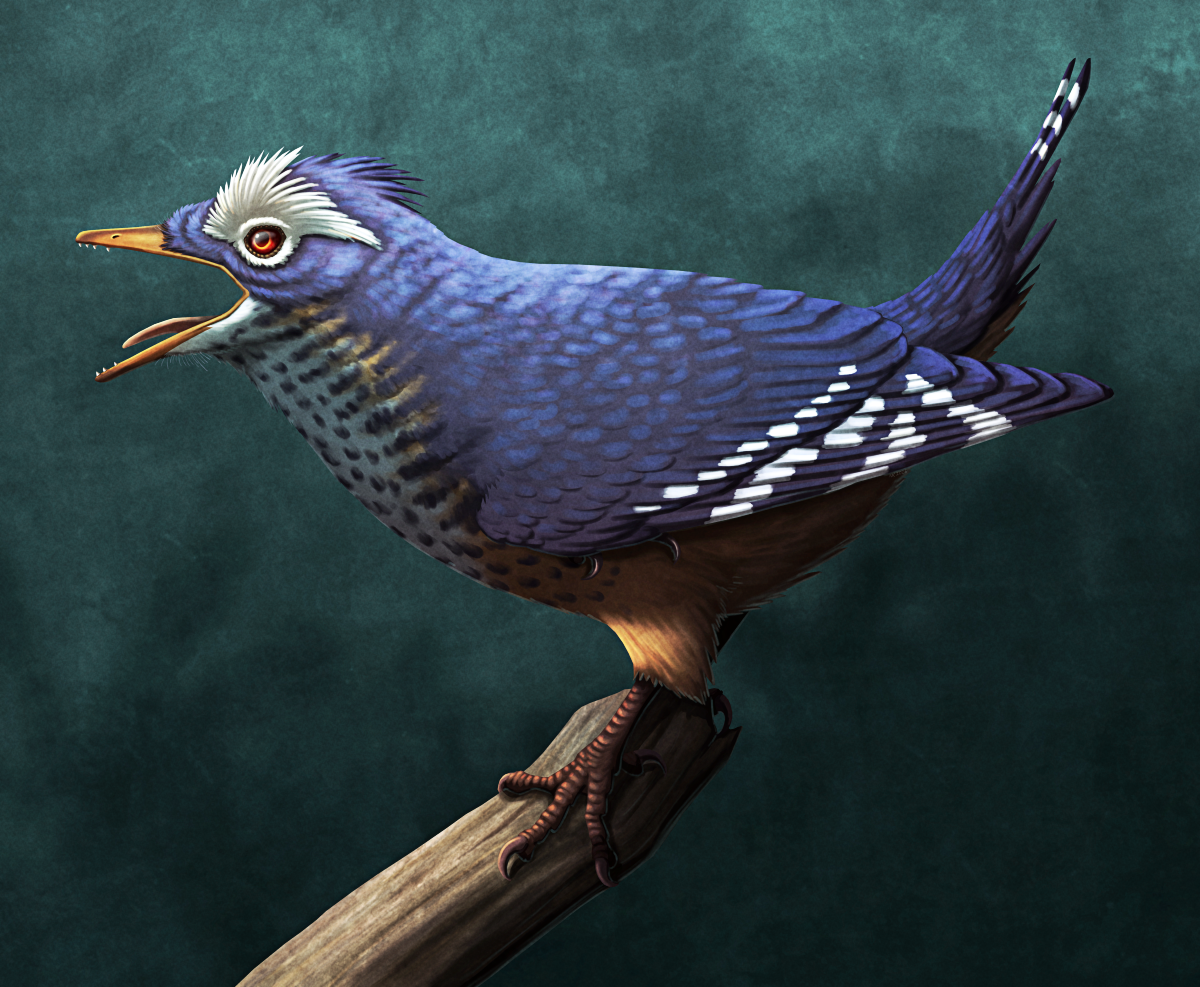
Gorgonavis alcyone was an enantiornithean bird that lived in what is now Spain during the early Cretaceous, about 129-126 million years ago.
Enantiornitheans were a diverse and abundant group of Mesozoic birds that retained claws on their wings and often had toothy snouts instead of beaks, and many also had ribbon-like display feathers on their tails instead of lift-generating fans. While they externally looked a lot like modern birds they weren’t ancestral to any living forms — instead they represented a separate “cousin” lineage to euornitheans that convergently evolved similar features and lifestyles.
Although known only from an isolated skull, Gorgonavis would probably have been around 14cm long (~5.5″) with an estimated wingspan of 30cm (~12″). It seems to have been a close relative of long-snouted enantiornitheans like Longipteryx, having similar elongated jaws with teeth only at the tips.
If it was a longipterygid it would be the oldest known member of that group and the only one currently known outside of China, suggesting that particular family was much more widespread than previously thought.
Longipterygids were traditionally interpreted as kingfisher-like birds specialized to prey on insects or fish, but two specimens from China with preserved gut contents recently demonstrated that they may actually have been frugivores feeding on the fleshy fruit-like seeds of gymnosperm plants.
References:
- Nebreda, Sergio M., et al. “An isolated skull from Las Hoyas (Early Cretaceous, Spain) informs the early evolution towards elongated rostra in enantiornithine birds (Aves, Ornithothoraces).” Swiss Journal of Palaeontology 145 (2026): 251-265. https://doi.org/10.3897/sjp.145.182813
- O’Connor, Jingmai, et al. “Direct evidence of frugivory in the Mesozoic bird Longipteryx contradicts morphological proxies for diet.” Current Biology 34.19 (2024): 4559-4566. https://doi.org/10.1016/j.cub.2024.08.012
- Wikipedia contributors. “Gorgonavis” Wikipedia, 17 Jun. 2026, https://en.wikipedia.org/wiki/Gorgonavis