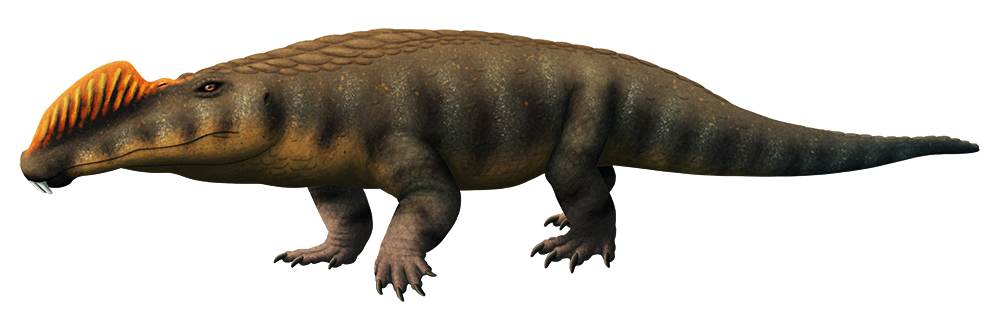
Nicrosaurus

Nicrosaurus kapffi from the Late Triassic of Germany, about 221-205 million years ago. Although rather crocodile-like in appearance, this 4-6m long (13′-19′8″) animal was actually part of an extinct group called phytosaurs – long-snouted heavily-armored reptiles with their nostrils high up on their heads near their eyes.

Phytosaurs’ exact evolutionary relationships are still disputed, with opinions currently going back and forth between them being archosauriformes or an early branch of the croc lineage within the true archosaurs. But either way they weren’t directly ancestral to modern crocodilians, and instead developed a very similar body plan via convergent evolution.

While some phytosaurs had very slender gharial-like snouts and probably fed mostly on fish, others like Nicrosaurus had much more robust jaws and seem to have secondarily adapted to a terrestrial predator lifestyle. They had longer limbs and a more upright posture than their semi-aquatic relatives, and enlarged fangs at the hooked tips of their jaws that may have been used to deliver a powerful stabbing blow to their prey.

Nicrosaurus also had a raised bony crest running along its snout, which I’ve depicted here as supporting an even larger soft-tissue display structure.
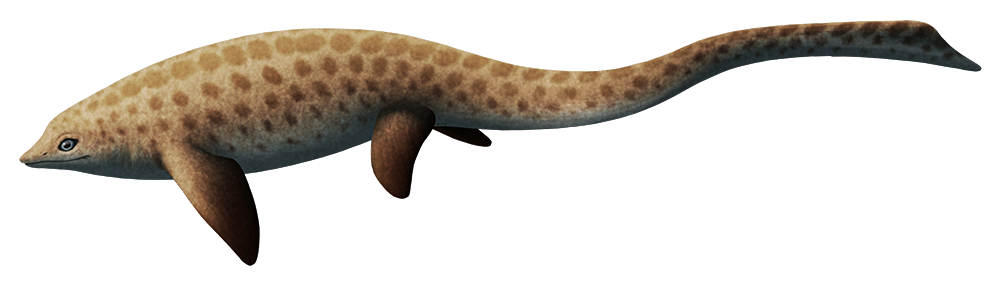
Sclerocormus

Sclerocormus parviceps, an unusual ichthyosauriform from the Early Triassic of China (~248 mya).

Its short toothless snout suggests it was a suction feeder, using water pressure differences to pull small soft-bodied prey straight into its mouth like a syringe.  Along with a heavily built body similar to those of hupehsuchians, and a very long tail that made up over half of its 1.6m length (5′3″), it was probably a fairly slow swimmer living in shallow coastal waters.

It was a close relative of Cartorhynchus, and may have been similarly capable of hauling itself onto land like a modern pinniped.

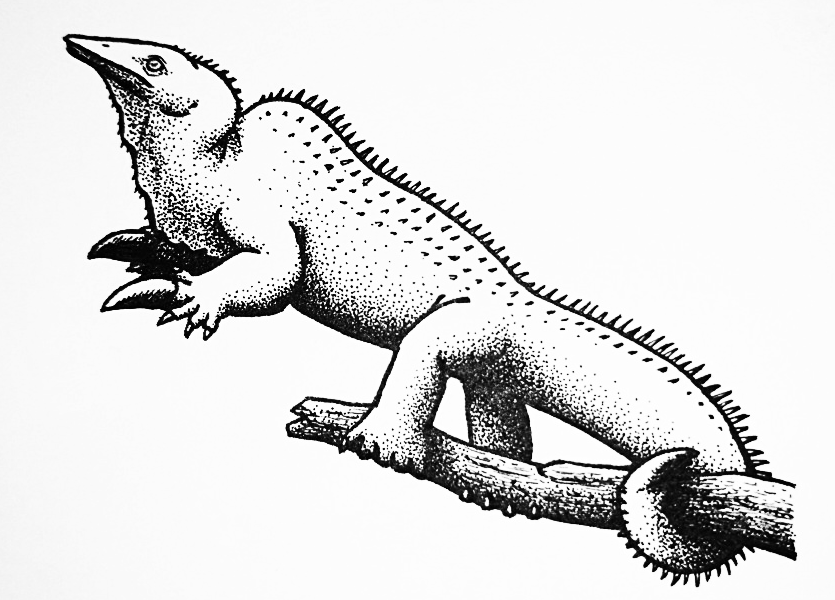
Drepanosaurus

One of my favorite palaeontological discoveries of 2016 also involved one of my favorite extinct animals: the odd little “monkey lizard” Drepanosaurus.

Living during the Late Triassic of Europe and North America (~218-212 mya), this reptile measured about 50cm long (20″). It was already known to have some particularly weird anatomy, featuring a humped back, grasping feet, a prehensile tail ending in vertebrae modified into a pseudo-claw, enormous claws on the second finger on each hand, and a bizarre arrangement of its forearm bones.

In 2016, new fossils gave us a better look at those arm bones, and they turned out to be even stranger than previously thought. As well as the radius and ulna being unusual, several wrist bones were also heavily modified and elongated, creating an arm setup unique among all known tetrapods. This may have been a specialization for “hook-and-pull” digging, ripping up tree bark to get at burrowing insects – but now the real mystery is why no other tetrapods have ever managed to modify their limb bones to this sort of extreme.