
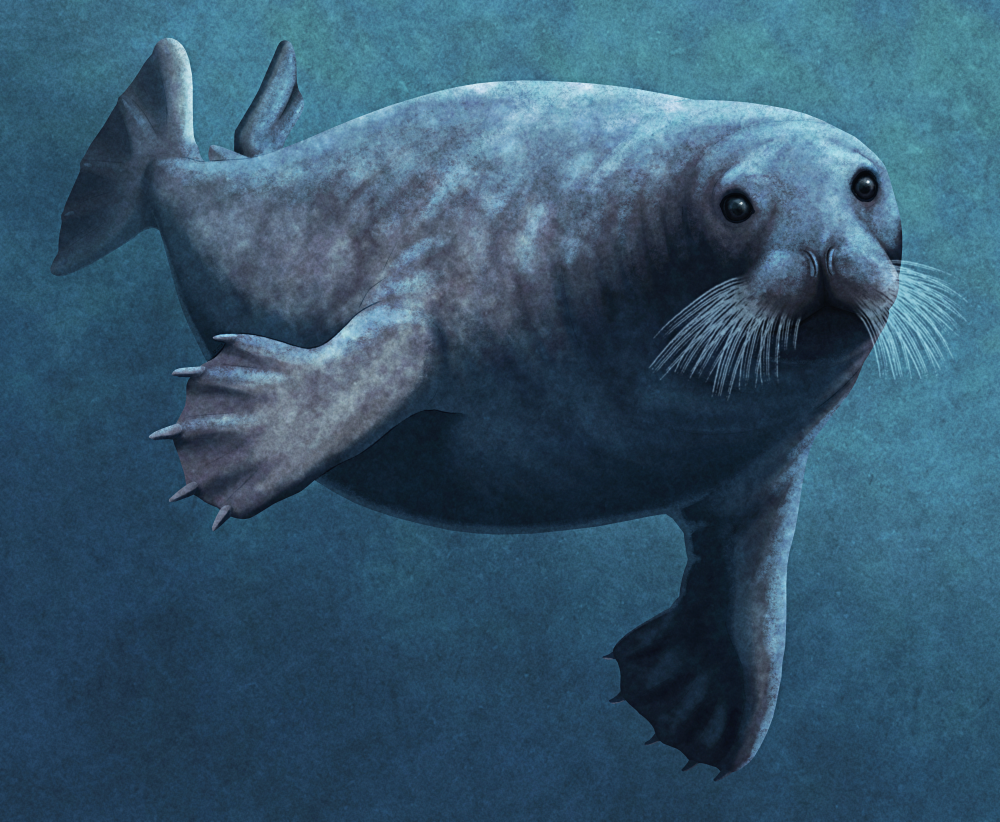
Nanophoca vitulinoides was a small earless seal that lived during the mid-Miocene (~14-12 million years ago) in what is now Belgium, which at the time was covered by the southern margin of the North Sea.
It was slightly smaller than any modern pinnipeds, no more than 1m long (3’3″), and had more mobile front and back flippers than modern earless seals — indicating it had a different swimming style than its living relatives, and that it may have been more mobile on land.
It also had a very dense skeleton, which would have made it a slower, less maneuverable swimmer. It may have fed on small prey on the seafloor in shallow coastal waters, similar to modern bearded seals.
References:
- Dewaele, Leonard, et al. “Reappraisal of the extinct seal “Phoca” vitulinoides from the Neogene of the North Sea Basin, with bearing on its geological age, phylogenetic affinities, and locomotion.” PeerJ 5 (2017): e3316. https://doi.org/10.7717/peerj.3316
- Dewaele, Leonard, et al. “Generalized osteosclerotic condition in the skeleton of Nanophoca vitulinoides, a dwarf seal from the Miocene of Belgium.” Journal of Mammalian Evolution 26.4 (2019): 517-543. https://doi.org/10.1007/s10914-018-9438-9
- Wikipedia contributors. “Nanophoca” Wikipedia, 23 Mar. 2026, https://en.wikipedia.org/wiki/Nanophoca