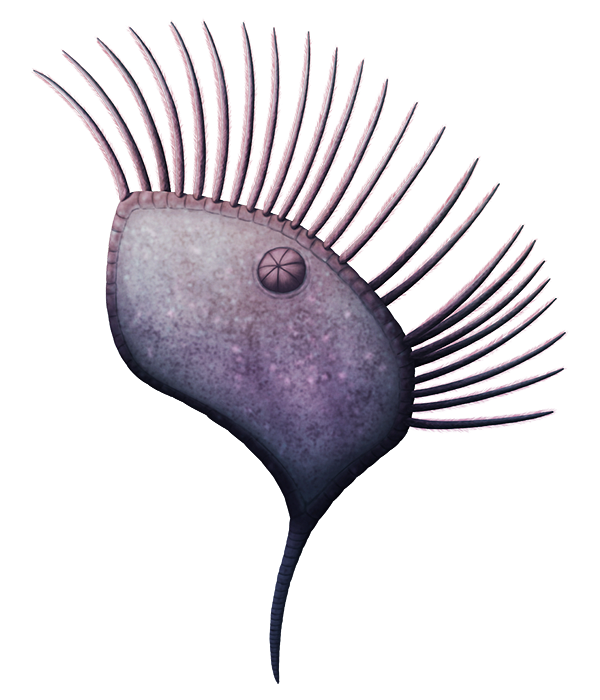
Ubaghsicystis segurae was an echinoderm that lived during the mid Cambrian, about 506-497 million years ago, in what is now Spain. Similar fossils are also known from Morocco, Mexico and Canada, suggesting this genus was quite widespread in marine continental shelf habitats at the time.
It was part of an extinct group known as eocrinoids, which were the earliest known echinoderms to develop stalked bodies and specialized feeding appendages — but despite the name and similar body plan, their resemblance to crinoids was due to convergent evolution rather than any direct relation.
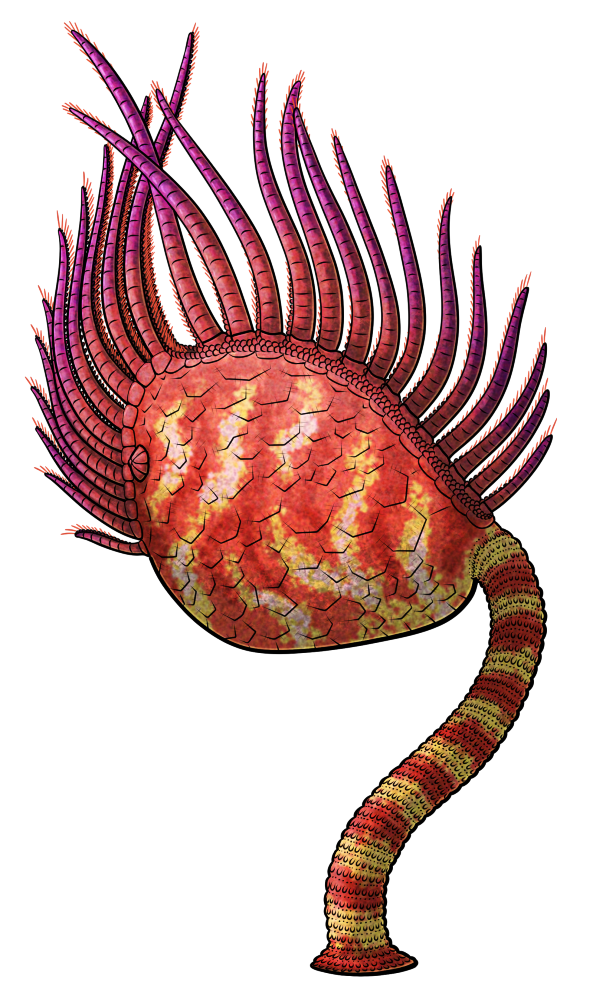
Its globular body was only about 5mm in diameter (~0.2″), with a long stalk at least twice that length ending in a small disc that attached it to the substrate. The upper half of its body was dotted with small holes (called epispires) that probably served a respiratory function, and unlike most other eocrinoids it seems to have had just two slender flexible feeding appendages.
It would have been a suspension feeder, using tube feet to catch food particles floating around in the water, then move it down to its mouth positioned at the base of the two “arms”.
Early echinoderms seem to have gone through an asymmetrical phase before starting to evolving their characteristic radial symmetry. The first truly radial forms had three-way symmetry, but soon a group called the edrioasteroids upped that count to five.
First appearing in the fossil record around 525 million years ago in the early Cambrian, edrioasteroids were mostly shaped like discs or domes, and were immobile filter-feeders that lived permanently attached onto surfaces like the seafloor or the shells of other animals. Unlike most modern echinoderms their pentaradial symmetry was actually created by taking a tri-radial body plan and forking two of their arms near the bases to create a total of five.
Thresherodiscus ramosus
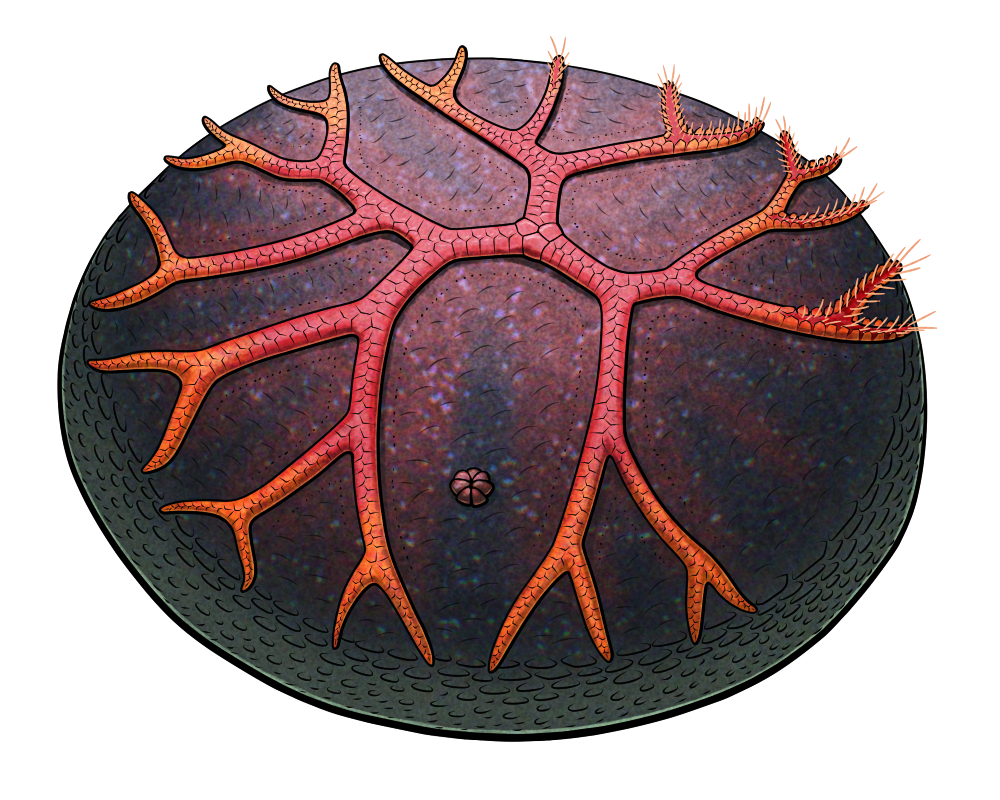
Thresherodiscus ramosus was an unusal edrioasteroid that lived in the shallow seas of what is now central Canada during the late Ordovician, around 460-450 million years ago. Up to about 4cm in diameter (~1.6″), its arms split additional times at irregular intervals, creating a complex asymmetrical branching pattern across its upper surface.
The tips of its arms protruded slightly over the rim of its body, and along with the erratic extra branching this may have been an adaptation to increase its food-gathering surface area.
Another group of early pentaradial echinoderms known as the blastozoans were characterized by erect feeding appendages called brachioles. But some blastozoans abandoned their five-way symmetry in favor of much stranger arrangements, sometimes having as few as two arms – and, in some cases, two mouths.
Amygdalocystites radiatus
Known from the same general area and time period as Thresherodiscus, Amygdalocystites radiatus was part of an Ordovician-to-early-Silurian lineage known as paracrinoids, which attached their irregularly-shaped bodies to the seafloor via a stem.
About 5cm long (~2″) Amygdalocystites had just two asymmetric arms forming “food grooves” along its upper edge, each lined with numerous long brachioles along just one of their sides. It probably orientated itself so its body was facing down-current, which would have created eddies that brought suspended food particles within easier reach of its brachioles.
Represented today by starfish, brittle stars, sea urchins, sea cucumbers, and crinoids, the echinoderms have a characteristic five-way radial symmetry that makes them barely even recognizable as bilaterians. Their true ancestry is only revealed by their genetics and their larvae, which still retain bilateral symmetry – and the way they metamorphose into adults is bizarre, essentially growing a whole new radial body from within the left side of their larval body.
(Sea cucumbers and sand dollars are superficially bilateral as adults, but evolved this secondarily on top of their existing radial symmetry. And some adult echinoderms like starfish also seem to retain a little bit of “behavioral bilaterism”, generally preferring to move with a specific arm always acting as their “front” end.)
The first known echinoderms appeared in the fossil record during the early Cambrian, about 525 million years ago, but the common ancestor of the whole group probably actually originated a few tens of millions of years earlier in the mid-to-late Ediacaran. Early echinoderms seem to have started off as flattened animals that sat on the seafloor filter-feeding, and with this largely immobile way of life their bodies started to shift into asymmetry, no longer constrained by the locomotory advantages of being bilaterally symmetric.
In fact, for these early sedentary filter-feeders being radial was actually much more advantageous, able to distribute sense organs all around their bodies and grab food from any direction without having to reposition themselves, converging on the lifestyle of non-bilaterian cnidarian polyps. The evolutionary transition from bilateral to asymmetrical to pentaradial seems to have happened incredibly quickly during the Cambrian Explosion, and all modern echinoderms probably evolved from a group called the edrioasteroids, maintaining their new base body plan even when they later began taking up more mobile lifestyles again.
But during the process of all that some very alien-looking lineages split off at various stages of anatomical weirdness.
Stylophorans had asymmetrical bodies with a single feeding arm at the front, and varied from irregular boot-like shapes to almost bilateral heart shapes depending on their specific ecologies. The highly asymmetrical forms were probably spreading their weight out over soft soupy mud in quiet waters, while the more bilateral forms may have been more streamlined to deal with stronger water currents.
Sokkaejaecystis serrata
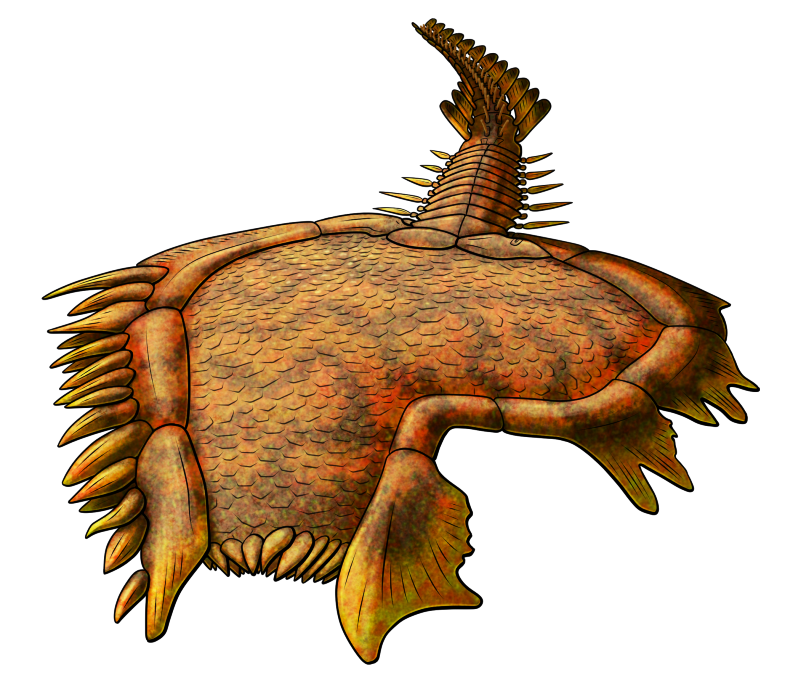
Sokkaejaecystis serrata was a stylophoran that lived during the late Cambrian, about 501-488 million years ago, in what is now South Korea. It was tiny, only about 1cm long (~0.4″), and its boot-shaped body was surrounded by spines and flanges that spread out its surface area and probably also made it much more awkward for small predators to attempt to eat.
Meanwhile the solutes started off as immobile animals living attached to the seafloor via a stalk-like appendage. But fairly early in their evolution they switched to a more active mode of life, modifying their stems into tail-like “steles” that were used to push themselves along.
Maennilia estonica
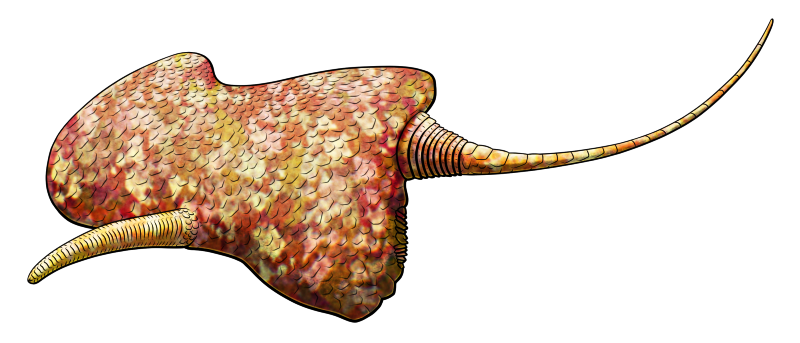
Maennilia estonica lived in what is now Estonia during the late Ordovician, about 450 million years ago. It was quite large for a solute at about 12cm long (~4.7″), with a sort of vaguely-trapezoidal body, a short feeding arm, and a long thin stele.
Both of these strange early echinoderm lineages were surprisingly successful, surviving for a good chunk of the Paleozoic Era alongside their more familiar radial relatives. The solutes lasted until the early Devonian about 400 million years ago, and the stylophorans continued all the way into the late Carboniferous about 310 million years ago.
It was part of an extinct Paleozoic echinoderm lineage known as edrioasteroids, which lived attached to the seabed or on hard surfaces like the shells of other marine animals, using the tube feet on their five arms to catch food particles from the water around them.
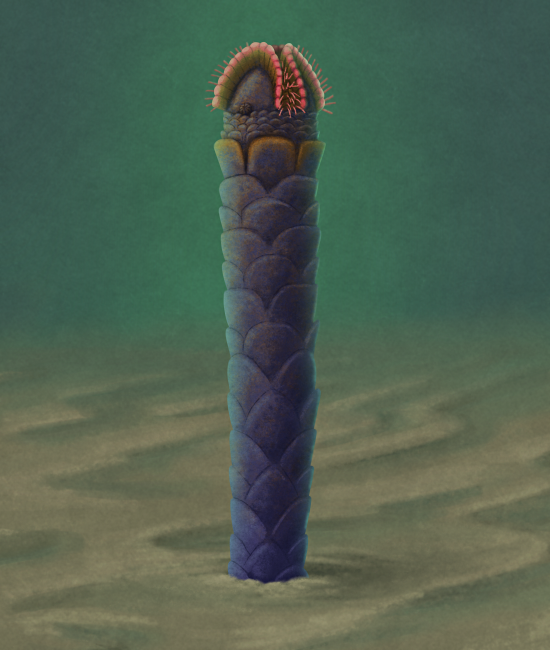
Living during the Silurian, about 435 million years ago, in what is now Quebec, Canada, it stood around 3-4cm tall (1.2-1.6″), firmly anchored into the seafloor sediment by a bulbous sac-shaped base. Its long stalked body was somewhat flexible, and it was able to partially contract the top feeding region down under a “collar” of large scale-like armor plates.
Vetulicolians were a group of odd Cambrian animals known from between about 520 and 505 million years ago. The front half of their bodies were large and streamlined, with a prominent mouth, no eyes, and five pairs of openings that seem to have been gills, with some species having a rigid exoskeleton-like carapace. Their back half was slender, segmented, and flexible, and functioned as a tail for swimming, giving them an overall appearance like alien tadpoles.
Their evolutionary affinities have been problematic for a long time, but evidence of a notochord in some specimens suggest they were probably related to the chordates in some way. Sometimes they’re considered to represent their own phylum, but they might also be stem-chordates or stem-tunicates.
It seems like echinoderms became five-way symmetric incredibly quickly following the group’s first appearances in the early Cambrian. We don’t really know why this secondary radial symmetry evolved in the group – but we do know that the common ancestors of all modern pentaradial echinoderms were suspension-feeding animals that lived attached to the sea floor.
And those ancestors were probably a group called the edrioasteroids.
While many of the earliest echinoderms had bizarre asymmetrical forms, at some point members of their lineage adopted radial symmetry instead – a development that would eventually lead to the familiar five-way symmetry of most modern species.
And they may have transitioned to that via three-way symmetry.
During their early evolution, echinoderms started developing unusual asymmetric body plans – and some of them were so strange-looking that for a while it wasn’t clear if they even were echinoderms.
Modern echinoderms typically have five-way radial symmetry as adults, and don’t at all resemble other deuterostomes – but their larvae give away their ancestry, still retaining bilateral traits and only developing radial symmetry when they mature and metamorphose.
The earliest definite echinoderms are known from the early Cambrian, about 525 million years ago, which seems to be around the point when early members of the group first developed biomineralized skeletons and became much more likely to fossilize. However, they must have an evolutionary history going back further than that, and molecular clock estimates suggest their last common ancestry with their closest relatives the hemichordates was in the Ediacaran about 570 million years ago.
For a long time the transition from bilateral to radial symmetry was a mystery, but various fossil discoveries are starting to reveal how this unique group of animals evolved.
And some of the most confusing of them were the paracrinoids, which evolved an incredibly diverse range of body shapes during their group’s relatively short 40 million year existence during the Ordovician.
Despite the name these echinoderms weren’t particularly closely related to true crinoids, instead being part of a completely extinct lineage known as the blastozoans. Their ancestors had been radially symmetric, but paracrinoids largely abandoned that body plan, instead developing irregularly shaped and often asymmetric bodies ranging from round to flattened. They had between two and five “food grooves” on their upper surfaces, derived from the ambulacra, lined with numerous feeding appendages along only the left side of each.
They were shallow-water animals, living either attached to the seafloor by a long stem or anchored into the sediment by a shorter one, suspension feeding with their appendages and transporting the food particles towards the mouth located between the bases of the food grooves.
(…And speaking of mouths, some paracrinoid species appear to have had two of them.)
About 10cm tall (4″), it lived on the seafloor in sheltered waters protected from strong waves by large reefs, and is unusual even among its weirdo relatives for features such as retaining feeding appendages on both sides of its food grooves – although irregularly arranged and with fewer on one side than the other. Its body was shaped rather like a flattened bean, with two food grooves diverging from roughly the centre of the top margin, chunky skeletal plates forming a border around its edges, and a short stem at is base.
It also had an unusually large “anal pyramid” on the opposite side of its body from its mouth, and this may have been used for respiration as well as waste expulsion, similar to modern sea cucumbers.