Spectember 2025 #04: Kerguelen Kingdom

A couple of anonymous submissions asked for “Kerguelen fauna before it sank 20 million years ago” and “a predator which prowled Cenozoic Kerguelen before it sank”:

[Context: The Kerguelen Plateau is today almost entirely underwater, but during the Cretaceous Period much larger parts were above water as island landmasses. Initially forming during the Gondwanan breakup of what would become Australia, India, and Antarctica, it was eventually left isolated in the forming southern Indian Ocean, and due to long-term volcanic hotspot activity it may have gone through as many as three different periods of rising and sinking before finally almost completely submerging about 20 million years ago.]

In the early Cenozoic, around the time of the Paleocene-Eocene Thermal Maximum, there’s less of Kerguelen’s land above water than there was in the Cretaceous, but the climate is warm-temperate and conifer forests cover the plateau’s islands.

A digital sketch of a speculative descendant of enantiornitheans. It's a large chunky shaggy-feathered flightless bird with a small head, toothed jaws instead of a beak, a long neck, vestigial wings with small claws, thick legs, and a pair of ribbon-like tail feathers that end in wider spaded plumes.

Enantiochen reliquia is a flightless bird standing around 1.5m tall (~5′), and its toothy jaws, wing claws, and ornamental ribbon-like tail plumes on males identify this species as an enantiornithean, descended from a small flighted form that just barely survived through the K-Pg extinction here.

It’s the largest current inhabitant of the Kerguelen plateau, a browsing herbivore filling a similar ecological role to the later moa of Aotearoa.

A digital sketch of a speculative descendant of gondwanatherian mammals. It vaguely resembles a rabbit with small pointed ears, with a deep snout, long digging claws on its digits, a short thin tail, and long hind feet.

Cuniculitherium kerguelensis is another Mesozoic holdover, a gondwanatherian mammal — although a little less unique than Enantiochen since other gondwanatheres still also survive in early Cenozoic South America and Antarctica.

About 40cm long (~1’4″), it’s a rather rabbit-like burrowing herbivore with long hind feet and a fast bounding gait, traits its lineage originally evolved to evade unenlagiine theropods and small terrestrial crocodylomorphs prior to the end-Cretaceous extinction. Those predators are gone from Kerguelen now, but…

A digital sketch of a speculative descendant of australobatrachian frogs. It has a large head, short chunky limbs, and an elongated body with a row of bony amor plates along its spine.

Daptobatrachus archaeotropus is a descendant of australobatrachian frogs. In a case of island gigantism it’s close to the size of a cat, around 50cm long (~1’8″), and with its elongated body, stubby hind legs, and a row of osteoderms down its back, it almost looks like a throwback to the Permian.

Although unable to hop, it’s an ambush predator capable of raising itself up for very brief bursts of crocodile-like galloping, preying on pretty much anything it can potentially fit into its mouth.
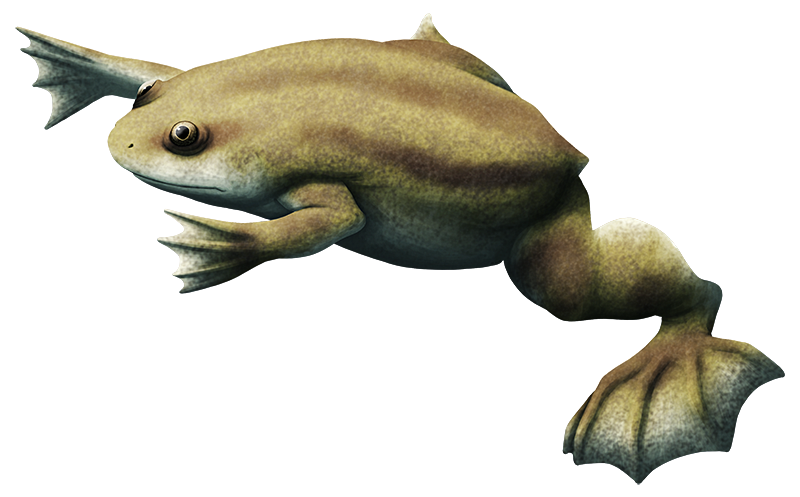
Almost-Living Fossils Month #25 –  Europe’s Fully Aquatic Frogs

The palaeobatrachids were a group of frogs, part of a fairly “primitive” lineage that also includes the living pipids. They first appeared in the fossil record about 70 million years ago in the Late Cretaceous, but may have actually originated much earlier, perhaps as far back as the Late Jurassic (~145 mya).

These frogs lived mainly in Europe, with a few possible remains also known from North America in the Cretaceous. They were fully aquatic, spending their entire lives in water, and fully-grown adults looked similar to modern Xenopus clawed frogs, with slightly flattened egg-shaped bodies, upwards-facing eyes, and long fingers and toes.

Some fossils preserve soft-tissue impressions, showing internal organs such as unusual bag-shaped lungs. Eggs and juveniles have also been found, and while most species’ tadpoles usually reached lengths of around 6cm (2.4″), a few were comparatively gigantic, growing to over twice that size.

The end-Cretaceous extinction (~66 mya) had little overall effect on the palaeobatrachids, and they continued to thrive in the warm wet environments of Europe during the early Cenozoic. But as climates in Western Europe gradually became drier and cooler starting in the Early Oligocene (~33 mya) they mostly disappeared from that region and instead shifted east towards Central and Eastern Europe, ranging as far as Russia.

By the Late Pliocene (~3 mya) they were struggling to cope with the ongoing cooling and drying, and the onset of the Pleistocene glaciations made things even worse for them.

Palaeobatrachus langhae was probably the last species of these frogs, known from the Early Pliocene to the mid-Pleistocene (~5 mya – 500,000 years ago). Growing to about 10cm long (4″), it lived in some of the final refuges of the palaeobatrachids in Eastern Europe, inhabiting inland temperate areas where winter temperatures weren’t too harsh.

Unfortunately the palaeobatrachids didn’t quite manage to make it through the Ice Age, ending up trapped by their fairly specialized habitat preferences. During repeated glacial periods the temperatures became too cold for them, freezing the water they depended on, but the warmer climates to the south were also too dry for them to migrate into – and with nowhere to go, they finally went completely extinct just half a million years ago.