Spectember 2023 #02: Carnivorous Ungulates

An anonymous submitter asked for a “derived carnivorous, pack-hunting agriochoerid“:
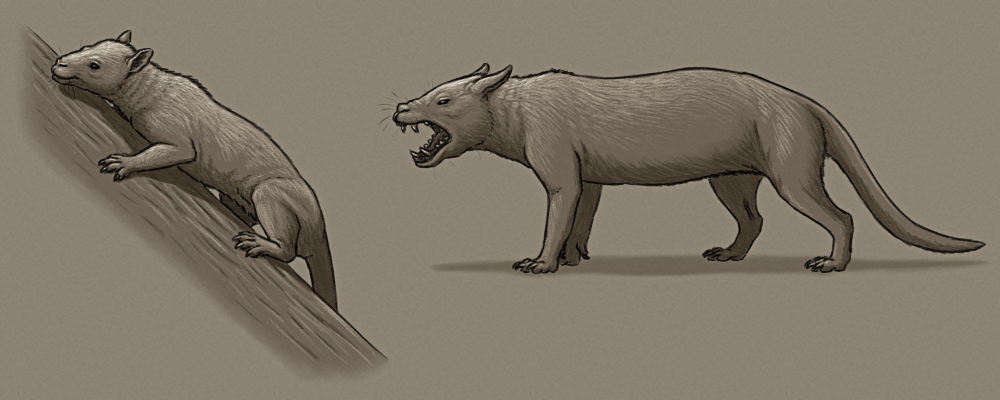
A shaded sketch of a speculative predatory early ungulate. It has a cat-like body, long and low-slung with clawed feet and a long slender tail. Its head looks like a mix between a cat and a camel, with a fleshy cleft lip, forward-facing eyes, leaf-shaped ears, and a mouth full of sharp pointy teeth. It's depicted in two poses: on the left climbing up a tree trunk, and on the right standing and baring its fangs.

Felichoerus ochlos is fairly similar-looking to its herbivorous relatives, but this cat-sized agriochoerid comes from a lineage that initially specialized in eating fleshy fruits – and then shifted towards eating actual flesh.

With its long cat-like body, forward-facing eyes, clawed digits, and flexible limbs, it’s a capable tree climber. Groups of this animal practice cooperative hunting, with one member chasing arboreal prey down to the ground for the rest to mob.


And another anon wanted to see an “obligate carnivore bovine”:

(I see what you did there. A literal carnotaurus!)
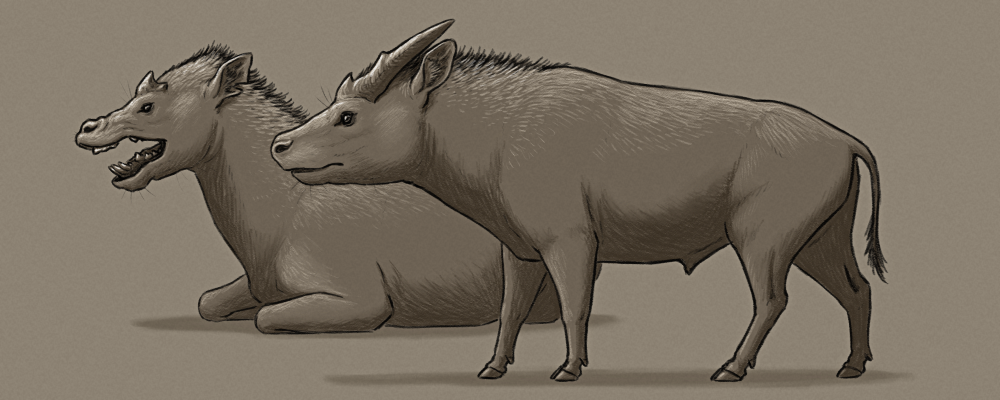
A shaded sketch of a speculative predatory bovine. It has a muscular body with humped shoulders and cloven hoofed feet, a thick neck, and a large cow-like head. Two individuals are depicted, a standing long-horned bull and a sitting short-horned cow. The cow has a chunk missing from one ear and has her mouth open to display her sharp teeth.

The bulltcher (Carnovitulus grassator) is a sheep-sized descendant of small buffalo that gradually took up more and more omnivorous diets, eventually becoming somewhat entelodont-like opportunists. This particular species has shifted over into hypercarnivory, occupying a predator niche in an ecosystem lacking other types of carnivorous mammal.

Like their ancestors they still lack upper front teeth, and instead have modified their dental pad into an almost beak-like tough keratinized structure that their sharp lower teeth can slice and self-sharpen against.

These animals live in small matriarchal herds, with bulls usually hanging around on the edges of the group to protect from threats. Bulls have larger backwards-pointing horns, used to compete with each other for mates – but the size of these structures on their skulls results in them having slightly less powerful jaw muscles than cows.

Herds hunt cooperatively, pursuing and harassing larger prey until it can be brought down and torn apart.
Spectember 2023 #01: Kiwi Alvarezsaur

It’s #Spectember time again!

I’m still trying to work through that big pile of speculative evolution concepts from a few years ago, so I’m hoping to make this month sort of a “lightning round” to finally clear out the backlog.

(I’m not going to set a definite posting schedule this year because things are pretty chaotic right now. But I’ll try to fit in as many as I can!)

So let’s start off with a concept from an anonymous submitter, who requested a “kiwi/sengi niche alverezsaur”:

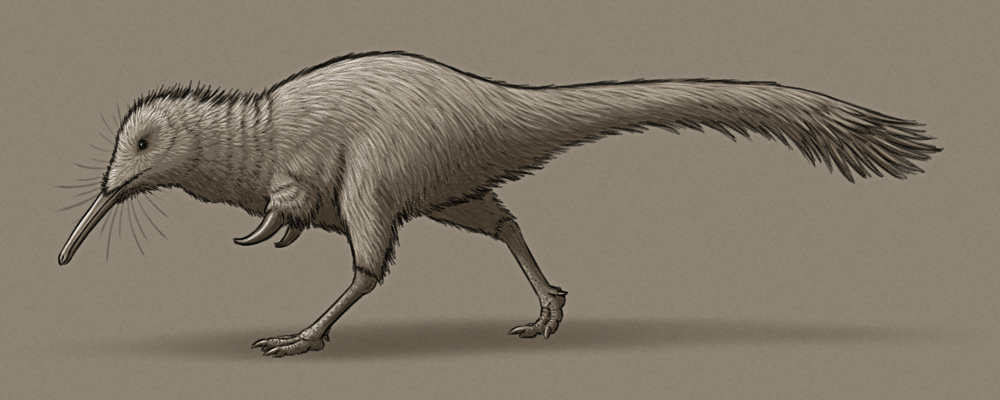
A shaded sketch of a speculative dinosaur. It has a long narrow snout, small eyes, and whiskery facial feathers like a kiwi bird, a round fuzzy body, short chunky arms with large hooked thumb claws, long slender legs, and a long tail with a tufted fan at the tip.

Khamartaia dolabella is similar in size and build to Shuvuuia, about 1m in length (3’3″), with slender legs and stumpy arms with massive thumb claws. Unlike its close relatives, however, it has small eyes and fairly poor vision, relying more on its other senses to forage around during the darkness of night.

It has an acute sense of smell, and its long narrow snout is full of highly touch-sensitive nerves, allowing it to probe around for invertebrate prey in soil, undergrowth, and cracks and crevices. Its chunky thumb claws are used to dig up burrows and to tear through bark to access deeper insect nests.

It mainly relies on its long legs to sprint away from threats, although with its poor eyesight these escapes are often rather ungainly.

Spectember 2022 #04: Aquatic Brontotheres

Squeezing in one last bonus #Spectember post this year!

This one isn’t based on a specific prompt, but instead is a companion piece to a previous one.


While North American brontotheres were adapting to the spread of grasslands, some of their Asian cousins took a very different evolutionary path through the rest of the Cenozoic.

Continue reading “Spectember 2022 #04: Aquatic Brontotheres”

Spectember 2022 #03: Swimming Hummingbirds

Today’s #Spectember concepts come from three submitters: anonymous, Jonas Werpachowski, and Novaraptoria.

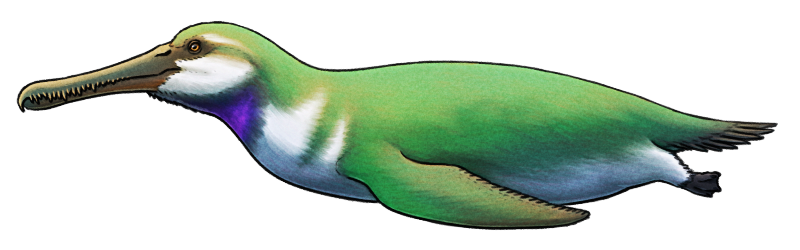
A digital illustration of a speculative future aquatic bird descended from hummingbirds, laying on its belly. It has a long beak with tooth-like serrations that give it a crocodilian appearance. Its body is penguin-like, with large flipper-wings, and it has relatively tiny webbed feet and a stubby tail. Its plumage is iridescent green and white, with a bright purple patch on its throat.
Humdertaker (Suchomergus pollinctor)

Despite having a convergent resemblance to penguins or gannetwhales, the humdertaker (Suchomergus pollinctor) is actually a distant descendant of modern hummingbirds.

Continue reading “Spectember 2022 #03: Swimming Hummingbirds”

Spectember 2022 #02: ‘Modern’ Brontotheres and Paraceratheres

Today’s #Spectember concept is a combination of a couple of anonymous submissions:

A digital illustration of two speculative hoofed mammals, descended from extinct brontotheres and paraceratheres. One resembles a hairy rhinoceros with an odd U-shaped horn on its nose and a fork-like bony "horn" on the back of its head. The other looks like a chunky camel with a moose-like bulbous nose and short downward-pointing protruding tusks.
Crowned brontothere (left) and woolly paracerathere (right)

These two animals are the descendants of brontotheres and paraceratheres, almost the last living representatives of their kinds, hanging on in the equivalent of modern-day times in a world similar to our own.

Continue reading “Spectember 2022 #02: ‘Modern’ Brontotheres and Paraceratheres”

Spectember 2022 #01: Arboreal Ornithopod

Despite some minor delays, it’s time once again for #Spectember – when I dive back into the big pile of speculative evolution concepts that you all submitted to me in 2020, and try to get through a few more of the backlog.

(…There’s still over 50 of them left. This is going to take a while.)

So today’s concept comes from an anonymous submitter, who requested an arboreal ornithopod dinosaur:

Continue reading “Spectember 2022 #01: Arboreal Ornithopod”

Spectember 2021 – Reedstilt Redesign

(This was originally supposed to be a final-day-of-#Spectember bonus post, but it got much longer than I expected so it’s a few days late.)

To finish off this year’s diversion into speculative evolution, instead of pulling from my still-rather-long list of unused submissions I’m doing something a little different – trying to give an idea of how I go through the actual process of designing a speculative species.

And for today’s example I’m going to do a “redesign” of sorts for a classic Dougal Dixon After Man creature: the reedstilt.

For several reasons:

  • It was on the cover of the old edition of After Man I first discovered as a kid in the local library, it immediately caught my attention, and as a result it’s always been one of my favorite species from the book.
  • But some of its anatomy doesn’t really hold up.
  • I really really Do Not Like the “official” redesign that replaced the original art in the 2018 reprint. It’s shrinkwrapped.
  • I just think it’s neat.
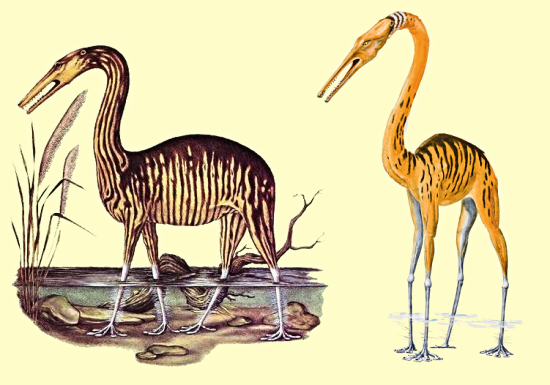
Reedstilt in both original flavor and 2018 revamp style.
Continue reading “Spectember 2021 – Reedstilt Redesign”

Spectember 2021 – Slime Snouters & Megaphone Birds

Today’s #Spectember concept is brought to you by @thecreaturecodex , who wanted to see a depiction of something from The Snouters: Form and Life of the Rhinogrades:

Continue reading “Spectember 2021 – Slime Snouters & Megaphone Birds”

Spectember 2021 – Quadrupedal Pachycephalosaurs

Today’s #Spectember concept comes from an anonymous submitter:

Continue reading “Spectember 2021 – Quadrupedal Pachycephalosaurs”