Coahuilaceratops (“Coahuila horned face”) was the first ceratopsid discovered in Mexico, living about 72-71 million years ago. Known from partial skull material and other fragmentary remains, it’s estimated to have measured around 5-6m in length (16′4″-19′8″)
It seems to have been an early member of a branch of the chasmosaur evolutionary tree that included animals more closely related to Chasmosaurus than to Triceratops. (This grouping doesn’t currently have an official name, but similarly to @a-dinosaur-a-day I’ll be referring to them as the “Chasmosaurini”.)
Its brow horns were proportionally huge for its size, each reaching up to 1.2m long (4′) – some of the largest of all known ceratopsids.
The chasmosaurs were the second major branch of the ceratopsids, and ranged throughout most of western North America from Mexico to Canada during the end portion of the Cretaceous (~78-66 mya). They tended to have larger brow horns than their centrosaur cousins, and more elongated frills that lacked elaborate spikes.
Mercuriceratops (“Mercury horned face”) was one of the earliest chasmosaurs, living in Alberta, Canada and Montana, USA about 77 million years ago. Known only from two almost-identical skull fragments found on each side of the Canada-USA border, its full body size is uncertain – but estimates range from 4 to 6m (13′-19′8″).
It had prominent projections on the sides of its frill, forming distinctive “wing” shapes unlike any other known ceratopsid.
The rest of its ornamentation is still unknown, but it was likely similar to other early chasmosaurs like Judiceratops, with moderately-sized brow horns and a small nose horn.
Those extinct horses weren’t the only ancient creatures with unexplained noses. Some dinosaurs had equally weird things going on with their snouts – and while hadrosaurs’ big honkin’ snoots are fairly well-known, there were other ornithischians with their own bizarre nasal anatomy.
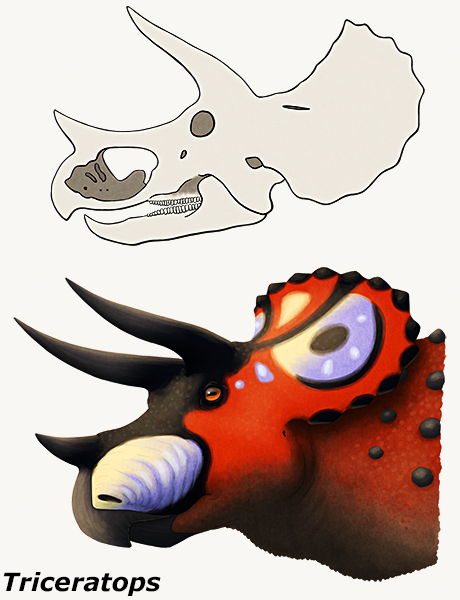
Triceratops horridus skull and head reconstruction
Many ceratopsids had an enormous nasal opening forming a giant bony “window” through their snout, with the chasmosaurines like the famous Triceratops having additional bony projections and hollowed regions within these holes. They probably supported some huge elaborate cartilage structures in life, but what they were for is still a mystery. They may have helped with heat dissipation or moisture conservation, aided sound production, provided a highly sensitive sense of smell, housed a vomeronasal organ, held part of an air-filled pneumatic system… or, getting more speculative, possibly even some sort of inflatable nasal display structure.
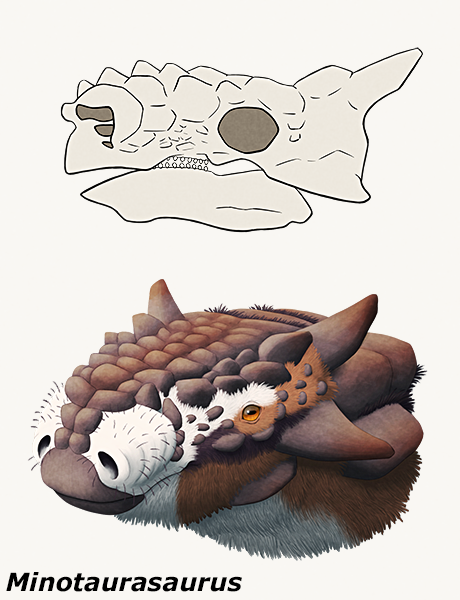
Minotaurasaurus ramachandrani skull and head reconstruction
Some ankylosaurids, meanwhile, went with multiple holes instead. Minotaurasaurus here had two additional openings around its nostrils, and Pinacosaurus could have up to five – the purpose of which is unknown. Many ankylosaurs also had forward-facing nostrils (a rare trait in archosaurs) and incredibly complex looping airways through their skulls. These may have allowed for mammal-like “air conditioning”, regulating the heat and moisture content of each breath, or perhaps enhanced their sense of smell or served some sort of resonance chamber function. Or, again, maybe even nose balloons.