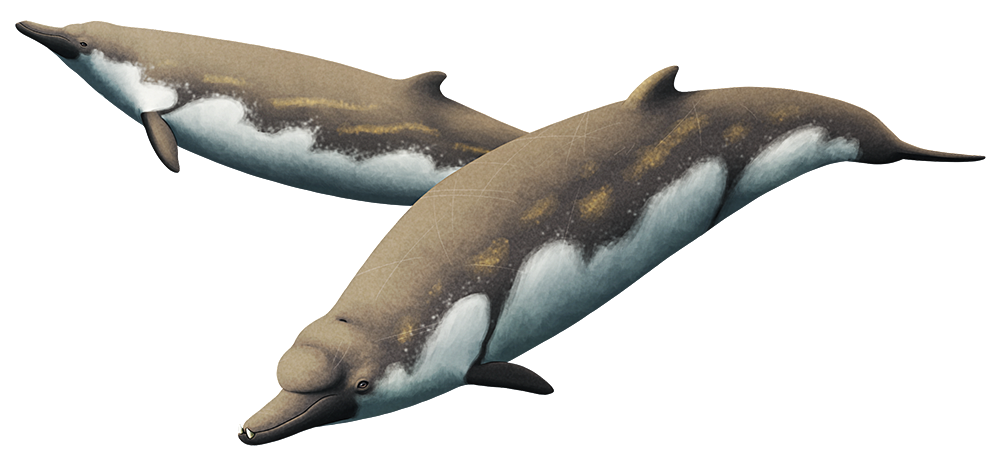
Beneziphius cetariensis was an early beaked whale that lived off the coast of what is now the northwest Iberian peninsula.
It’s only known from a partial skull that was fished up by bottom trawling nets from the seafloor, so its exact age isn’t known, but based on related species it’s estimated to date to somewhere between the mid-Miocene and early Pliocene, around 13-5 million years ago.
About 4m long (~13′), it had a fairly short narrow snout and was functionally toothless, with evidence of only small vestigial teeth that would have been fully embedded in its gums. Males of this species probably had a pair of tusk-like “battle teeth” at the tip of their lower jaw, similar to some other beaked whales, which would have been used in fights against each other.
The back of Beneziphius’ skull was also proportionally tall, and although not as elaborate as some other fossil species this may still have functioned like “internal antlers” — display structures visible only via echolocation.
Continue reading “Beneziphius”