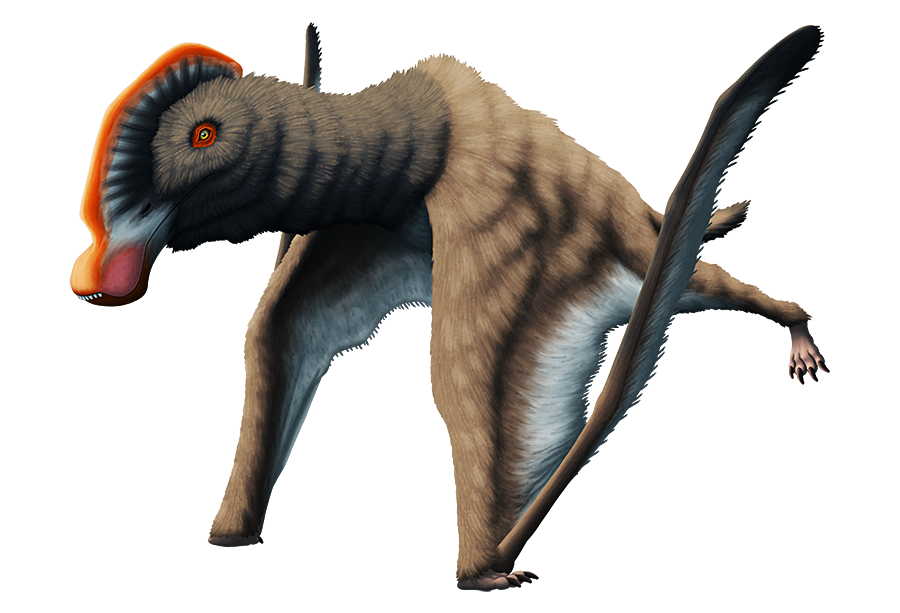
Cycnorhamphus

Cycnorhamphus suevicus, a pterosaur from the Late Jurassic of Germany and France (~150-145 mya).

It had a wingspan of about 1.3m (4′3″), and was originally thought to look similar to Pterodactylus with long straight jaws – but a well-preserved fossil nicknamed “the Painten Pelican” revealed its snout was actually much more oddly-shaped.

“Painten Pelican mount” by Mike Steele | CC BY 2.0 | cropped from original

It turns out Cycnorhamphus’s jaws arced outwards, creating an opening that seems to have become more pronounced as individuals reached adulthood. Soft-tissue impressions in the fossil also show some sort of stiff “flanges” on each side of the upper jaws, covering the gap and giving it a sort of bulldog-like appearance.

The function of this jaw structure is unknown for certain, but it’s been speculated to be a specialization for cracking open hard-shelled prey like molluscs.

Ikrandraco

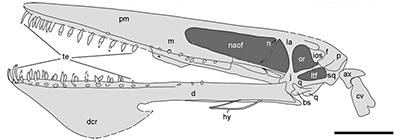
Ikrandraco avatar, a pterosaur from the Early Cretaceous of China (~120 mya). Although it was close relative of the well-known Pteranodon it was much smaller, with an estimated wingspan of around 1.5m (4′11) – similar in size to a large seagull.

Its name was based on the fictional ikran creatures from the 2009 movie Avatar, in reference to similarity of the the large crests on their lower jaws.

Ikrandraco’s skull (scale bar = 5cm)
[image source]

A hook-shaped projection at the back of the crest may have been an attachment point for a pelican-like throat pouch. The paleontologists who described Ikrandraco also suggested that its crest could have been used for skim-feeding, although this is a highly controversial idea among pterosaur specialists.