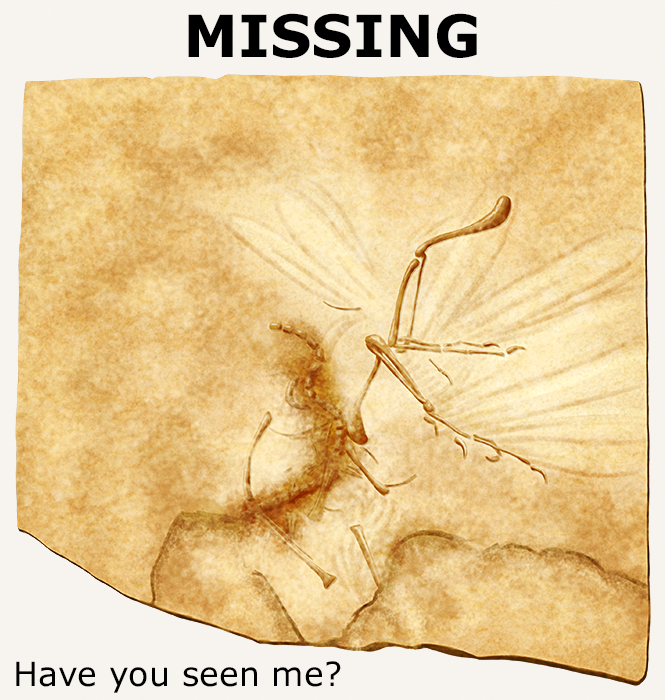
Unsolved Paleo Mysteries Month #13 – The Case of the Absent Archaeopteryx

One of the most famous of all fossil organisms, and a classic example of a transitional form, Archaeopteryx is currently known from 12 body fossil specimens.

Except one of them is missing.

The Maxberg specimen was part of the private collection of Eduard Opitsch, the owner of the Bavarian quarry where it was originally discovered in 1956. Despite being partially disintegrated, and missing its head and tail, it was still an immensely important discovery – at the time, it was only the third recognized Archaeopteryx ever found.

After briefly attempting to sell the new Archaeopteryx, Opitsch eventually allowed it to be held at the local Maxberg Museum. In 1974 he permitted casts to be made from it – but then suddenly removed it from public display and refused all further requests to access or study it.

(This may have been a reaction to the 1973 announcement of the more complete Eichstätt specimen. Opitsch, who was described as having “a difficult personality”, became increasingly defensive about the fossil, seeming to feel this new discovery was getting more attention and was deliberately devaluing his own.)

From then on the Maxberg specimen was lost to science.

When Opitsch died in 1991 his heir attempted to locate the fossil – it was rumored to be kept under his bed – but it was nowhere to be found. There’s some speculation that he was buried with it, literally taking his prized Archaeopteryx to the grave as a final act of spite. Another possibility is that it was stolen and sold in secret, perhaps to this day hidden away in a wealthy owner’s private collection.

It’s been missing for over 25 years, but there’s still lingering hope that the missing Maxberg specimen will one day resurface.

For now, though, all we have left are a few casts, photographs, and x-rays.
Unsolved Paleo Mysteries Month #04 – Who’s That Theropod?

In the early 1970s an opalized dinosaur leg bone in a South Australian gem shop came to the attention of paleontologist Neville Pledge. The specimen’s owner allowed it to be borrowed and studied, and it was eventually named as Kakuru kujaniKakuru after the Rainbow Serpent of Australian Aboriginal mythology, and kujani after a variant spelling of the Guyani, the local indigenous people. Later the fossil was auctioned off to another private owner and lost to science for nearly 30 years, until finally being acquired by the South Australian Museum in 2004.

But all we really know about Kakuru is that it was some sort of theropod dinosaur. The 33cm (1′) tibia probably belonged to an animal up to about 2m long (6′6″), living during the Early Cretaceous (~125-112 mya), but any placement in a specific group is almost impossible. Based on particular features of the bone – such as a tall and narrow astragalar process – it’s been proposed to be either an oviraptorosaur or an abelisaur. But more recent examinations have concluded the bone’s preservation is too poor for those features to be confidently identified, and consider Kakuru to be a basal coelurosaur or even just a dubious name for an indeterminate theropod.

It’s all a bit of a mess, really, and more and better material is needed to clear up this mysterious dinosaur’s identity.

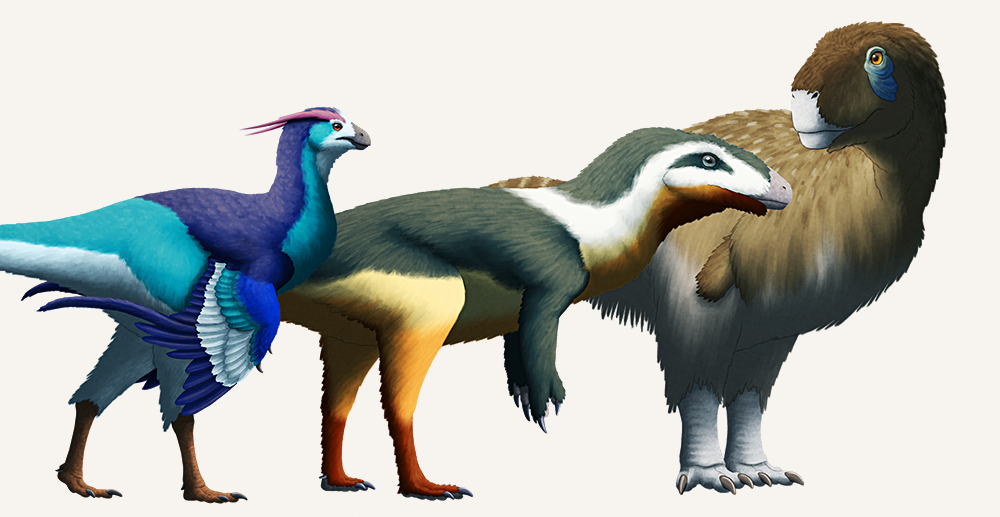
I’ve restored Kakuru here in three different ways, to illustrate just how varied the interpretations are – on the left, an early oviraptorosaur; in the middle, a generic coelurosaur; and on the right, an abelisaur.

(Yes, the abelisaur is fluffy. South Australia was within the Antarctic Circle during the Early Cretaceous, and while the climate there wasn’t as cold as it is today it was still chilly enough for some floofy insulation to be useful.)