Bataspis

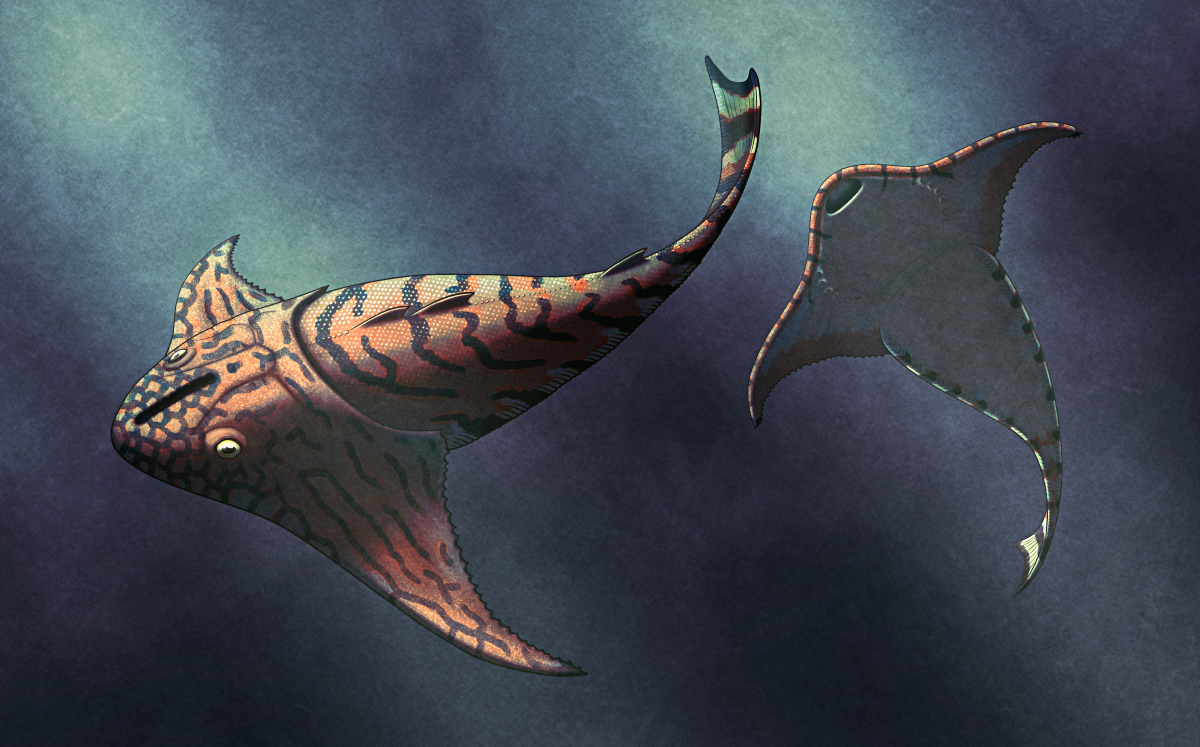
Bataspis crux was an armored jawless fish that lived during the early Devonian, around 419 million years ago, in coastal marine waters covering what is now southwestern China.

It was a member of the galeaspids, a group characterized by massive headshields covered in a pattern of sensory canals, with a large opening on the front top surface between the eyes. While this hole often looked like a comical mouth, it was actually a single nostril that took in water for the gills, while the real mouth was located on the animal’s underside.

Galeaspids also had scaly bodies with three dorsal fins, a tail fin, and long low ribbon-like fins along the sides that may have been the precursors to paired fins in jawed fish.

Bataspis’ headshield was unusually shaped compared to its relatives, with sweeping side projections forming a distinct “batwing”. Hydrodynamic simulations indicate that it functioned as a hydrofoil, generating lift while swimming and making Bataspis an efficient underwater glider — and suggesting that galeaspids were much more ecologically diverse than previously thought.

Continue reading “Bataspis”
Tridensaspis

Although the only surviving agnathans in modern times are the lampreys and hagfish, back in the early-to-mid-Paleozoic these “jawless fish” were much more diverse. Many of them were heavily armored with large bony head shields – a feature eventually inherited by early jawed fish like the placoderms – which protected their heads, gills, and some of their internal organs.

And some of the oddest-looking of these armored agnathans was a lineage known as the galeaspids.

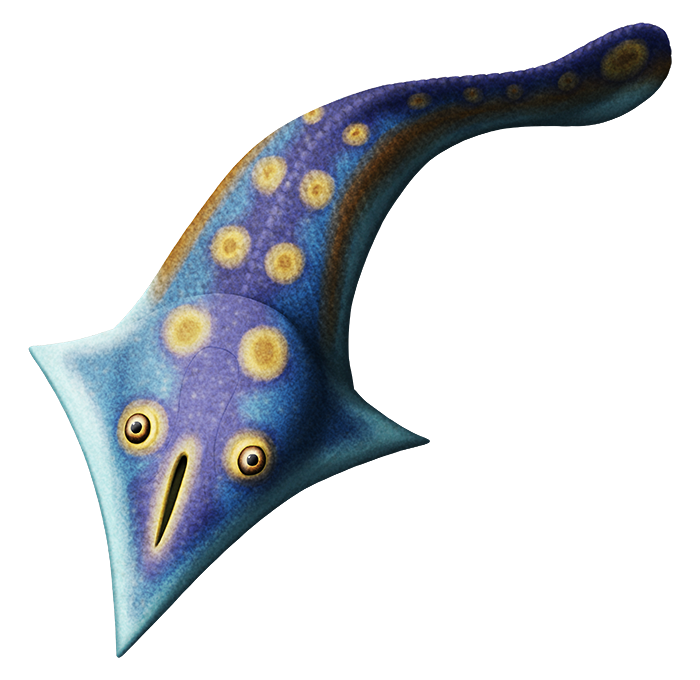
Known from southern China, Tibet, and Vietnam, these small fish were bottom-dwellers living in the shallow waters of lagoons and river deltas. Their most distinctive feature was a single large opening on the upper side of their head shields – and despite looking like a particularly goofy mouth this hole was actually a nostril, used for both a sense of smell and as a water intake for their gills. The actual mouth and the gill openings were on the underside of the head.

While early galeaspids had rounded head shields, later forms developed some more unusual shapes, with long spines sticking out to each side and pointed or spatula-shaped snouts.

Tridensaspis magnoculus here lived during the early Devonian in Southwest China, about 407-393 million years ago, and was only about 5cm long (2″). It wasn’t the most extremely pointy of its kind, but still had a weird kite-shaped head shield, a long vertical slit-shaped nostril opening, and rather large upwards-facing eyes.