
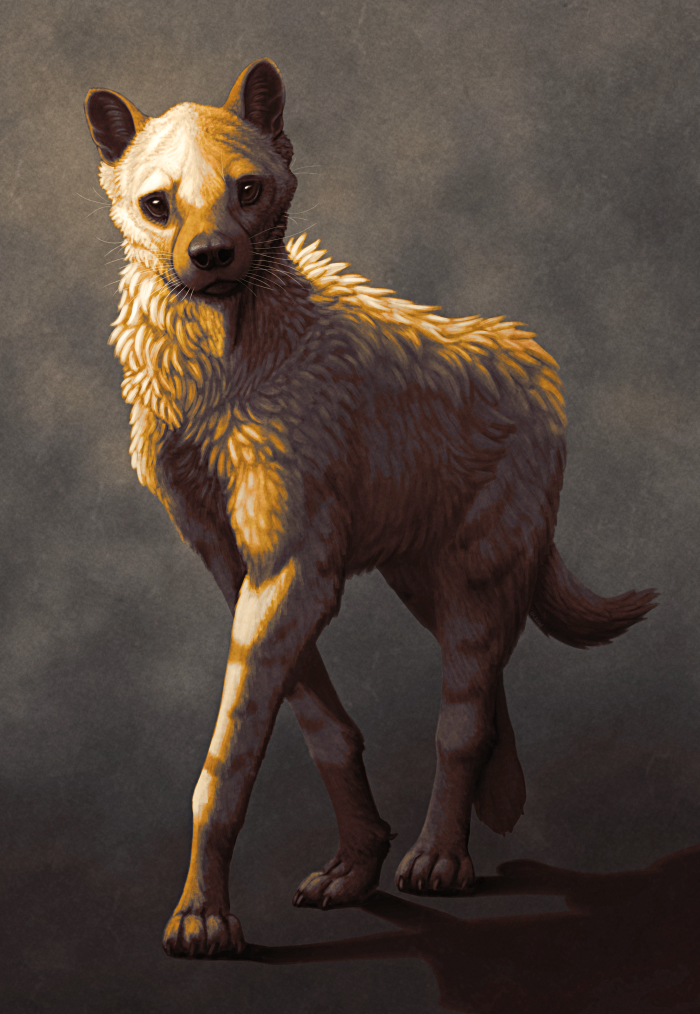
Ictitherium ebu* was a hyena that lived in what is now Kenya during the late Miocene and early Pliocene, around 7-5 million years ago. It was part of an early branch of the hyaenids known as ictitheres, dog-like hyenas found across Miocene Africa and Eurasia that occupied similar ecological niches to modern canids.
(*alternatively classified as Hyaenictitherium ebu by some studies)
It was similar in size to the modern aardwolf, standing about 50cm tall at the shoulder (~1’8″) – but it had proportionally longer legs, giving it a build convergently similar to the present-day maned wolf. Despite these long limbs it wasn’t a fast runner, with its joint anatomy instead suggesting it was adapted for efficient walking, pouncing on prey, and looking over the tall grasses of its savanna woodland habitat.
References:
- Kargopoulos, Nikolaos, et al. “The last of Europe: systematics and palaeoecology of the ictitheres (Hyaenidae) from Venta del Moro (Spain).” Journal of Mammalian Evolution 32.4 (2025): 43. https://doi.org/10.1007/s10914-025-09780-5
- Semenov, Yuriy. “Taxonomical reappraisal of “ictitheres” (Mammalia, Carnivora) from the Late Miocene of Kenya.” Comptes Rendus Palevol 7.8 (2008): 529-539. https://doi.org/10.1016/j.crpv.2008.09.012
- van der Hoek, Julien, and Lars Werdelin. “A hyaena on stilts: comparison of the limb morphology of Ictitherium ebu (Mammalia: Hyaenidae) from the Late Miocene of Lothagam, Turkana Basin, Kenya with extant Canidae and Hyaenidae.” PeerJ 12 (2024): e17405. https://doi.org/10.7717/peerj.17405
- Werdelin, Lars. “Mio-pliocene carnivora from Lothagam, Kenya.” Lothagam: The Dawn of Humanity in Eastern Africa. Columbia University Press, New York (2003): 261-328. https://doi.org/10.7312/leak11870
- Wikipedia contributors. “Ictitherium” Wikipedia, 18 May 2026, https://en.wikipedia.org/wiki/Ictitherium