Cambrian Explosion Month #07: Phylum Cnidaria – The Weird Ones

Odd shell-like structures that resemble angular ribbed cones with four-way symmetry appear in the fossil record starting around the mid-to-late Cambrian (with a possible Ediacaran record).

Known as conulariids, these fossils are so distinctive and different from anything else that for a long time their evolutionary affinities were unknown, and they were considered to be a “problematic” group. But in recent years they’ve been identified as being cnidarians, generally thought to be close relatives of modern stalked jellyfish.

Continue reading “Cambrian Explosion Month #07: Phylum Cnidaria – The Weird Ones”

Cambrian Explosion Month #06: Phylum Cnidaria – Medusozoa

 The medusozoans are a group of cnidarians that includes modern true jellyfish, box jellyfish, stalked jellyfish, hydrozoans, and the weird fish egg parasite Polypodium.

Due to their soft gelatinous bodies their fossil record is very sparse. While vague fossilized blobs tend get interpreted as jellyfish fairly often, many of them turn out to be trace fossils or inorganic structures, and definite preserved medusae are only found in a few sites of exceptional preservation.


Among those rare examples of fossil jellies there are some amazingly well-preserved specimens known from the mid-Cambrian, discovered in the Marjum Formation in Utah, USA (~505 million years ago).

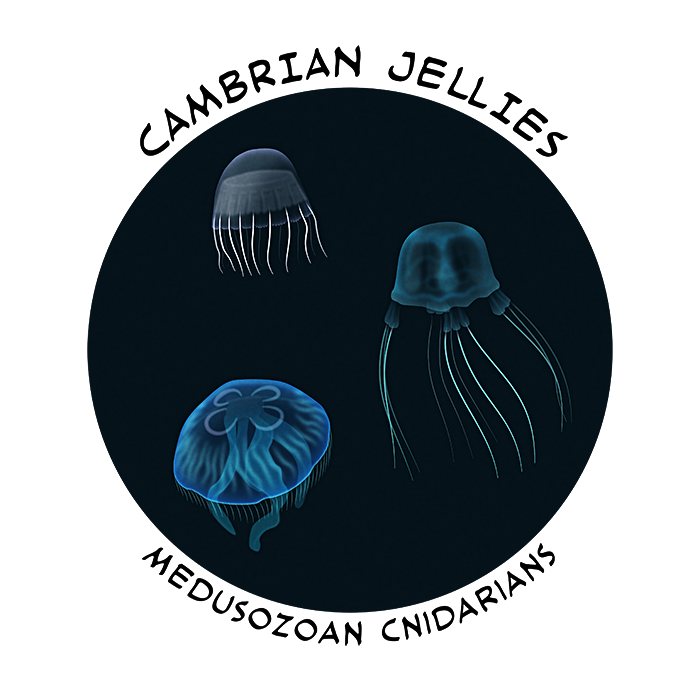
Cambrian Narcomedusae, Cubozoa, and Semaeostomeae

None of these species have been given their own names, and they’re all tiny, only around 1cm in diameter (0.4″). But their anatomy is still preserved in enough detail to tentatively classify them into known lineages, including the box jelly, narcomedusan, and semaeostomean shown here.

Much larger Cambrian jellyfish have been also found in Death Valley, California, and in Wisconscin, representing preserved mass stranding events on ancient shorelines. Some of these jellies were up to about 50cm in diameter (20″), indicating that large soft-bodied animals were much more common in Cambrian seas than previously thought.

Cambrian Explosion Month #05: Phylum Cnidaria – Anthozoa

Cnidarians are a diverse group that includes modern corals, sea anemones, sea pens, jellyfish, hydra, and even some parasitic forms. They’re the closest relatives of bilaterians in the animal evolutionary tree, and their ancestry goes back at least 560 million years into the Ediacaran Period, with the polyp-like Haootia being one of the earliest definite cnidarian fossils – and molecular clock estimates suggest the group might have actually originated much much earlier than that, possibly as much as 740 million years ago.

The anthozoan lineage of cnidarians (corals, anemones, and sea pens) spend their adult lives as polyps attached to the seafloor, either solitary or colonial, and since many lineages have hard calcium carbonate skeletons their fossil record is generally much better than that of the soft-bodied medusozoan jellyfish.

While corals are major contributors to reef ecosystems in modern times, back during the Cambrian they were actually rather rare. The weird little archaeocyathan sponges were the main reef-builders in the early-to-mid Cambrian, and after their decline reefs were mainly formed by algae and other types of sponges.

But, sometimes, growing among these reefs were also some tiny Cambrian corals.

Continue reading “Cambrian Explosion Month #05: Phylum Cnidaria – Anthozoa”

Cambrian Explosion Month #04: Phylum Ctenophora (And Petalonamae?)

Much like the sponges, the ctenophores (commonly known as “comb jellies”), are one of the oldest animal lineages, but their exact position in the evolutionary family tree is a little uncertain. Traditionally they’re placed between sponges and all other animals, as the earliest branch of the eumetazoans, but some studies have suggested that they might be much more ancient, possibly branching off before even the sponges did.

And while their fossil record is poor due to their soft gelatinous bodies, some of what we do have is starting to hint that their ancestry was very different from their modern jellyfish-like representatives – and they might even have links to some weird Precambrian creatures.

Continue reading “Cambrian Explosion Month #04: Phylum Ctenophora (And Petalonamae?)”

Cambrian Explosion Month #03: Phylum …Porifera?

Sponges were major reef builders during the Cambrian Explosion, and for the first half of the Cambrian Period the dominant reef-forming group were the bizarre archaeocyathans.

Although their reign was geologically short, lasting only about 15 million years, these tiny calcified sponges were incredibly numerous and diverse during that time, with hundreds of different species known from warm shallow marine waters all around the world. They came in a huge range of shapes, including cups, cones, funnels, towers, and irregular blobs, and were so weird that they weren’t even properly recognized as being sponges until the 1990s.

Continue reading “Cambrian Explosion Month #03: Phylum …Porifera?”

Cambrian Explosion Month #02: Phylum Porifera

Sponges are one of the very oldest branches of the animal family tree, originating sometime in the Proterozoic Eon. Fossils are known from at least 600 million years ago, and their ancestry probably goes back even further back than that into the Cryogenian Period or late Tonian Period, at least 750 million years ago.

So it’s not especially surprising that sponges were already common and highly diverse in the Cambrian, with representatives of the major modern groups all present – demosponges, glass sponges, and calcareous sponges.

Continue reading “Cambrian Explosion Month #02: Phylum Porifera”

Spectember Epilogue

Now that Spectember has wrapped up, and I’m catching my breath before we return to the regular paleo-theming of this blog, a couple extra notes:

Anyone who suggested a concept during the original submission period back in May, but didn’t see it get used this month – don’t worry! I got far more entries than I could possibly fit into the schedule (almost a hundred), and they were all wonderfully creative ideas, so I’m going to try to do something with them at a later date.

(Everyone else, please be aware I’m not currently accepting extra specevo suggestions. While I appreciate all the enthusiasm I can’t take on even more work right now.)

Also, here’s a few other neat specevo things that I didn’t have time to go into detail about this month:

Continue reading “Spectember Epilogue”

Spectember #22: Land Dolphins 2 – The Beakening

And so we finish Spectember as we started… with ridiculous land dolphins!

Transcript for the text on the image under the cut:

Continue reading “Spectember #22: Land Dolphins 2 – The Beakening”