Unsolved Paleo Mysteries Month #04 – Who’s That Theropod?

In the early 1970s an opalized dinosaur leg bone in a South Australian gem shop came to the attention of paleontologist Neville Pledge. The specimen’s owner allowed it to be borrowed and studied, and it was eventually named as Kakuru kujaniKakuru after the Rainbow Serpent of Australian Aboriginal mythology, and kujani after a variant spelling of the Guyani, the local indigenous people. Later the fossil was auctioned off to another private owner and lost to science for nearly 30 years, until finally being acquired by the South Australian Museum in 2004.

But all we really know about Kakuru is that it was some sort of theropod dinosaur. The 33cm (1′) tibia probably belonged to an animal up to about 2m long (6′6″), living during the Early Cretaceous (~125-112 mya), but any placement in a specific group is almost impossible. Based on particular features of the bone – such as a tall and narrow astragalar process – it’s been proposed to be either an oviraptorosaur or an abelisaur. But more recent examinations have concluded the bone’s preservation is too poor for those features to be confidently identified, and consider Kakuru to be a basal coelurosaur or even just a dubious name for an indeterminate theropod.

It’s all a bit of a mess, really, and more and better material is needed to clear up this mysterious dinosaur’s identity.

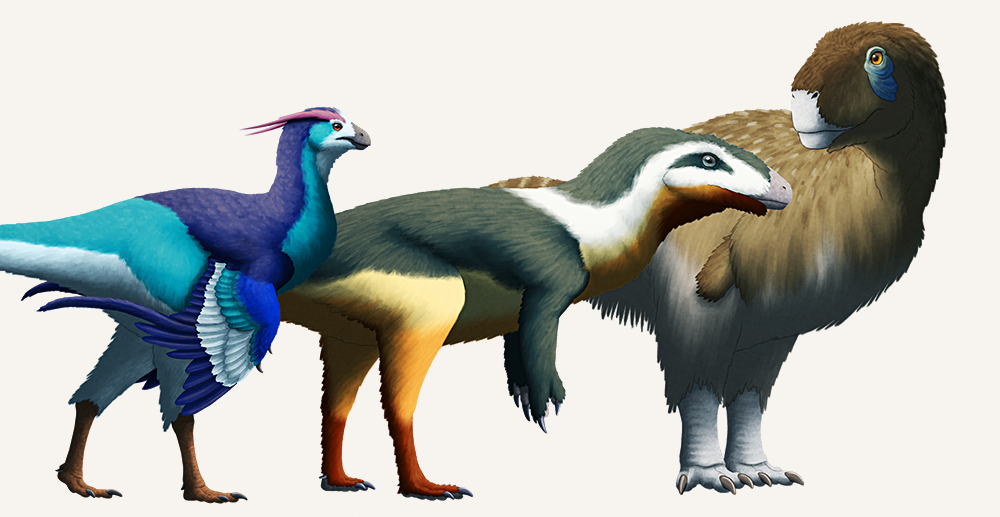
I’ve restored Kakuru here in three different ways, to illustrate just how varied the interpretations are – on the left, an early oviraptorosaur; in the middle, a generic coelurosaur; and on the right, an abelisaur.

(Yes, the abelisaur is fluffy. South Australia was within the Antarctic Circle during the Early Cretaceous, and while the climate there wasn’t as cold as it is today it was still chilly enough for some floofy insulation to be useful.)
Unsolved Paleo Mysteries Month #03 – Ammonite Anatomy

Ammonites (or “ammonoids” in technical terms) are one of the most recognizable types of fossil, found in such high abundance that they’re frequently used to precisely date rock layers. They’re absolutely everywhere in fossil collections, and are even made into jewelry.

So we must already know everything we possibly could about them, right?

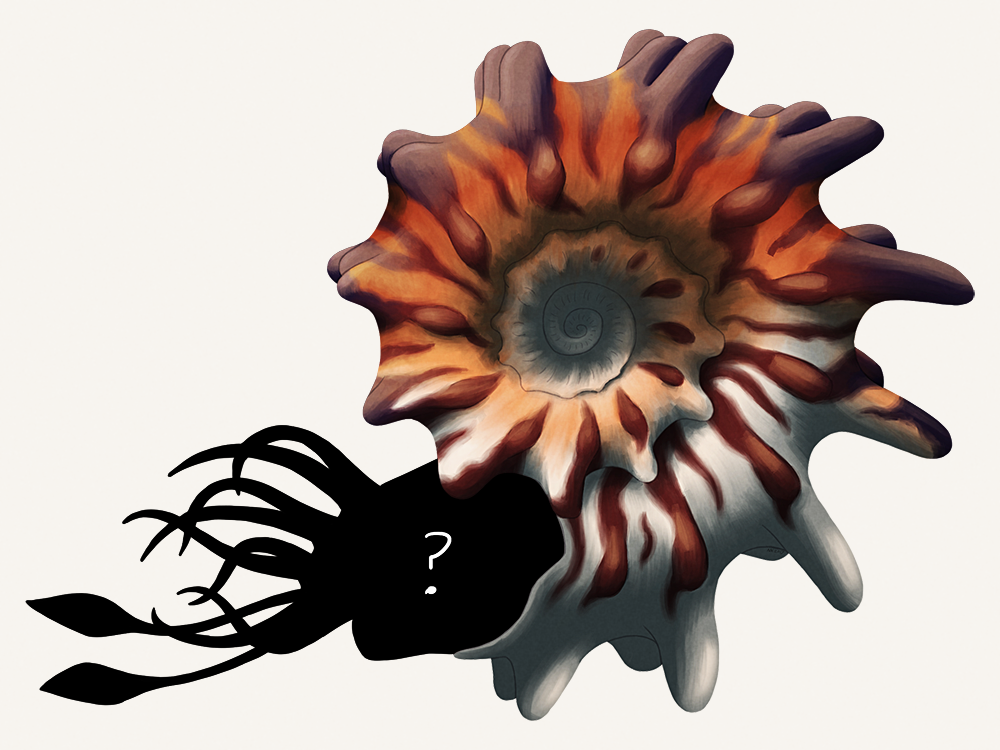
Except… we really don’t know what their soft parts looked like.

The fossil record for ammonite soft tissue is surprisingly empty for a group that existed for over 300 million years. A possible ink sac and a few organs have been found, but nothing else.

Based on their other cephalopod relatives, they probably had at least ten arms (the two longer tentacles shown on this Collignoniceras are a little speculative), along with a siphon for propulsion – but until we find that elusive exceptional preservation we just don’t know for sure.

[Edit: As of 2022, a few more traces of soft tissue have been found!]

Unsolved Paleo Mysteries Month #02 – The Paleodictyon Problem

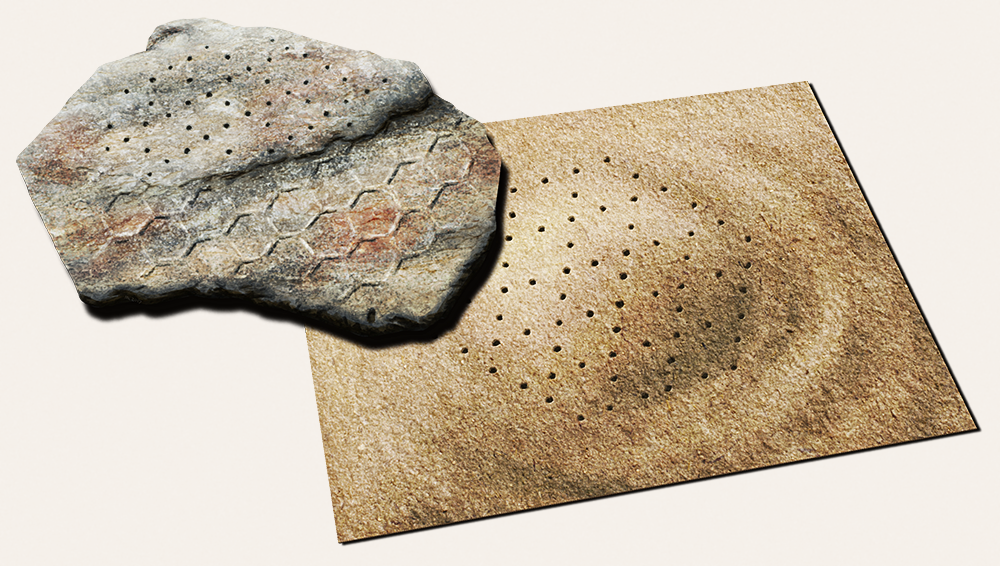
Paleodictyon is the name for a net-like pattern found in the marine fossil record, starting in the Late Precambrian/Early Cambrian (~541 mya). Formed from thin tubes in seafloor sediment, each element of the mesh is around 1-3cm in diameter (0.4-1.1″), with entire networks covering areas of up to a square meter (10.7ft²). Some forms also have vertical tubes connecting the mesh to the surface.

And nobody knows what it is.

These patterns have even been found on the modern day seafloor at mid-ocean ridges. Samples have been taken, DNA tests have been performed… and nothing conclusive has yet been found.

Whatever makes these patterns is alive today, but we still don’t know what it is!

There are two main hypotheses about the mysterious identity of the mesh-maker. It might be some sort of small worm-like animal excavating burrows, engineering water flow through the tubes to collect food. Or the whole mesh might be the body imprint of a single creature – either a sponge or a giant foraminiferan.

Hopefully one day somebody will finally catch the Paleodictyon culprit in the act.

Unsolved Paleo Mysteries #01

Welcome to Unsolved Paleo Mysteries Month!

There’s a lot of things we now know about the distant past that seemed impossible only a few decades ago – discovering the colors of fossilized animals, fragments of collagen in dinosaur bones, and even finding near-complete remains of previously enigmatic animals like Deinocheirus.

But there’s also still a lot of things we don’t know. The fossil record is spotty and very incomplete, and even as we answer some questions others remain frustratingly unanswered.

So, every weekday during March I’ll be featuring a different paleontological mystery. Starting with…


Ptransitional Pterosaurs

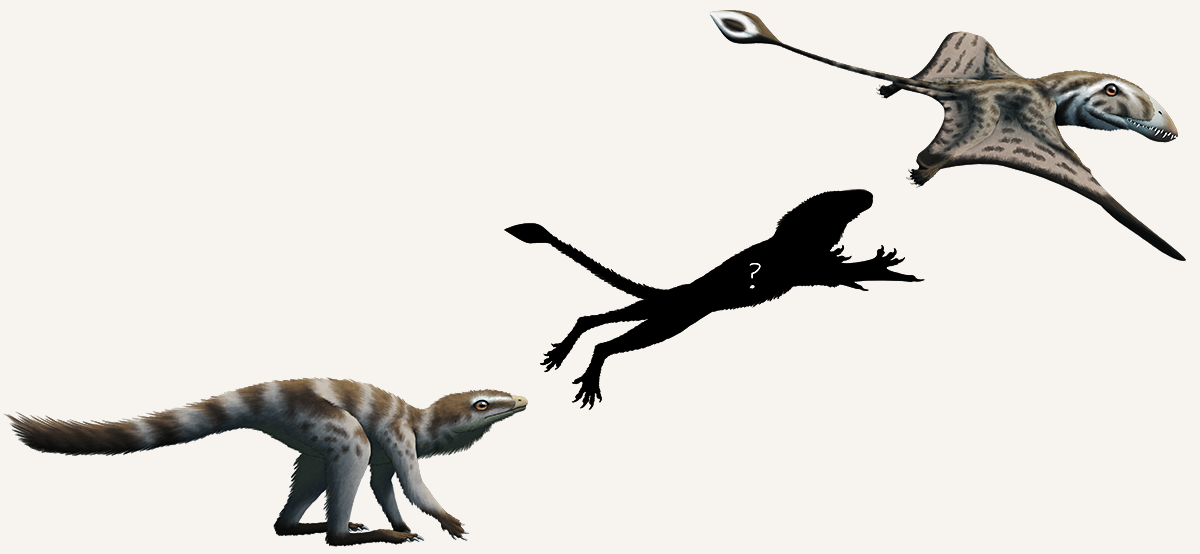
We don’t really know where pterosaurs came from.

They appeared suddenly in the Late Triassic (~228 mya) with their anatomy already fully adapted for flight, and there are no traces of transitional forms before that point.

We at least know they were members of the archosaurs, and the sister group to dinosaurs, and their closest known relative seems to have been a small hopping creature named Scleromochlus. The complete lack of any other potential ancestors suggests that proto-pterosaurs must have evolved incredibly rapidly in an environment that just didn’t favor fossilizing their tiny fragile remains.

We might get lucky one day and finally find a pterosaur equivalent of Archaeopteryx, but for now all we have are hypothetical ideas of what such animals might have looked like.