
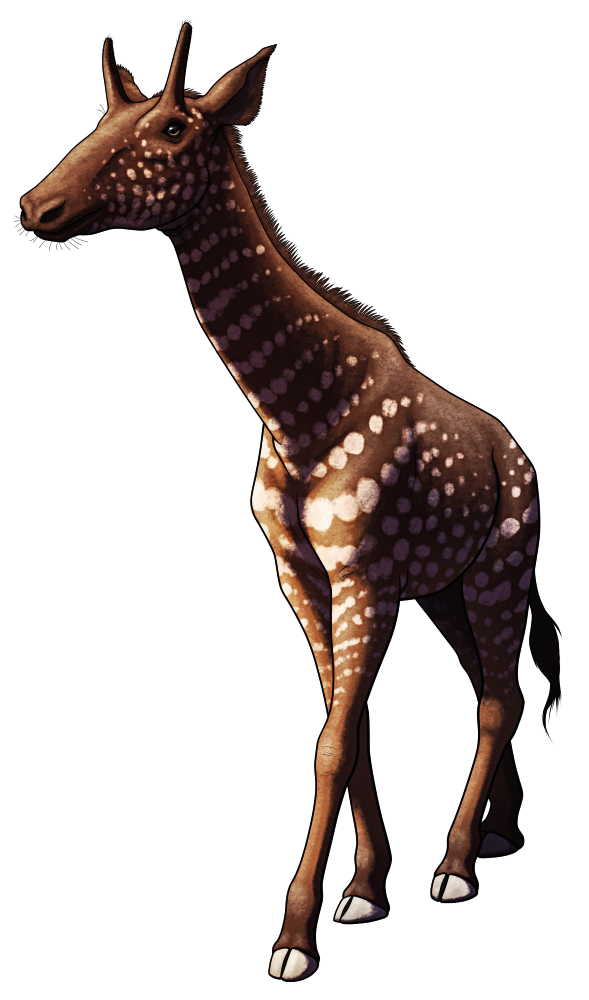
Have you ever seen half a giraffe?
Samotherium boissieri was a giraffid that lived from the mid-Miocene to early Pliocene, about 12-5 million years ago, ranging across what is now Southeastern Europe, North Africa, and the Middle East.
Standing 2.3m tall at the shoulder (~7’6″), and with a total height of around 3-3.5m (9’10”-11’6″), it had long pointed ossicones and a neck that was halfway in both length and bone anatomy between those of its modern relatives the okapi and giraffe.
(But it wasn’t a direct ancestor of modern giraffes, instead being an offshoot of the okapi lineage and most closely related to sivatheres.)
The shape of its snout and microwear on its teeth suggest that it was a seasonal mixed feeder, varying its diet between grazing and browsing at different times of year.
It would have also lived alongside another slightly larger species in the same genus, Samotherium major — but the two appear to have been ecologically partitioned, avoiding direct competition by each preferring slightly different habitats and diets. S. boissieri inhabited more open grasslands, while S. major lived in mixed woodland-grassland and was more of a grazing specialist.
Continue reading “Samotherium”