Spectember/Spectober 2025 #08: Alphabugs

One last entry for this year!

Dwoll suggested “a family of creatures that have evolved to look like every letter of the Roman/English alphabet”:

A digital sketch of a speculative treehopper bug. It has a large elaborate "helmet" crest on the back of its neck forming a shape that resembles the letter A.

Grafficimex dwolli is a domesticated species of treehopper closely related to the neotropical genus Cladonota.

Its wild ancestor, the now-extinct species Grafficimex ignotus, had an elaborate pronotum “helmet” with a close resemblance to the English letter F. It proved to be surprisingly easy to raise in captivity, being docile around humans and happily using common houseplants such as Monstera as hosts, and it was also quite morphologically variable. Varieties resembling letters such as E, C, and U were quickly developed, and hobbyists began competing to breed more and more new shapes.

Now, after centuries of selective breeding, the English alphabet has been completed, along with a couple of recently-developed breeds with bulbous protrusions that resemble question mark and exclamation mark shapes.

An "alphabet" of speculative Grafficimex treehoppers with crests that resemble the letters from A to Z, along with a pair that resemble a question mark and an exclamation mark.

(Breeds resembling the alphabets of other languages are also in development.)

At about 2cm long (~0.8″), Grafficimex dwolli is rather large for a treehopper, and much like the domestic silk moth it has almost entirely lost the ability to fly.

Along with being kept as novelty pets, often carefully lined up on plant stems to spell out amusing messages, these insects are also quite popular with beekeepers – the honeydew produced by Grafficimex nymphs and adults can be harvested by bees to make dark strong-flavored honeydew honey.

Spectember/Spectober 2025 #07: Kelp Yourself

An anonymous submission asked for a “live bearing bird”:

A digital sketch of a speculative aquatic descendant of moa birds, shown swimming in a kelp forest. It has a small head with a turtle-like beak, a long neck, no wings at all, a streamlined body, and large flipper-like webbed feet. Clumps of long ribbon-like feathers run down its back, vaguely mimicking the appearing of kelp fronds.

Rimurimuornis ovovivipara is a future descendant of the broad-billed moa, in a timeline where these Aotearoan birds weren’t hunted to extinction.

About 2m long (~6’6″), this fully aquatic bird grazes in kelp forests and seagrass meadows. It’s a rather slow swimmer, propelled solely by its large flipper-like feet – because like all moa it completely lacks wings.

Its ancestors’ laid incredibly thin-shelled eggs, and a combination of reducing the hard shell away even further to a more leathery state, then increasing egg retention time inside females’ bodies, has led to this lineage evolving an ovoviviparous form of live birth at sea.

It also has long ribbon-like feathers along its back that mimic the appearance of seaweed fronds. While terrestrial moa have few large predators to worry about, Rimurimuornis has to contend with sharks, orca-like whales, and leopard seal-like pinnipeds, and if its camouflage fails its primary tactic to discourage attacks is defensive defecation.

Spectember/Spectober 2025 #06: A Curiously Charged Choristodere

The Dark Master requested: “Maybe a speculative Placodont or choristoderes. Feel free to do anything, just if they had continued to evolve and survive”

A digital sketch of a speculative descendant of choristodere reptiles. It's an aquatic lizard-like animal with a wide flat head with long narrow jaws, a long neck, four webbed paddle-like limbs, and a long eel-like tail.

In a slightly different timeline to our own, the last surviving choristodere Lazarussuchus didn’t go extinct during the Miocene. Instead it survived in European waterways until the Messinian salinity crisis, and dispersed down into northern Africa when the Strait of Gibraltar closed up.

During one of the “Green Sahara” humid periods its descendants made their way further south, and now Keravnodraco dominusobscuri is found in lakes and rivers throughout the rainforests of West and Central Africa.

About 1m long (3’3″), it hunts small fish and aquatic invertebrates in dark murky waters, using a unique set of electrogenic organs in its elongated neck to actively sense the bioelectric fields of prey in dark murky waters – and also generating electric shocks that can stun its targets or deter predators.

Spectember/Spectober 2025 #05: Strangels

We’re continuing into Spectober with another anonymous request, this one asking for: “Hominids that evolved with 6 limbs, 2 of which are wings. Limb placement is up to you.”

A digital sketch of a speculative six-limbed hominind, pictured in both tree-climbing and gliding poses. It has a monkey-like face with very large eyes, opposable thumbs and first toes, no tail, short fur over its body – and an extra pair of "arms" hanging just behind its shoulders that end in stubby fingerless hands and support a large gliding membrane. In the aerial pose it's shown grabbing hold of its wing-limbs to hold them in place for gliding.

Living several million years in a possible future, Anomalangelus anthropogenis is a bizarre case of a six-limbed primate.

Its additional pair of upper limbs originate from a heritable form of notomelic polymelia, similar to the Developmental Duplications condition seen in our time’s domestic cattle. It has a rather chimeric genome that appears to contain ancestry from several different hominid lineages, suggesting that this strange little creature actually descends from something that was originally genetically engineered.

It’s a tiny dwarfed species, only about 25cm long (~10″), with a highly arboreal omnivorous loris-like lifestyle, spending most of its life clambering around in trees. Although its extra limbs can’t move independently, lacking a lot of functional musculature and nerve connections, they’ve been exapted into brightly-patterned display structures and also serve as attachment for a large gliding membrane – Anomalangelus uses its forelimbs to grab hold of these “wings” while airborne, spreading them out and stabilizing them to form a composite wing.

Spectember/Spectober 2024 #10: Nosey Sea Monkey & Louse Mouse

Okay, let’s finish up this year’s round of speculative evolution concepts with one last post before we get back to normal paleoart content.

(…what do you mean it’s November 3rd? how did that happen?)

Belial Lyka asked for a “marine proboscis monkey with a somewhat buoyant nose”:

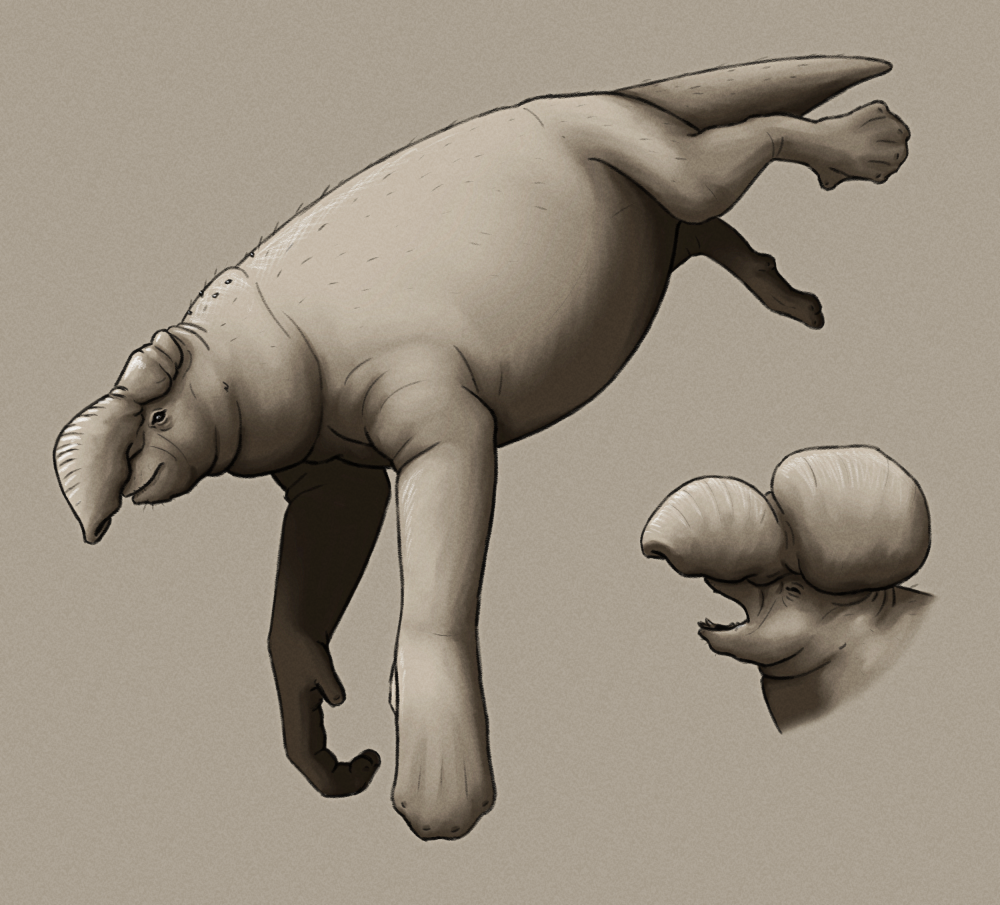
A shaded sketch of a speculative semiaquatic descendant of proboscis monkeys. It has a large trunk-like nose, a fat body, long arms ending in flipper-like hands, short legs with webbed feet, and a short thick tail. A second image shows its head with its nose inflated into a balloon-like display structure.

A descendant of modern proboscis monkeys, Phusarhinus beliallykae is a large semiaquatic primate found in shallow marshy coastal areas of what was once Southeast Asia. Around 4m long (~13′) it has a lifestyle somewhat similar to ancient early sirenians, feeding on soft aquatic plants and hauling out onto land to rest.

Its dense rib bones and long flipper-like grasping forelimbs make it rather front-heavy, allowing it to naturally float with its head and arms hanging down closer to the bottom for energy-efficient foraging. When it needs to resurface to breathe it shunts air from its lungs into its large inflatable nasal sacs, altering its buoyancy enough to tip its head back up towards the surface.

Unlike its ancestors the elaborate nasal structures are found on both males and females – although they’re more brightly colored in males and are also used for visual courtship displays and as resonating chambers for loud booming calls.


And somebody who only gave their name as “bunny” suggested a “parasitic rodent”:

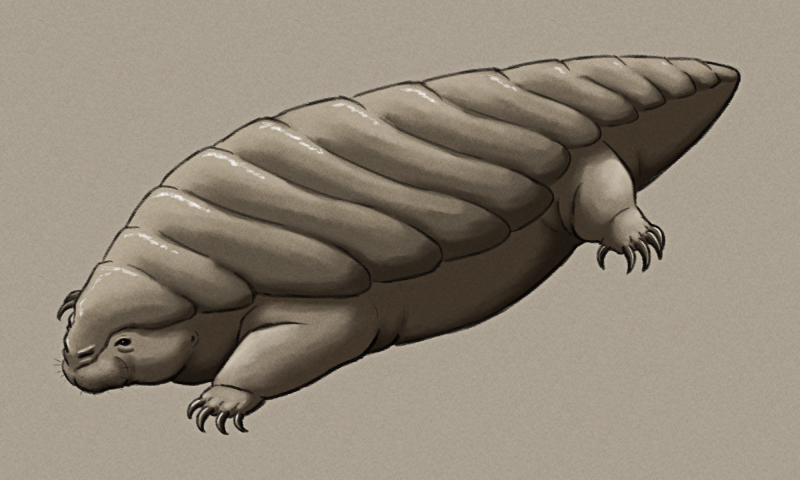
A shaded sketch of a speculative parasitic descendant of semiaquatic rats. It has a wide flattened body with thick armor-like bands running down its back, a small head, stubby limbs tipped with long hooked claws, and a short fat tail.

Sanguichelonamys bunnyi is a highly unusual descendant of a rakali-like semiaquatic rodent that had a symbiotic relationship with early members of the Phusarhinus lineage. The rodents initially just removed algae and external parasites from the bodies of the increasingly bulky aquatic monkeys, but things have recently started to turn more parasitic.

At just 3cm long (~1.2″) Sanguichelonamys is one of the smallest mammals to ever exist, with a wide flattened body and sharp hooked claws used to cling onto its host monkey’s thick skin. Although it still does remove other parasites, during haul-out periods it will also use its sharp incisors to deliberately enlarge the wounds left behind – or even open up new ones – and directly feed on fresh blood from its host.

The thickened keratinous skin along its head and back has a specialized hydrophobic surface that traps a layer of air while underwater, acting as a “rebreather” bubble similar to that of water anoles. Along with the ability to drastically slow down its metabolism and respiration rate, this allows Sanguichelonamys to survive being submerged during its host’s lengthy foraging dives.

Spectember/Spectober 2024 #09: Big Bad Wild Dogs

@poshtearexdoodles asked for “African wild dogs evolved to fill the larger pack animal niche of lions”:

Although in this particular timeline the endangered and fragmented wild painted dogs in Africa didn’t survive far past modern times, that wasn’t the final extinction of the species – captive groups persisted, and after the [REDACTED] of humans an escaped population managed to carve out a niche for themselves in the grasslands of southern North America.

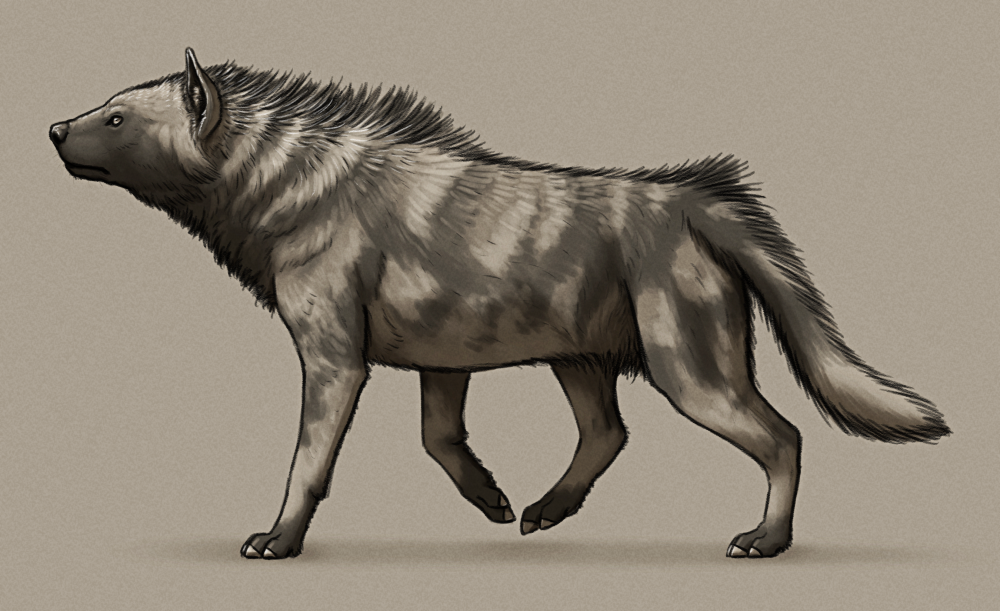
A shaded sketch of a speculative descendant of painted dogs. It's a large wolf-like animal with short thick hyena-like jaws, a mottled shaggy coat of fur, and and small hoof-like nails on its feet.

Their most notable descendant is Megainolycos poshtearexi. At nearly 1m tall at the shoulder (~3’3″) it’s one of the largest canids to ever exist, comparable to present-day lions in size and general ecology, with short thick bone-crushing jaws convergent with those of hyenas.

It also retains the complex variable coat coloration of its ancestors, with each individual having a unique disruptive pattern of black, white, and brown blotches.

Much like its ancestors it’s a highly social pack predator specialized for endurance hunting. Along with some surprisingly horse-like limb ligament morphology, its feet now sport hoof-like nails rather than claws, and it pursues prey over long distances to the point of exhaustion – mainly targeting the larger ungulates across its prairie habitat such as hogs, horses, bovids, and deer.

Spectember/Spectober 2024 #08: Saberatel

Roy (@roygattero) requested “ratel becoming the new african big predator”:

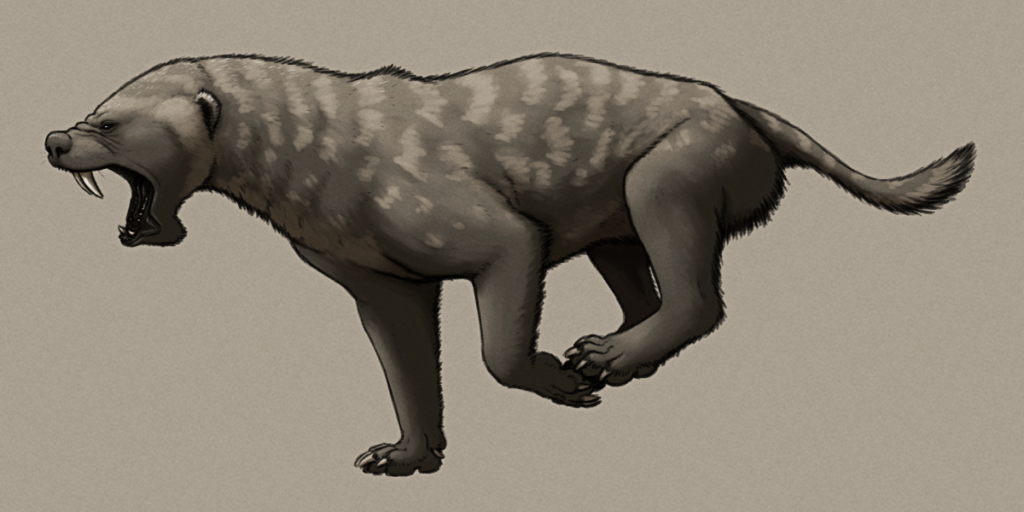
A shaded sketch of a speculative descendant of honey badgers. It's a somewhat cat-like animal with a short snout, long saber-teeth, small ears, semi-digitigrade limbs, a mottled coat, and a short tail.

Perforictis royi is the latest in the long and venerable tradition of various synapsid lineages discovering the ecological niche of “big stabby saber-teeth“.

A descendant of the modern ratel/honey badger, it stands around 80cm tall at the shoulder (~2’8″), and convergently resembles the feline-like build of some of its more ancient relatives. Inhabiting the tropical forests of the rifted-off island continent of East Africa, it’s an ambush predator specializing in tackling larger prey – primarily ungulates and primates, but also occasionally giant rodents and hyraxes.

Usually cooperatively hunting in mated pairs, these mustelids stalk close to their targets before attacking, with one individual focusing on toppling and immobilizing their target while the other positions itself to deliver a swift precision killing bite to the throat with its saber-teeth and powerful neck musculature.

Perforictis scent marks its territory using extremely pungent secretions from its anal pouch rubbed onto vegatation, along with making loud scream-like vocalizations.

Spectember/Spectober 2024 #07: Mole Dino

Today’s spec creature is a combination of a couple of submissions – James P. Quick asked for “a post-K/Pg relict dinosaur from pre-glaciation Antarctica”, and an anonymous asked for “a subterranean (like, say, Talpa or Spalax) burrowing dinosaur”:

At the time of the K/Pg mass extinction some of the small ornithopods that inhabited Late Cretaceous Antarctica had been developing increasingly complex burrowing behavior and a more generalist omnivorous diet than most other ornithischians – and, along with their ability to endure the long dark cold polar winters, this was juuust about enough for them to survive while the rest of their non-avian cohorts vanished.

They were very briefly a fairly successful disaster taxon in the devastated polar forests, but they were quickly displaced by other diversifying survivors and never really got another ecological foothold to regain anything close to the non-avian dinosaurs former glory.

Instead the little ornithopods specialized even further for burrowing, spending more and more of their lives underground to avoid the increasing competition and predation from mammals and birds.

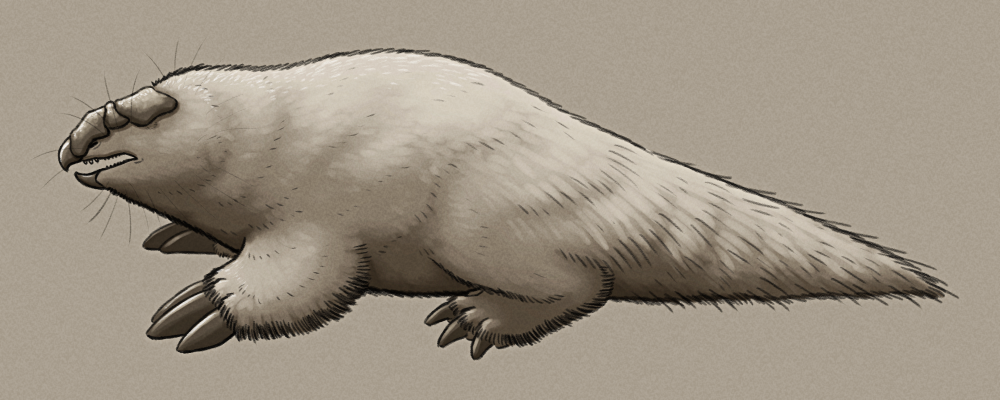
A shaded sketch of a speculative descendant of small ornithopod dinosaurs in Antarctica. It's a fuzzy little mole-like animal with a hoked beak at the tip of its toothy snout, no eyes, a keratinous shield on its head, large shovel-clawed forelimbs, a chunky body, stocky legs, and a fat bristly tail.

Now, well into the Cenozoic at the dawning of the Miocene, Cthonireliqua quicki is the very last representative of the non-avian dinosaurs. Small and stocky and mole-like, just 15cm long (~8″), it has muscular forelimbs with large shovel-like claws, a keratinous shield on its head, and a thick bristly tail where large fat reserves are stored.

Its eyes are almost completely absent, only vestigial remnants present under the skin of its face, and it navigates its extensive burrows using sensitive whisker-like filaments and its keen senses of hearing and smell. Still omnivorous like its ancestors, it feeds on whatever it comes across while tunneling – mainly worms, insects, smaller vertebrates, roots, and tubers.

Unfortunately for Cthonireliqua, and the rest of its Antarctic ecosystem, time is running out. Over the last few million years Antarctica’s climate has been steadily cooling and drying, the continent has become fully isolated, and the Antarctic Circumpolar Current has formed. Glaciation is well underway in the continental interior, and the once-lush forests are shrinking away and being replaced with tundra.

Soon all evidence of these dinosaurs’ existence will be buried under the ice.

Spectember/Spectober 2024 #06: Death Ray

Yeah, I’m keeping this stuff going again for another round of Spectober!

An anonymous request asked for a “big macropredatory ray”:

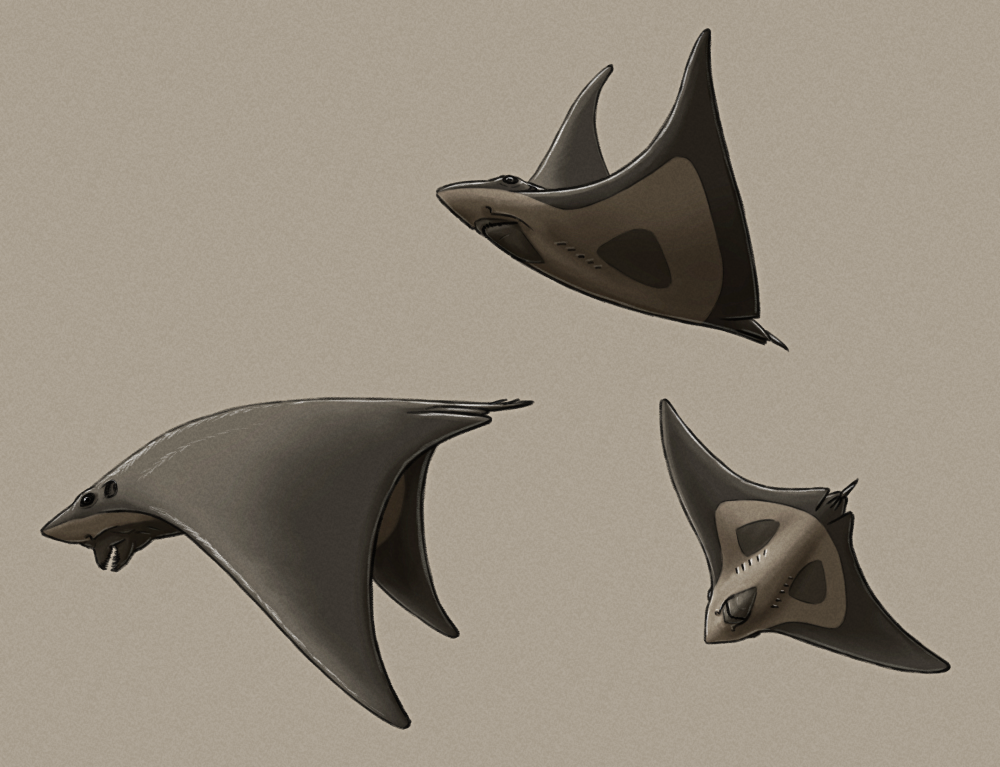
A shaded sketch of the head of a speculative descendant of pelagic stingrays. Its a large ray with triangular wing-like fins, a slightly shark-like pointed snout, protrusible sharp-toothed jaws, and a vaguely skull-like pale marking on its underside.

Speirobatis thanasima is a large ray found in open oceanic waters, reaching sizes comparable to the modern giant manta ray at around 3m in length (~10′) with a wingspan of over 5m (~16’5″).

But despite its body shape closely resembling that of mobulids or myliobatids, its closest present-day relative is actually the pelagic stingray. Already being active hunters with mouths full of sharp pointed teeth, these ancestral rays gradually evolved bigger body sizes and began occupying an apex predator niche similar to that of large sharks and toothed whales.

Speirobatis is a strong swimmer, using flapping motions of its triangular wing-like pectoral fins to travel at high speed and make acrobatic jumps out of the water. Highly intelligent and social, it lives in family groups that hunt cooperatively – encircling and herding schools of fish tightly into bait balls, taking turns stunning prey with slaps of their fins, and then grabbing incapacitated individuals with snaps of their protrusible jaws.

Groups will also tackle larger prey such as marine mammals and sharks, harassing and chasing targets to exhaustion while taking quick opportunistic bites out of them.

Spectember/Spectober 2023 #11: A Large Spider

An anonymous submission requested a “spider the size of a coconut crab”:

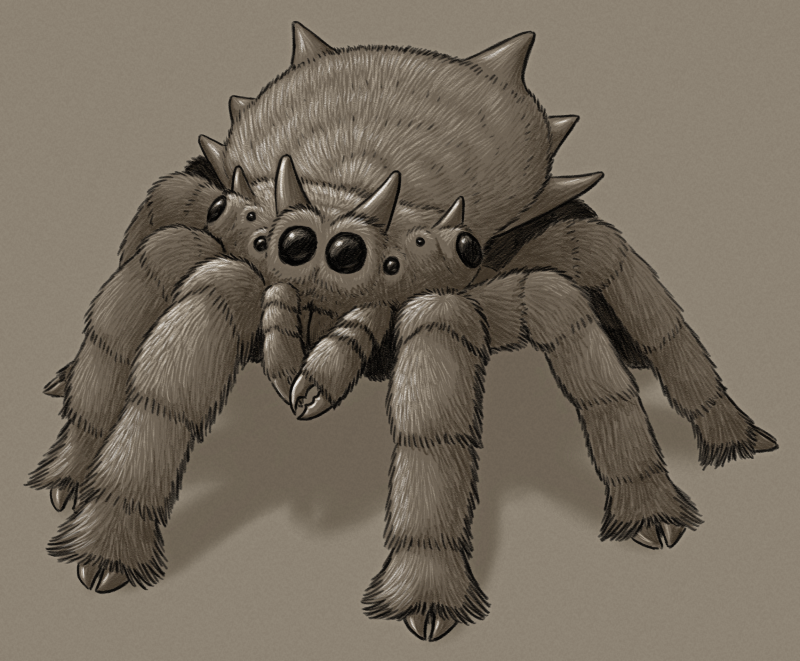
A shaded sketch of a speculative giant herbivorous descendant of jumping spiders. It's a big stocky spider covered in fuzz, with thick legs ending in cloven-hoof-like claws. It has the characteristic large main pair of eyes of jumping spiders, with the other three pairs more spread out around the front and sides of its wide head, and it also has two pairs of "horns". Its abdomen is wide and round, somewhat flattened on the top, with several spiky structures around the edge.

Ceratohispidus aspectus is a distant descendant of jumping spiders living on an Aotearoa-like landmass, isolated with no mammalian predators.

This particular lineage is notable for both their extreme gigantism (with their larger size and weight causing them to lose the ability to jump) and for having taken up herbivory in a similar manner to one modern species. Most of these big plant-eating spiders are around the size of wētāpunga, and occupy a similar ecological niche, but Ceratohispidus is the largest of them by far – rivalling the modern coconut crab with a body length of up to 40cm (~1’4″) and a legspan of almost 1m (~3’3″).

After reaching sexual maturity at 5-10 years old, adults grow very slowly, molting only once every year or two and taking several decades to actually get anywhere close to their maximum size.

Ceratohispidus’ thick legs end in hoof-like claws, and it selectively browses on vegetation by snipping off pieces with its pincer-like palps. A gizzard-like structure in its digestive system helps to grind up fibrous plant material with small gastroliths, and its wide abdomen houses both large book lungs and a tracheal system with air sacs that can contract and expand to provide a small amount of active ventilation.

While the “horns” and spikes ornamenting its body may provide some defense from the few avian and reptilian predators in its habitat, they’re mainly used as part of highly elaborate visual displays between individuals.