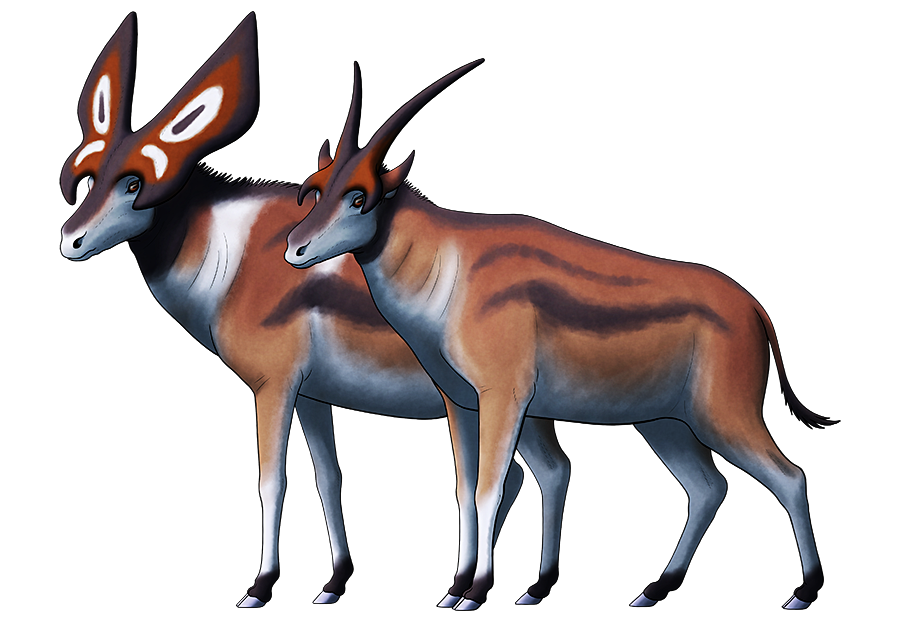
And Prolibytherium was probably the most striking of the lot.
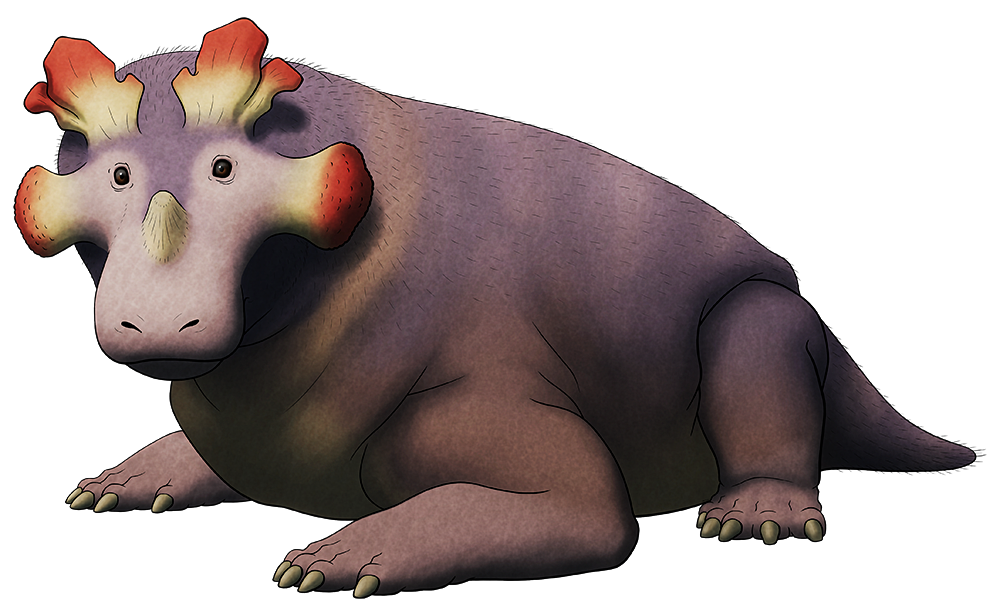
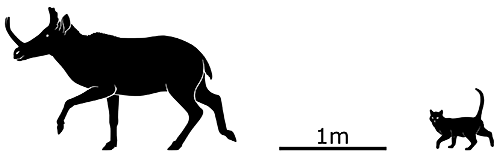
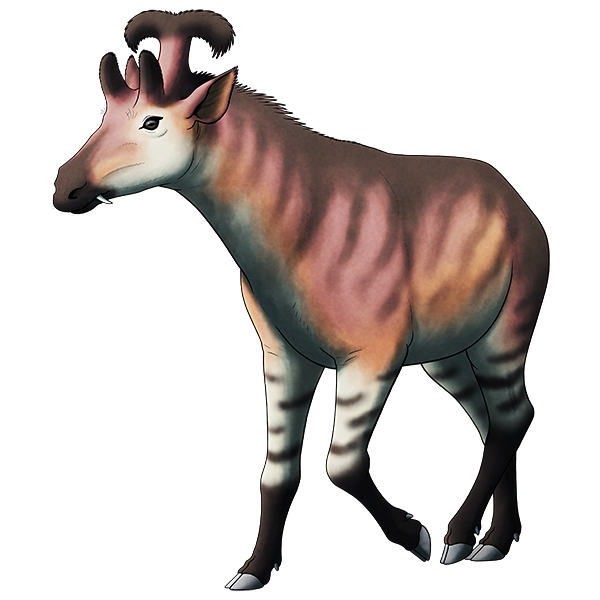
Two different species have been identified, with Prolibytherium magnieri here living in North Africa during the early-to-mid Miocene, about 17-16 million years ago. Its exact evolutionary relationships are uncertain but it was probably part of a group called climacoceratids, deer-like giraffoids which often had thorny branching ossicones that resembled antlers.
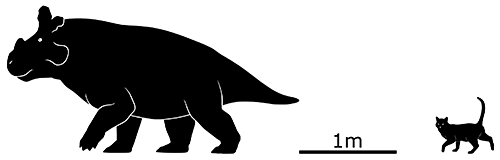
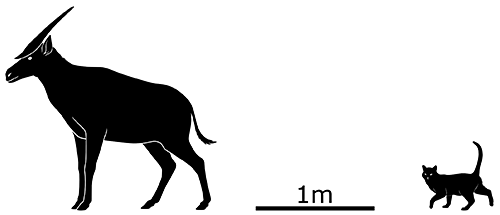
It stood around 1.2m tall at the shoulder (~4′), and exhibited dramatic sexual dimorphism – females had slender forked horn-like ossicones, while those of the males flared out into large wide flat shapes that resembled butterfly wings.
Heavy reinforcement in the bones of the back of the males’ skulls helped to support all the extra weight of those huge ossicones, and if they actually used the structures to fight with each other then this may have also provided some protection or shock absorption.
Modern ruminants are the only living mammals with bony headgear, with four different lineages each sporting a slightly different type: deer antlers, bovid horns, giraffid ossicones, and the prongs of pronghorns.
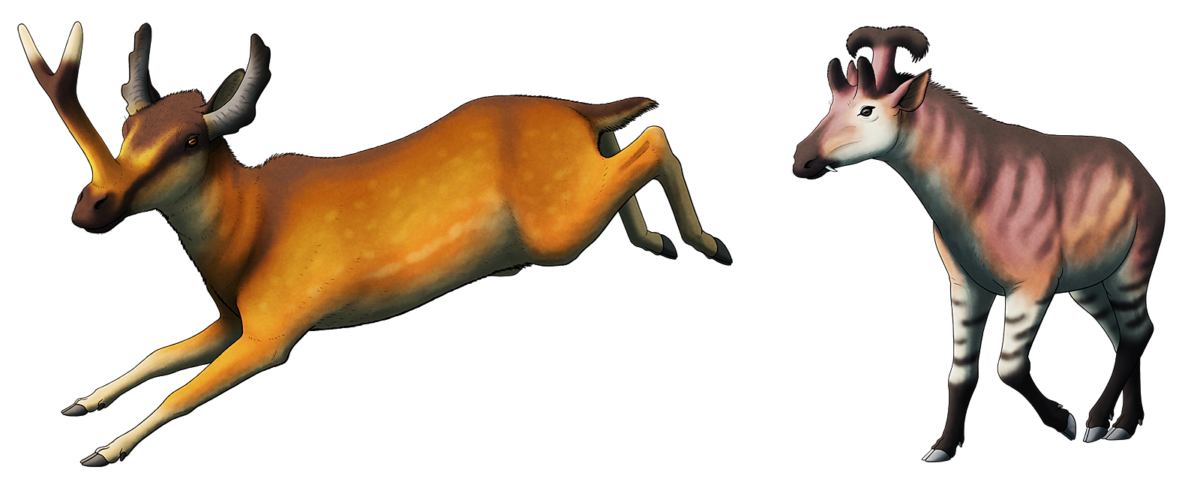
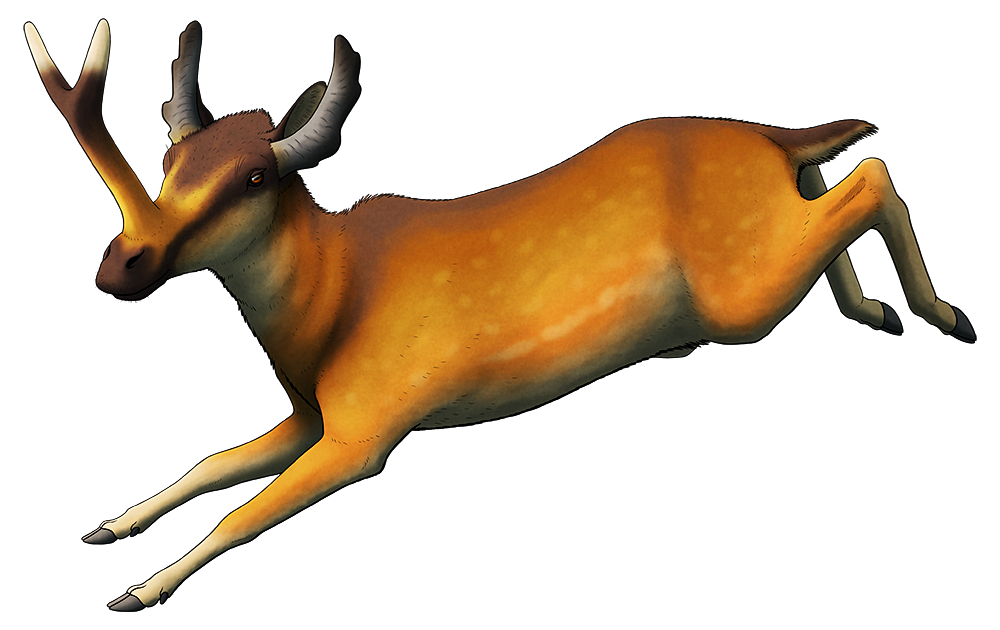
The protoceratids were an early group of North American ruminants whose relationships are uncertain, but may have been related to modern chevrotains. They were convergently deer-like in appearance, with teeth adapted for grazing on tough grasses – and along with having a pair of horns in the usual position on their heads, males also sported an additional pair of ossicone-like growths on their noses.
Synthetoceras tricornatus lived during the Late Miocene, around 10-5 million years ago, and was one of the largest protoceratids, standing about 1.1m tall at the shoulder (3’7″). Its two nose-horns were partially fused into a single long structure with a forked tip, which may have been used for sparring in a similar manner to the antlers of modern deer.
Synthetoceras tricornatus
Meanwhile on a different branch of the ruminant family tree, closer related to deer and giraffes, a group known as the palaeomerycids independently developed a similar sort of extra head appendage – but at the opposite end of their skulls.
These ruminants were a little more heavily built than the protoceratids, and specialized in feeding on soft vegetation in humid forest environments. They were a highly successful group, existing for almost 30 million years, ranging across Eurasia, Africa, and North America, and even ventured into South America during the early phases of the Great American Interchange.
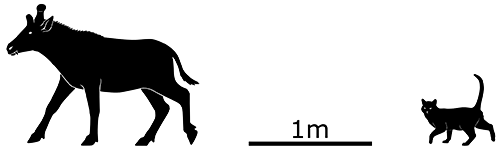
Males had two giraffe-like ossicones above their eyes, along with a third crest-like one at the very back of their heads. In some species this formed a single central “horn” shape, while in others it forked out to each side. They also often had long saber-like canine teeth similar to modern water deer and musk deer, which were probably used for fighting while their elaborate headgear was purely for visual display.
Xenokeryx amidalae lived in Spain during the mid Miocene, about 16 million years ago. It stood around 0.8-1m tall at the shoulder (2’7″-3’3″) and had a unique T-shaped “handlebar” crest which ended up inspiring its genus name – a reference to the similar shape of one of Queen Amidala’s headpieces in Star Wars, which was itself based on Mongolian imperial fashion.
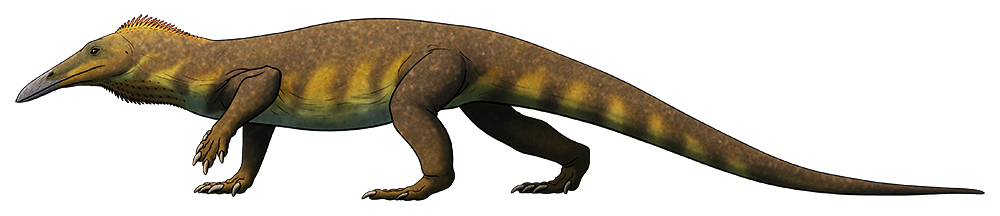
Living in Nova Scotia during the Late Triassic, around 235-221 million years ago, Teraterpeton (meaning “wonderful creeping thing”) was first named in the early 2000s based on a skull and partial skeleton, with some additional skeletal material being described recently in 2019.
Its head had a confusing mix of anatomical features, with a long beak-like toothless snout at the front of its jaws, small sharp interlocking cheek teeth further back, a huge nasal opening, and a closed-up fenestra at the back of its skull making it look more like the skulls of marine reptiles.
It also had a lizard-like body, perhaps up to 1.8m long (~6′), with rather long slender limbs and large blade-like claws, and more anatomical weirdness in the pelvic region convergently resembling those of distantly related groups like rhynchosaurs and tanystropheids. It had a sprawling posture, but its hind limb musculature suggests it might have been capable of getting up into a more erect stance when walking, somewhat similar to modern crocodilians’ “high walk” gait.
It was clearly quite an ecologically specialized animal, but quite what it was specialized for is still uncertain. It was presumably a herbivore like its close relatives, but it must have been eating a very different diet with its long beak, and its deep claws could have been used for scratch digging to get at roots and tubers.
Another possibility it that it could have been an insectivore with a diet similar to modern aardvarks or armadillos, probing with its beak and digging with its claws for insects, grubs, and other invertebrates. Since termite-like social insect nests do seem to have existed around the same time, it might even have been one the earliest known animals to specialize in myrmecophagy.
Trilobites were one of the most successful groups of early animals, existing for over 300 million years – and during that time they developed a huge diversity of weird heads, with various arrangements of spines, horns, eyestalks, and even long snouts and tridents.
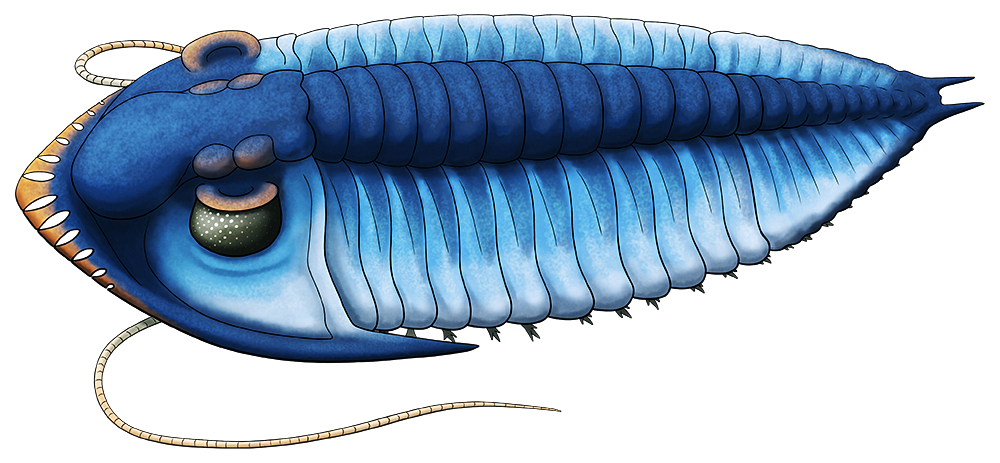
But perhaps one of the oddest was the genus Odontocephalus, known mainly from the early-to-mid Devonian and represented here by Odontocephalus aegeria.
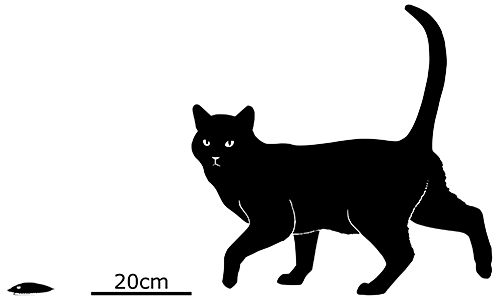
Living about 390 million years ago in northeast North America, this trilobite grew up to around 9cm long (3.5″). And although it wasn’t overall very elaborately ornamented, the front margin of its head had a row of extensions that flared out to meet at their tips, forming something resembling the cowcatchers used on trains.
The actual function of this structure is unknown. It might have been purely used for visual display since trilobites had excellent vision – but Odontocephalus was also a fast-moving bottom-dweller, and its “cowcatcher” may have served the same sort of purpose as its modern equivalent, deflecting small obstacles in its path as it trundled along the seabed.
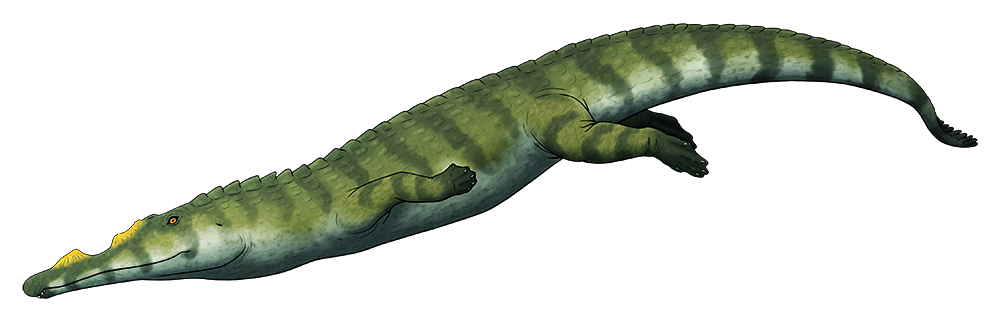
But while they had toothy snouts and bodies heavily armored with bony ostederms, unlike crocodilians their nostrils were far back on their heads up near their eyes, often in a sort of bony “snorkel” so they could breathe while almost fully submerged underwater.
Mystriosuchus westphali lived in Germany during the Late Triassic, about 215-212 million years ago. Around 4m long (~13′), it was even more aquatic than other phytosaurs, with paddle-like limbs and long slender gharial-like jaws adapted for catching slippery prey.
And along with the typical phytosaur snorkel, it also had raised crests along its upper jaw – which may have supported even larger keratinous display structures.
South America was an isolated “island continent” for a large chunk of the Cenozoic, and during that time it was home to a unique mix of species evolving completely separately to the rest of the world.
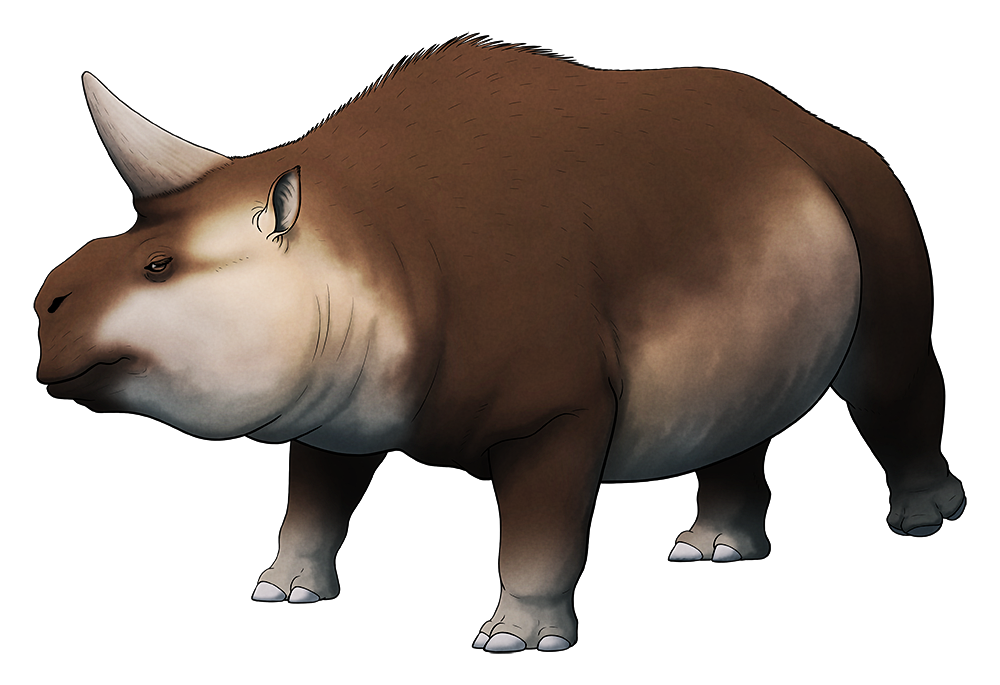
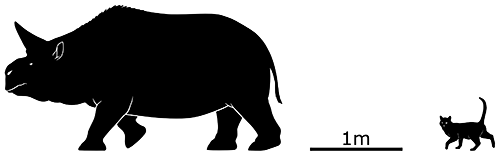
And, like rhinos, some of them may even have had horns.
Hoffstetterius imperator lived in Bolivia during the late Miocene, about 11-5 million years ago. Standing around 1.6m tall at the shoulder (5’3″), it had a particularly oddly-shaped skull, with a deep downward-flaring lower jaw and a large bulging bony “shield” on its forehead that resembles the attachment points for horns on rhino skulls.
Keratinous structures like that only fossilize very rarely, so the actual size and shape of whatever attached there is unknown – the pointed horn shown here is one possibility – but we honestly don’t know what was going on with these guys’ heads.
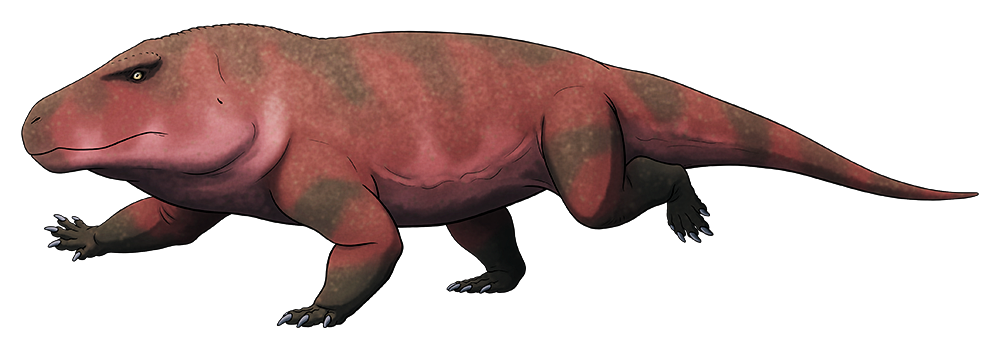
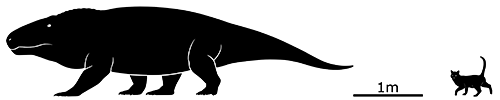
It was one of the earliest archosaurifomes to develop a more upright-limbed posture, and convergently evolved a very theropod-like head with a deep narrow snout full of large serrated teeth.
A head that was absolutely massive proportional to the rest of its body, measuring about 1m long (3’3″).
As a result of such a big noggin, Erythrosuchus must have also had some bulky musculature in its neck and forequarters to support it. And while its fairly short neck wouldn’t have been very flexible buried in all that tissue, it probably didn’t need to be – some of its main prey would have been large slow-moving dicynodonts, and its hunting strategy may have consisted of simply “aim at food and lunge”.
Sometimes the really weird thing about a head isn’t any sort of ridiculous ornamentation.
Sometimes it’s just the wrong size.
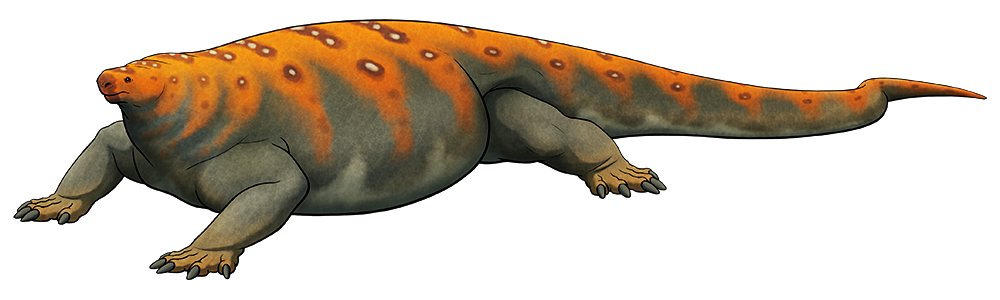
That’s what was going on with Cotylorhynchus romeri from the early Permian of North America, living about 280-272 million years ago. Despite looking like a big fat lizard this creature was actually a very early synapsid, closer related to modern mammals than to reptiles, and it was a distant cousin of other stem-mammals like the famous Dimetrodon.
Around 3.5m long (11’6″), it was one of the largest herbivores of the early Permian, with a very wide barrel-shaped body, chunky limbs, and a comically small head. Such a tiny head isn’t necessarily unique – another synapsid Edaphosaurus also had a fairly small skull compared to its body, and dinosaurs like stegosaurs, sauropods, and moa had heads even more disproportional. But something about Cotylorhynchus in particular just looks… incredibly odd.
It also had some surprisingly sizeable nostril openings in that little skull, and it had may have had a very good sense of smell or perhaps some sort of specialized breathing system like the modern saiga’s “air conditioning” nose.
Although usually depicted as a fully terrestrial animal, the structure of Cotylorhynchus‘ bones and its flattened paddle-like hands and feet have recently been used to suggest that it may have been semi-aquatic, more of a Permian hippo than a cow. But such a lifestyle would have required it to have a much more efficient method of breathing than previously thought – suggesting it had a mammal-like diaphragm, and possibly also explaining that weird nose.
It’s been a whole four years since Weird Backs Month, so we’re long overdue for a companion series:
Weird Heads Month!
Ever since heads first evolved as a defined body part, over 500 million years ago, evolution has been experimenting with them. There are many modern examples of animals that have modified parts of their heads and faces in a variety of strange-looking ways – elephants, deer, narwhals, hornbills, sawfish, bats, stalk-eyed flies, hammerheads, barreleyes, and star-nosed moles, to name only a few – and species in the fossil record were just as diverse and weird.
One of the most immediately recognizable examples of extinct animals with strange head structures are the pterosaurs, almost always depicted in pop culture with a large Pteranodon-like head crest.
But that wasn’t anywhere near as weird as pterosaur crests got.
Nyctosaurus gracilis here had an absolutely ridiculous elaborate crest, sporting an enormous antler-like structure on the back of its skull that grew to lengths longer than its own body.
Living around the Western Interior Seaway of the Midwestern United States during the Late Cretaceous, around 85 million years ago, it was a fairly small pterosaur standing about 40cm tall without the crest (1’4″) and with a 2m wingspan (6’6″). Its wings were long and narrow, and had completely lost the three small clawed fingers seen on other pterosaurs, suggesting it may have been less capable of moving around on the ground. It’s thought to have been a specialized soaring flier that spent most of its life on the wing at sea, much like a modern albatross.
Made up of two long thin spars arising from a common base, Nyctosaurus‘ crest has sometimes been reconstructed with a large sail-like membrane of skin – but since there’s no evidence at all of soft-tissue attachment on the bones, this seems unlikely. Juveniles were crestless, with only fully mature adults developing their spectacular headgear, so it was probably some sort of display structure.
It’s also not clear whether there was any sexual dimorphism in Nyctosaurus, since well-preserved skulls with intact crests are incredibly rare. But as with most other crested pterosaurs it’s likely that all mature individuals had crests, just with a difference in size and shape between sexes.
Mammuthus creticus was originally thought to also be a palaeoloxodontine, but more recent studies of its anatomy and ancient DNA have confirmed it was indeed another tiny mammoth. It was probably descended from either the Southern mammoth or Mammuthus rumanus, which would have arrived on Crete during the late Pliocene or early Pleistocene between about 3.5 and 1 million years ago.
Isolated on Crete, with no predators and living at a time when the island was much smaller, it quickly dwarfed and became the tiniest known mammoth to ever exist, standing just 1.1m tall at the shoulder (3’7″). Not much is known about its ecology, but its teeth suggest it was a browser feeding on leaves and shrubs, possibly filling a similar niche to the mid-sized deer that came later.
This mini-mammoth seems to have gone extinct by the mid-Pleistocene, about 1 million years ago, around the time when rising sea levels during an interglacial phase may have submerged so much of the smaller proto-Crete that its population could no longer be supported.
Later in the mid-to-late Pleistocene, after the sea level dropped again and tectonic uplift brought Crete close to its modern dimensions, the small mammoths were replaced by both newly-arriving deer and Palaeoloxodon elephants, which evolved into the much more moderately dwarfed forms of Palaeoloxodon creutzburgi and Palaeoloxodon chaniensis.
Palaeoloxodon tiliensis
To the north and east of Crete the Cyclades and Dodecanese islands had endemic dwarf elephants on at least eight islands, with the best known being the species that lived on Tilos.
Palaeoloxodon tiliensis stood about 1.8m tall (5’11”), on the larger side for a dwarf Mediterranean elephant but still one of the smallest palaeoloxodontines in the Aegean region. Several thousand specimens have been found, and radiocarbon dating shows it was a fairly recent evolutionary development, appearing just 45,000 years ago in the late Pleistocene.
This dwarf elephant was also the very latest surviving of its entire kind, living well into the Holocene until at least 4000 BCE. This is several thousand years after humans first arrived on Tilos, suggesting it was a rare case of an island elephant that managed to endure the effects of a human presence for quite some time.
In fact there’s some speculation that Palaeoloxodon tiliensis (or a similar unknown species) may have survived for even longer than that, since one Ancient Egyptian tomb from around 1480-1400 BCE contains a painting depicting traders with exotic animals, including what appears to be a small hairy elephant with slender limbs and thin upward-curving tusks. We may never know for certain if this was actually a late-surviving dwarf, a mutant modern elephant, or just artistic license with scaling, but the possibility is still intriguing.
Palaeoloxodon cypriotes
Over on isolated Cyprus further to the east, the only native large mammals were the miniature hippos and an equally miniature elephant.
Palaeoloxodon cypriotes was smaller than the Aegean palaeoloxodontines, about 1.4m tall (4’7″), and much like its cousin on Tilos seems to have evolved very recently towards the end of the Pleistocene, sometime around 20,000 years ago.
It wasn’t the first dwarf elephant on Cyprus — there was a larger, earlier species known as Palaeoloxodon xylophagou at least 200,000 years ago — but it’s not clear whether these two species represent a single evolutionary line or two entirely different colonizations of the island.
Similarly to the hippos it lived alongside, Palaeoloxodon cypriotes disappeared shortly after humans arrived on Cyprus, between 12,000 and 10,000 years ago. Collections of its bones have been found in a rock shelter with evidence of having been burnt, suggesting that it was being actively hunted and cooked.
And that’s all for the Island Weirdness series! Even over two months there are still plenty of species I didn’t have time to feature, so this definitely won’t be the last we see of strange endemic species.
Thank you for following along — with a shoutout to my Patreon supporters! — and regular weekly art posts will resume here next Monday.