Xenocranium

Xenocranium pileorivale lived during the late Eocene, about 35 million years ago, in what is now the Midwestern and Mountain states regions of the USA.

Despite its very mole-like appearance, this little mammal was a member of an extinct lineage known as palaeanodonts — and its closest living relatives are actually pangolins.

Around 15cm long (~6″), Xenocranium was highly adapted for a subterranean burrowing lifestyle, with an upturned shovel-shaped snout bearing a pad of thickened skin, and short powerful limbs with large digging claws. Its eyes were very reduced, functionally blind, and may not have even been visible in life. Its sense of hearing was also specialized for the sort of low-frequency sounds that carry well through the ground.

It was probably a head-lift digger, using upward motions of its snout and downward strokes with its forelimbs to excavate tunnels while foraging for worms and underground insects.

Continue reading “Xenocranium”
Eurotamandua

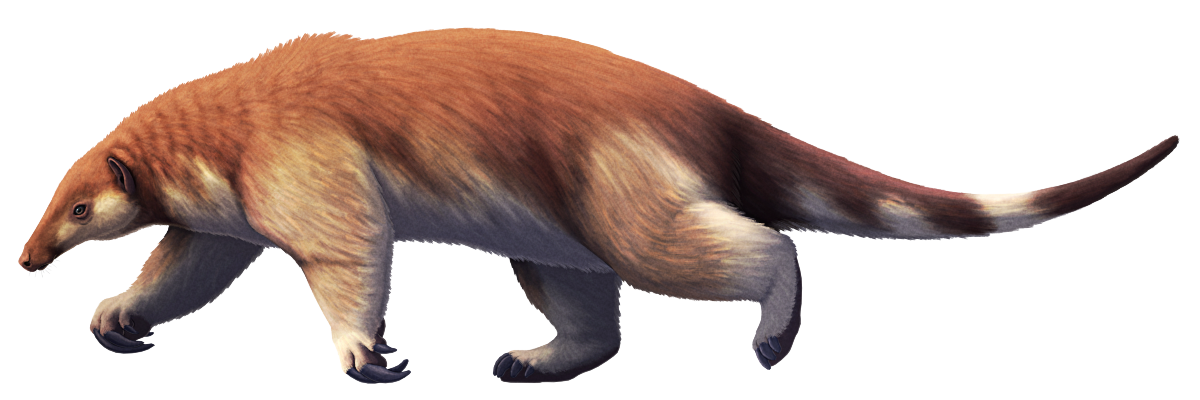
Eurotamandua joresi lived during the mid-Eocene, about 47 million years ago, in the lush subtropical forests that covered what is now central Germany.

When it was first described in the early 1980s it was classified as an anteater due to its close resemblance to some modern species… but there were big problems with this interpretation. Anteaters have a sparse fossil record, but they’re known to have originated during the early Eocene in the isolated island continent of South America – so Eurotamandua’s ancestors making it all the way to Europe within just a few million years would be pretty remarkable!

Also, on closer inspection it didn’t have the distinctive skeletal features of a xenarthran mammal, suggesting it wasn’t an anteater after all.

Instead more recent studies have identified it as a close relative of pangolins, part of an early branch of the group that didn’t have the characteristic large scales.

About 90cm long (~3′), Eurotamandua would have a lifestyle much like the anteaters it convergently resembled, using its large claws to rip open ant nests and a long sticky tongue to feed.