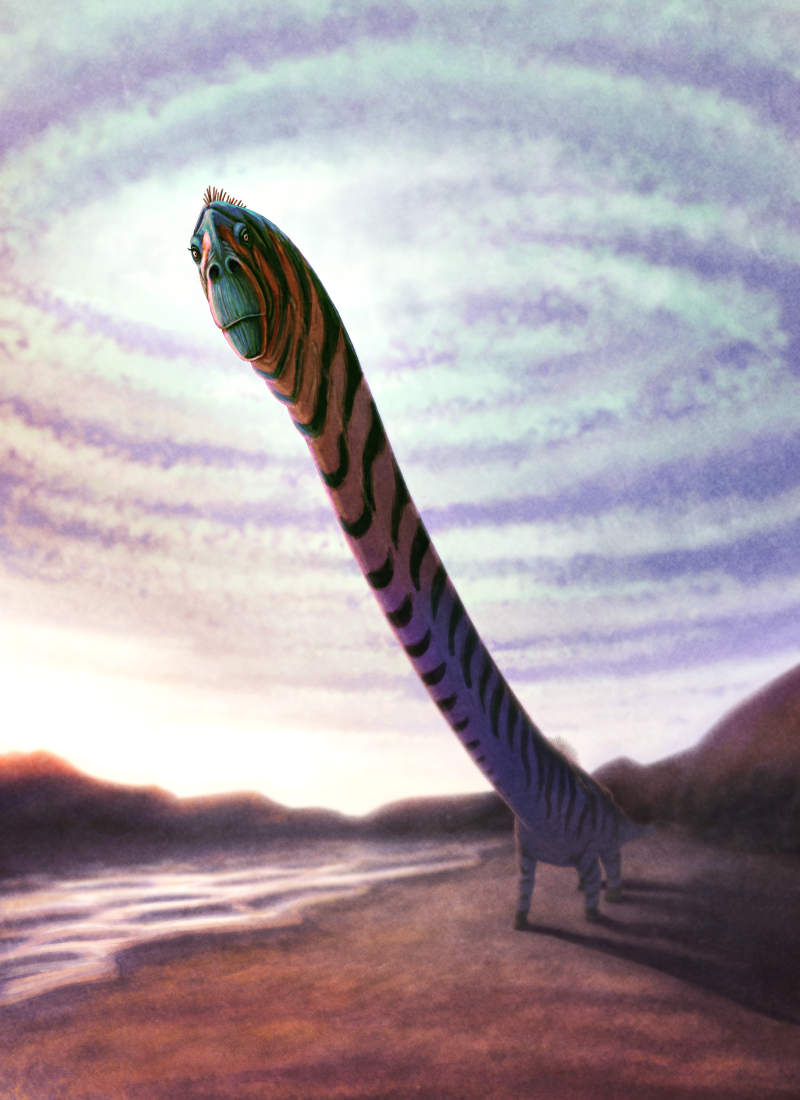
Although sauropod dinosaurs are famous for their long necks, one group known as mamenchisaurids took that particular feature to the extreme, with elongated necks that made up around half of their total body length.
And ‘Mamenchisaurus’ sinocanadorum* was one of the largest and longest. Living in what is now northwestern China during the Late Jurassic, about 160 million years ago, it had a 15m-long neck (~49′) and an estimated total length of 25-30m (~82-98′).
(*The whole Mamenchisaurus genus is a bit of a wastebasket and needs revision. Recent phylogenetic analyses suggest M. sinocanadorum was closer related to Xinjiangtitan than to other Mamenchisaurus species, but whether it actually belongs in that genus instead or merits its own new name has yet to be determined.)
Its enormous neck was ultralightly-built and highly pneumatic, with the vertebrae containing around 70% air sacs by volume. Extremely long cervical ribs served to stabilize the neck, but would also have limited flexibility along most of its length — it may have operated like a crane arm, sweeping around to feed on vegetation across a wide arc without having to move its body at all.
Continue reading “Mamenchisaurus”