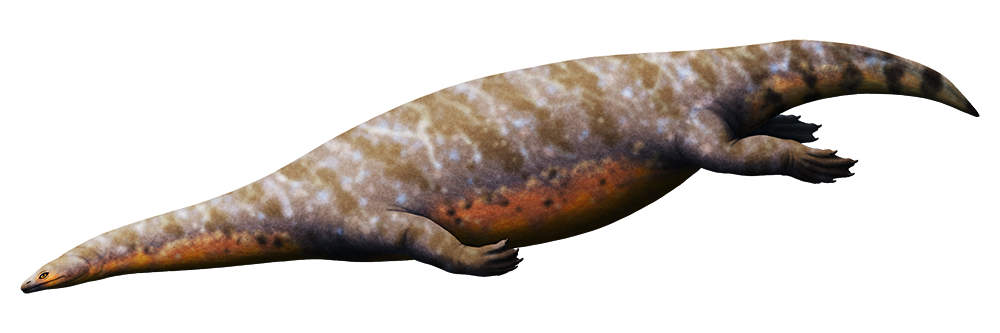
Panzhousaurus

Panzhousaurus rotundirostris, a sauropterygian marine reptile from the mid-Triassic of southwestern China (~245 mya), living just a few million years after the devastating Permian-Triassic mass extinction. This small marine reptile was only about 40cm long (1′4″) and is known from a single near-complete skeleton.

Although it was a distant evolutionary cousin to plesiosaurs (and even more distantly to modern turtles), it was actually most closely related to an early sauropterygian lineage known as the pachypleurosaurs – a group of small lizard-like aquatic reptiles with tiny heads, long necks, and paddle-like limbs.

It had an unusually short and rounded-off snout compared to its relatives, and since it would have lived alongside many other diverse marine reptiles it was probably specialized for a slightly different ecological niche.

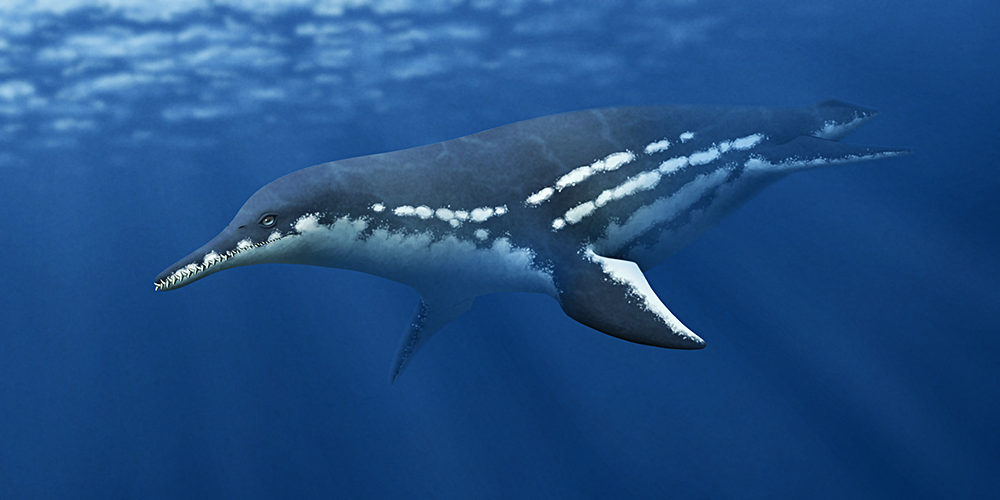
Paludidraco

Paludidraco multidentatus from the Late Triassic of Spain (~237-227 mya).

This 3m long (9′10″) animal was a member of the nothosaurs, a group of semi-aquatic seal-like marine reptiles that were closely related to plesiosaurs (and both were also evolutionary cousins to modern turtles).

It had long slender jaws full of numerous tiny teeth, creating an interlocking comb that was probably used for filter feeding – scooping up mouthfuls of fine-grained sediment from the seafloor and filtering out small invertebrates or soft plant matter.

The bones of its skeleton were also highly thickened and dense, a condition known as pachyostosis that provided ballast to weigh it down in the water. This would have made it a slow and unmaneuverable swimmer, but a very energy-efficient one, using its natural neutral buoyancy to hover or walk along the seabed.

It was essentially a reptilian manatee, filling a similar sort of ecological niche.

Mauriciosaurus

Mauriciosaurus fernandezi, a polycotylid plesiosaur from the Late Cretaceous of Mexico (~94-89 mya). About 1.9m long (6′3″) with a flipper-span of 1.5m (4′11″), it’s known from a near-complete skeleton with preserved soft tissue impressions. The fossil shows evidence of rows of very tiny scales, the skin outlines of the flippers, and also a thick layer of insulating blubbery fat.

Its body shape in life would have been similar to modern leatherback turtles, roughly teardrop-shaped and hydrodynamic – much chubbier than most plesiosaur reconstructions had been previously depicting!