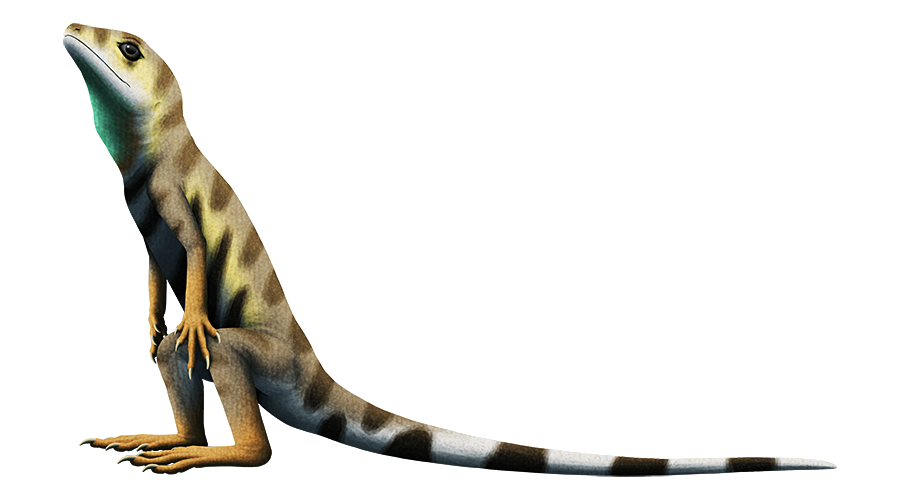
Eudibamus

Eudibamus cursoris, a bolosaurid from the Early Permian of Germany (~284-279 mya).

Although very lizard-like in appearance, this animal was actually part of a completely extinct group known as parareptiles – a diverse group of early sauropsids who were once thought to be the ancestors of turtles, but are now considered to instead be the evolutionary cousins to the true reptiles.

With a total length of about 25cm long (8-10″), the structure and proportions of its limbs suggest it could run fast on its hind legs, making it one of the earliest known examples of bipedal locomotion. Since its teeth were adapted for a herbivorous diet, it wasn’t using its speed to chase down prey but was instead probably sprinting away from predators.

But unlike the sprawling running of some modern lizards, Eudibamus may have been capable of holding its legs in a more upright position directly under its body, convergently evolving a more energy-efficient posture similar to that of later bipedal animals like dinosaurs.
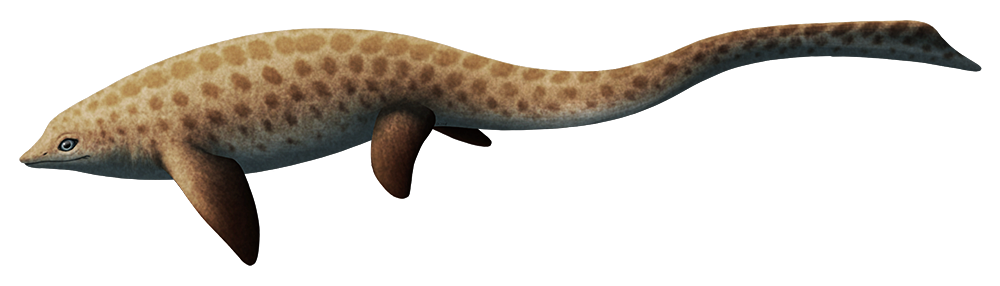
Sclerocormus

Sclerocormus parviceps, an unusual ichthyosauriform from the Early Triassic of China (~248 mya).

Its short toothless snout suggests it was a suction feeder, using water pressure differences to pull small soft-bodied prey straight into its mouth like a syringe.  Along with a heavily built body similar to those of hupehsuchians, and a very long tail that made up over half of its 1.6m length (5′3″), it was probably a fairly slow swimmer living in shallow coastal waters.

It was a close relative of Cartorhynchus, and may have been similarly capable of hauling itself onto land like a modern pinniped.

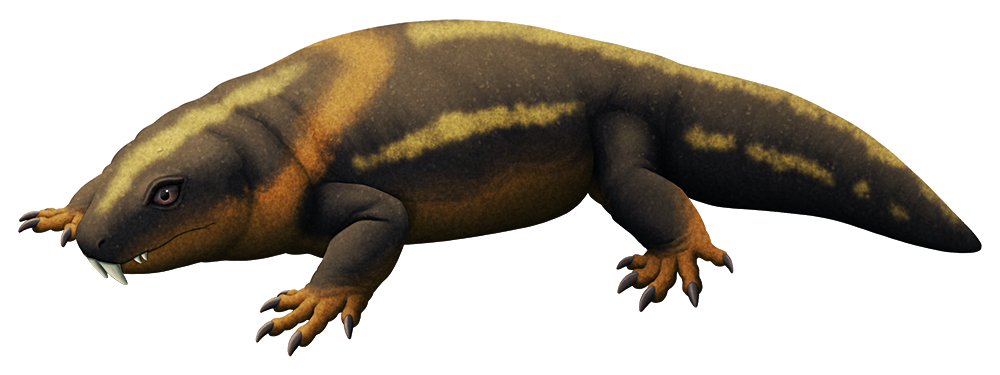
Colobomycter

Colobomycter pholeter, a parareptile from the Early Permian of Oklahoma, USA (~289 mya). Although known only from partial skull fossils, its full size was probably around 30cm long (1′).

It had huge fangs at the front of its jaws, along with a few other enlarged teeth further back, all with serrated edges that show it was clearly a predator. What exactly it was feeding on with this unusual tooth arrangement is unknown – but proposed ideas include piercing through hard-shelled arthropods, or stabbing into smaller vertebrate prey.

Bunostegos

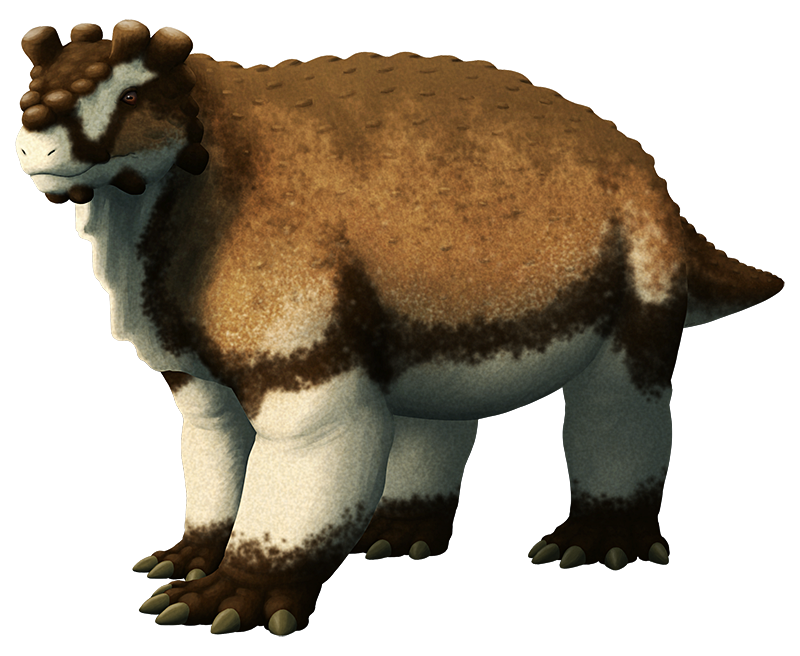
Bunostegos akokanensis, from the Late Permian of Niger (~260 mya). About 2.5m long (8′2″), similar in size to a modern cow, it was a member of a group known as the pareiasaurs – stocky herbivorous reptile-relatives with osteoderm armor in their skin and knobbly bony nodules on their skulls.

The anatomy of its limb bones suggest it walked fully upright, with its legs held vertically under its body. This sort of posture has independently evolved multiple times in different tetrapod lineages, but Bunostegos is one of the earliest known examples.

Shringasaurus

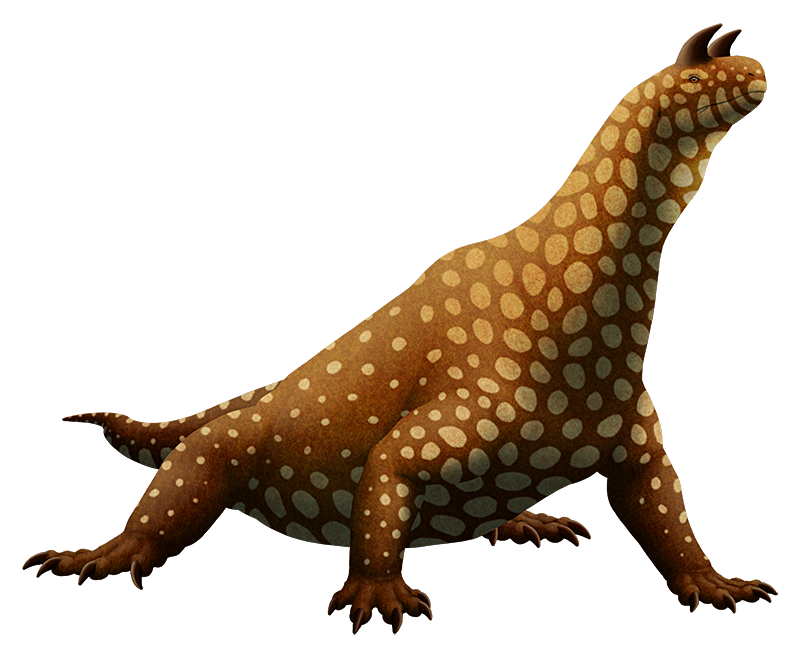
Shringasaurus indicus, an archosauromorph reptile from the Middle Triassic of India (~247-242 mya). About 3-4m long (9′10″-13′1″), it was part of a group known as the allokotosaurs, specialized herbivores with lizard-like bodies, and was related to the strange long-beaked Teraterpeton.

Partial remains of about seven different Shringasaurus individuals of varying ages have been found, with several of them having large curving horns over their eyes convergently similar to those of the later ceratopsids. A couple of adult specimens lack horns entirely, suggesting the feature was sexually dimorphic with only the males developing ornamentation – a very rare arrangement among archosauromorphs, but similar to some horned mammals.

Titanoboa

Titanoboa cerrejonensis, a boine snake from the Mid-to-Late Paleocene of Colombia, South America (~60-58 mya). Estimated to have reached lengths of up to 12-14m (39-46′) it was one of the largest known snakes of all time, about twice the length of the biggest modern anacondas and pythons. It was probably able to reach such a huge size due to a combination of factors – mainly a very warm climate and the absence of large terrestrial predators immediately following the K-Pg extinction a few million years earlier.

Despite frequently being depicted eating dyrosaurid crocodiles, the anatomy of Titanoboa’s skull suggests it primarily fed on fish. Considering that some of the fish in its tropical riverine habitat were some of the largest available prey in the area, reaching around 3m in length (10′), a piscivorous diet would actually make a lot of sense for a such a big snake.

Teleocrater

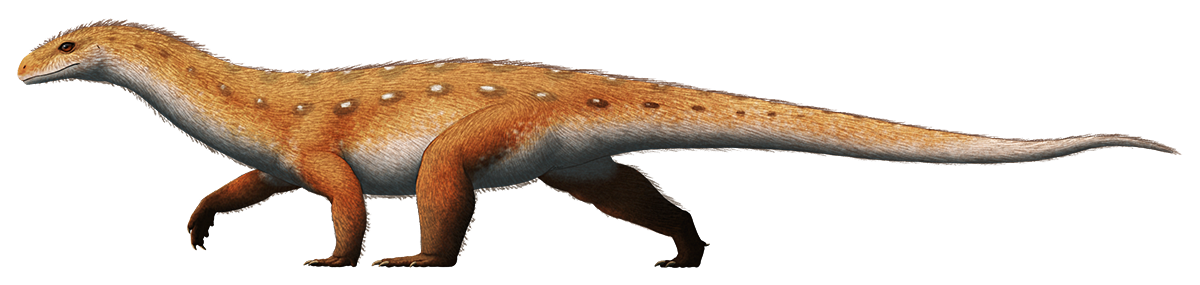
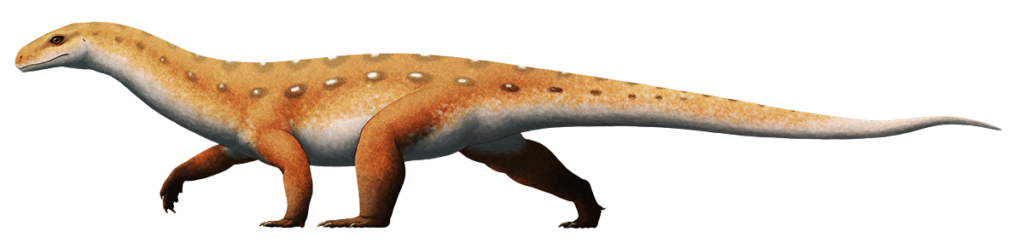
Teleocrater rhadinus from the Middle Triassic (~245 mya) of Tanzania. Measuring about 2.5m long (8′2″), it was one of the earliest known members of the avemetatarsalians – the dinosaur-and-pterosaur (or “bird-line”) branch of the archosaurs. Its fossils have been known for over 80 years, but it was only very recently given an official name and classification following the discovery of additional specimens in 2015.

It turned out to be rather different from what paleontologists had expected an early bird-line archosaur to look like. Instead of being a bipedal basal-dinosaur-like animal, Teleocrater was actually a quadruped with more crocodilian-like limbs and oddly elongated neck vertebrae.

I’ve done two variations of the image today – both with and without a little speculative proto-fuzz.

An illustration of an extinct reptile related to the ancestors of dinosaurs and pterosaurs. It's a quadrupedal animal with a lizard-like head, a long neck, crocodile-like limbs, and a long tail.
Teleocrater rhadinus (no fuzz version)

Unsolved Paleo Mysteries Month #09 – The Unknown Ugly Crocodile

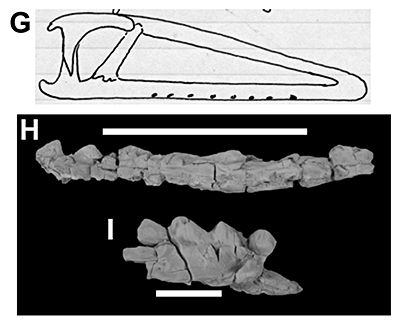
In 1923, paleontologist Charles Camp recorded the discovery of an unusual-looking skull from the Late Triassic (~220 mya) of Arizona, USA. He made a field sketch before attempting to remove the fossil from the surrounding rock – only for it to completely fall apart, leaving just a couple of intact fragments covered in odd bony knobs.

Camp’s original drawing of the Acallosuchus fossil, and the remaining broken pieces. Scale bars equal 5cm for H and 1cm for I. [source]

The fossils were stored away at the University of California Museum of Paleontology and were left forgotten for the next sixty years. Eventually they were rediscovered by Robert Long and Phillip Murry, and described in 1989 with the name Acallosuchus rectori (meaning “Rector’s ugly crocodile”).

But what is it?

At first it was classified as a proterochampsid, a group of archosauriforms known from South America. But this classification was based on some additional skeletal remains that were thought to belong to it, which were later split off and named as the semi-aquatic Vancleavea instead. It’s also been compared to Doswellia and the pseudosuchian Revueltosaurus.

The material is just far too fragmentary to make a confident identification, and the original sketch is anatomically unclear. At best we can say that Acallosuchus was an “indeterminate diapsid” – some sort of reptile, but for now nobody knows what.

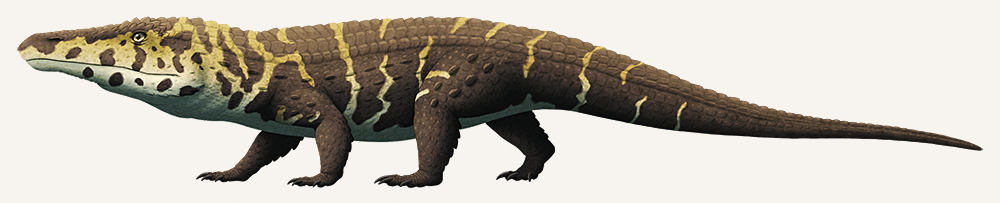
I’ve restored it here based mainly on proterochampsids, but any interpretation of this animal is going to be highly speculative until more fossil material is found.

Spinoaequalis

Spinoaequalis schultzei, an early diapsid reptile from the late Carboniferous of Kansas, USA (~300 mya). Measuring about 30cm long (1′), it appears to have been semi-aquatic, with limbs like a typical terrestrial reptile but also possessing a long flexible paddle-like tail to aid in swimming – making it one of the earliest amniotes to experiment with “returning to the water”.

Drepanosaurus

One of my favorite palaeontological discoveries of 2016 also involved one of my favorite extinct animals: the odd little “monkey lizard” Drepanosaurus.

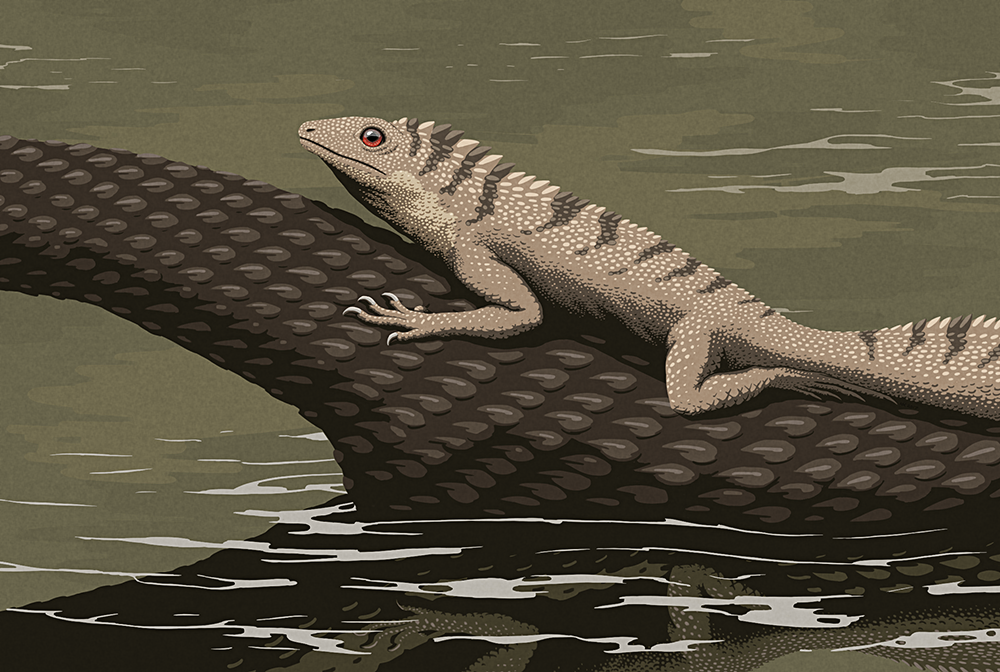
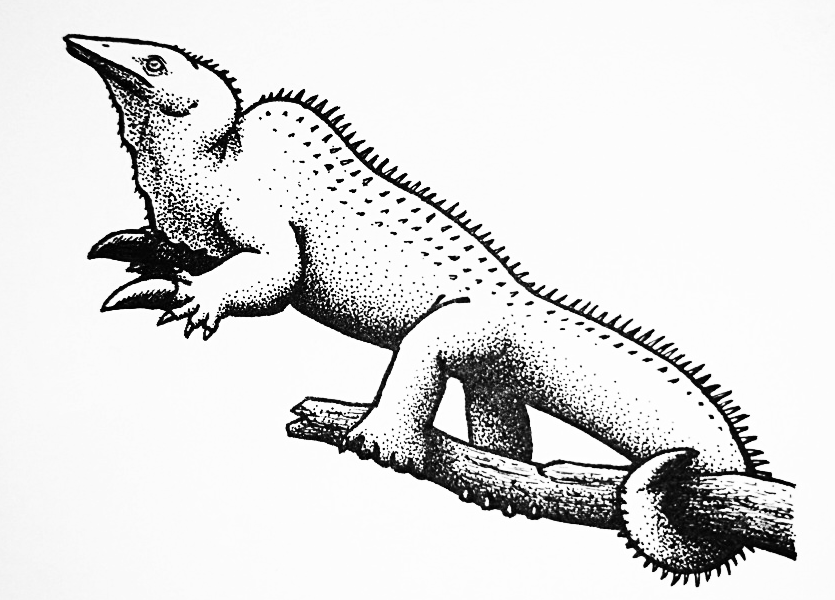
Living during the Late Triassic of Europe and North America (~218-212 mya), this reptile measured about 50cm long (20″). It was already known to have some particularly weird anatomy, featuring a humped back, grasping feet, a prehensile tail ending in vertebrae modified into a pseudo-claw, enormous claws on the second finger on each hand, and a bizarre arrangement of its forearm bones.

In 2016, new fossils gave us a better look at those arm bones, and they turned out to be even stranger than previously thought. As well as the radius and ulna being unusual, several wrist bones were also heavily modified and elongated, creating an arm setup unique among all known tetrapods. This may have been a specialization for “hook-and-pull” digging, ripping up tree bark to get at burrowing insects – but now the real mystery is why no other tetrapods have ever managed to modify their limb bones to this sort of extreme.