Ceratopsian Month #06 – Protoceratops andrewsi

The protoceratopsids were a mainly Asian branch of the ceratopsians (with one species also known from Europe), splitting off shortly after the leptoceratopsids. Although still fairly small, they looked a lot more like a typical ceratopsian than their ancestors, with relatively big heads for their body size and large neck frills.

The best-known member of this group was the 1.8m long (6′) Protoceratops (“first horned face”), which lived in Mongolia during the Late Cretaceous (~75-71 mya). It was a very common animal, with hundreds of fossils representing all different stages of growth, and large numbers found together suggest it may have lived in herds.

The size and shape of its frill differed a lot between individuals, with some being short and compact and others being much longer or wider. Some paleontologists have considered this to be evidence of sexual dimorphism, but further studies show no clear distinctions between the proposed “male” and “female” morphs – it was probably just natural genetic variation among the population.

For many years a fossilized clutch of eggs was believed to belong to Protoceratops, with a nearby Oviraptor with a crushed skull thought to be an egg-eating thief killed while trying to raid the nest. The later discovery of an identical egg containing an Oviraptor embryo revealed that the story was the wrong way around – the Oviraptor was the one brooding and protecting its nest all along. 

Another famous fossil preserves a fight between a Protoceratops and a Velociraptor, the pair dying together before being buried in sand. The predator’s sickle claw was lodged into the Protoceratops’ neck, while the ceratopsian was crushing the Velociraptor’s arm in its beak.

(Oh, and Protoceratops fossils also probably didn’t actually inspire legends about griffins.)

Ceratopsian Month #05 – Leptoceratops gracilis

During the mid Cretaceous, around 100-80 million years ago, the leptoceratopsids split off from the main ceratopsian lineage. Fairly small with low frills, they were a successful group lasting throughout the rest of the Mesozoic. Seeming to originate in western North America, a few species have been found in Asia that may represent a dispersal event back across Beringia, and partial remains are also known from Europe and Appalachia. There’s even a dubious identification from Australia.

Leptoceratops (“small horned face”) was one of the last of this branch of the ceratopsians, living during the very end of the Cretaceous (~66 mya). About 2m long (6′6″), its fossils have been found in Alberta, Canada, and Wyoming, USA, and it would have lived alongside some of its larger distant cousins like the much more famous Triceratops.

Its skeleton shows it was a stocky quadrupedal sort of pig-like animal. Short deep jaws with strong teeth gave it a powerful bite, adapted for slicing and crushing, and it was probably specialized for a diet of very tough plant matter.

Ceratopsian Month #04 – Auroraceratops rugosus

Auroraceratops (“dawn horned face”) lived during the Early Cretaceous of China (~130-100 mya). Around 2m long (6′6″), it had a shorter and wider snout than other early ceratopsians, with a more flattened broader head shape.

It was closely related to other small Asian species like Koreaceratops, and was probably primarily bipedal due to its proportionally short arms. But, since it falls at a transitional point in ceratopsian evolution between bipedal ancestors and quadrupedal later forms, it may have adopted a four-legged posture while feeding or moving at slow speeds.

Its skull had several patches of thickened bone, found directly in front of its eyes and on its lower jaw. These could have had some visible tough keratinous coverings in life – although I’ve not depicted any here – and could potentially have been used for pushing and butting during fights.

The back of its small frill shows evidence of attachment sites for its jaw muscles, suggesting that ceratopsian frills may have originally evolved to support large powerful chewing muscles before being secondarily modified into elaborate display structures.

Ceratopsian Month #03 – Aquilops americanus

Although most early ceratopsians are known from Asia, during the Early-to-Mid Cretaceous a few dispersed across to North America via a land connection in Beringia.

These migration events happened at least three times, and Aquilops (“eagle face”) was part of the first wave of immigrants, dating to 109-100 mya and representing one of the earliest ceratopsians discovered in North America. Known from a single tiny skull found in Montana, USA, its full size would have been only around 60cm long (2′) – about the size of a large rabbit.

The narrow triangular shape of its snout suggests it was probably a selective browser, feeding on leaves and soft shoots in low-level foliage. Its hooked beak also had a raised bump on the front, which may have supported a larger display structure such as a horn.

Ceratopsian Month #02 – Psittacosaurus sp.

Living during the Early Cretaceous (~126-101 mya) in Mongolia, Siberia, and China, Psittacosaurus (meaning “parrot lizard”) represents an early specialized offshoot of the ceratopsians – it wasn’t directly ancestral to any of the later forms, instead being more of an evolutionary cousin.

It’s one of the most well-studied of all non-avian dinosaurs, represented by hundreds of fossils at all ages from hatchlings to adults. A large number of species have been named within the genus, although there’s disagreement about how many are actually valid, and even some of the best-preserved specimens still haven’t been given an official species classification.

Growing up to about 2m long (6′6″), it had sideways-flaring cheek horns and little-to-no frill, and only four fingers on its hands instead of the five seen in all other ceratopsians. One fossil preserves an amazing level of soft-tissue detail, showing the outline of the body, a row of long bristles, skin membranes running from its ankles to the base of its tail, and even evidence of the countershaded color pattern the animal had in life.

While adults were fully bipedal, hatchlings and juveniles seem to have moved around on all fours – suggesting that some of their direct ancestors may have evolved to be quadrupedal before secondarily re-acquiring two-legged locomotion.

Ceratopsian Month #01 – Yinlong downsi

It’s time for another month of themed blog posts, and this August features one of the most iconic groups of dinosaurs: the “horn-faced” ceratopsians!

Existing for almost 100 million years, from the Late Jurassic all the way up to the K-Pg mass extinction, ceratopsians originated in Asia and were part of a group called marginocephalians, sharing a common ancestor with the closely related pachycephalosaurs. The earliest members barely resembled their more famous descendants, lacking showy headgear and looking more like fairly generic basal neornithischians – but by the time of the Late Cretaceous their descendants had migrated across to North America and evolved into large quadrupeds, with some forms like Triceratops being so incredibly common that they must have been the dominant herbivores in their environments.

So let’s start right at the beginning of the group with…

Continue reading “Ceratopsian Month #01 – Yinlong downsi”

Mirischia

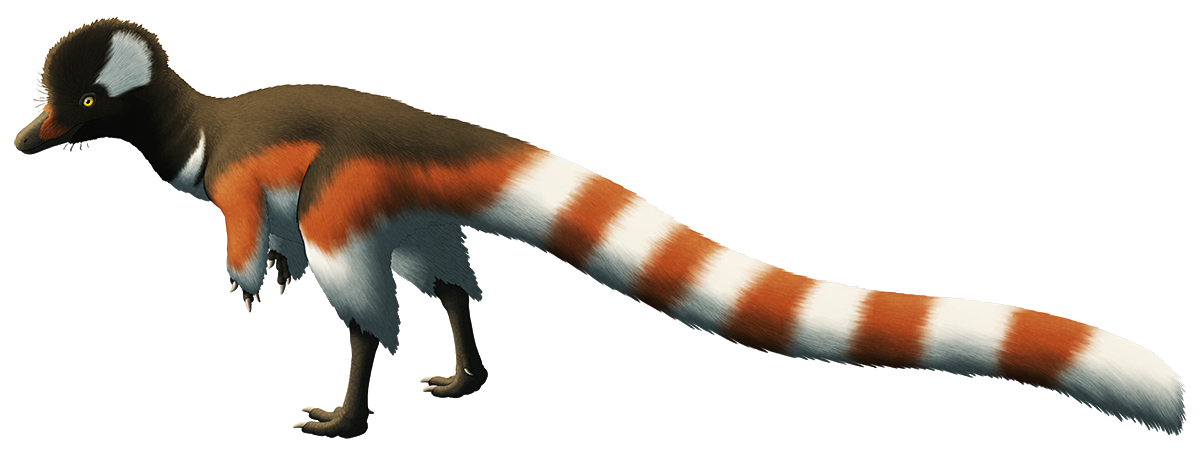
Mirischia asymmetrica, a theropod dinosaur from the Early Cretaceous of Brazil (~112-99 mya). Although known only from its hips and a few other partial bones, these pieces were so well-preserved that it was given a genus name that translates to “wonderful pelvis”.

In life it would have been about 2m long (6′6″), but since the known fossil represents a subadult its full-grown size may have been a little bit larger. It was probably a member of the compsognathids, closely related to Compsognathus and Aristosuchus – which would make it the only representative of that family currently known from the Americas.

The ischium bones of Mirischia’s pelvis were oddly asymmetrical, hence the species name ‘asymmetrica’, with one side featuring a hole and the other side only having a notch in the same position. The fossil specimen also had thin-walled bird-like bones, and soft-tissue impressions of intestines and a posterior air sac.

Turtle-jawed moa-nalo

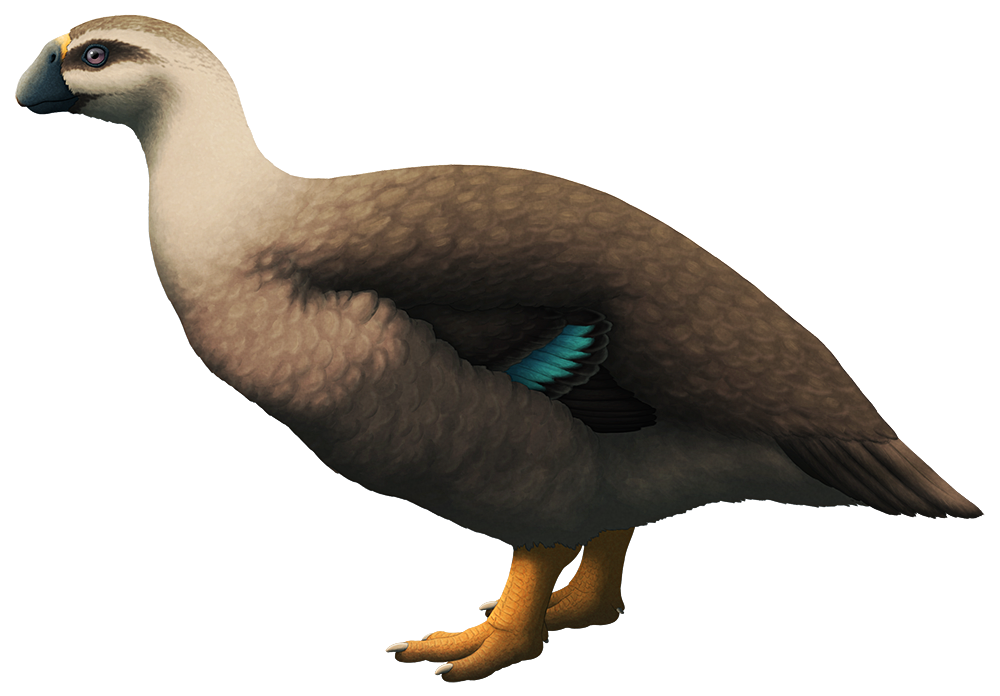
The turtle-jawed moa-nalo (Chelychelynechen quassus) was a large flightless goose-like duck from the Hawaiian island of Kaua‘i. About 90cm tall (3′) and weighing around 7kg (15lbs), these birds and their relatives were descended from dabbling ducks and existed on most of the larger Hawaiian islands for the last 3 million years or so – before going extinct around 1000 years ago following the arrival of Polynesian settlers.

Chelychelynechen had an unusually-shaped bill, tall and broad with vertically-oriented nostrils, convergently similar to the beak of a turtle. It would have occupied the same sort of ecological niche as giant tortoises on other islands, filling the role of large herbivore in the absence of mammals.

Herrerasaurus

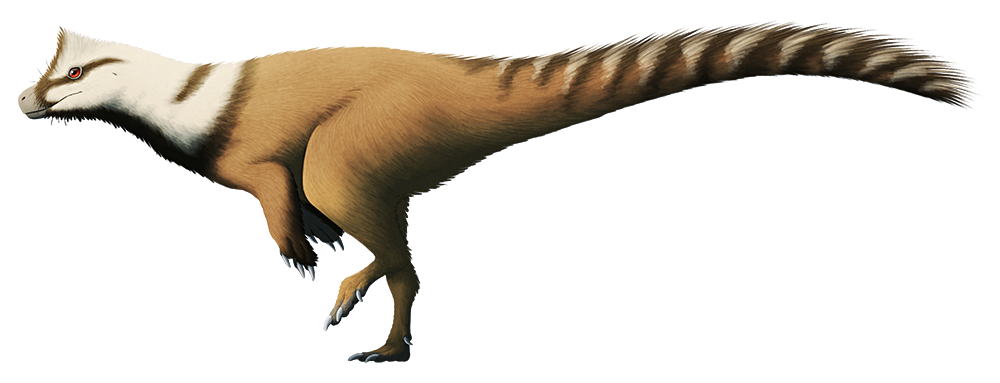
One of the earliest known dinosaurs, Herrerasaurus lived during the Late Triassic (~231 mya) in what is now Argentina, South America. It was a fairly lightly-built bipedal carnivore, with the largest specimens reaching sizes of just over 5m long (16′4″).

The exact classification of herrerasaurids is still somewhat unclear, with different analyses putting them in different positions on the early dinosaurian family tree. They’re generally considered to at least be closely related to basal theropods – but a recent analysis that reshuffles dinosaur relationships suggests their resemblance to the theropods might be a result of convergent evolution, with them being the sister group to sauropods instead.

Utahraptor

Utahraptor ostrommaysorum lived during the Early Cretaceous (~130-124 mya) in Utah, USA, and was the largest known dromaeosaurid. Reaching lengths of around 6m long (20′), it’s often compared in size to the fictional raptors of Jurassic Park.

Recent discoveries show it had some weird proportions compared to its relatives – a thick stocky body, chunky legs, smaller arms, a shorter and more flexible tail, and a large deep skull with an oddly curved lower jaw.

But we still don’t know very much about it… yet.

There’s a huge slab of rock full of Utahraptor fossils just waiting to be extracted and studied. There are at least six raptors in there ranging from babies to adults, hinting at the presence of a family group or even pack hunting behavior, and potentially other animals and new discoveries too – but the main roadblock for this project is lack of funding.

The paleontologists involved have turned to crowdfunding to attempt to raise enough money for essential equipment and the services of a professional fossil preparator, but they’re still only at about 10% of their goal.

So this first week of April is #UtahraptorWeek in the paleontology community, raising awareness of this fascinating giant raptor and how close we are to finding out so much more about it. Spread the word, and if you’re able to please consider helping out the Utahraptor Project on GoFundMe.