Almost-Living Fossils Month #02 – The Saber-Toothed “Herring”

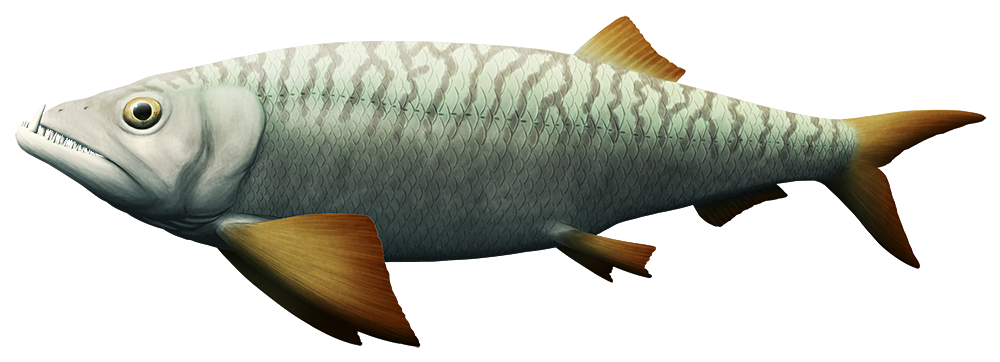
First appearing in the mid-Cretaceous, about 113 million years ago, Enchodus was a small-to-medium-sized genus of predatory fish. Different species ranged from a few centimeters to up to 1.5m in length (4′11″), with Enchodus gladiolus here being an averaged-sized example at about 60cmlong (2′).

The most distinctive feature of these fish were the enlarged fang-like teeth in both their upper and lower jaws, over 6cm (2.4″) long in the largest individuals, which may have been a specialization for feeding on soft-bodied cephalopods.

Despite having been nicknamed “saber-toothed herrings”, they weren’t actually closely related to herrings at all, instead being part of the aulopiformes – a group also containing modern lizardfish, lancetfish, and a different type of sabertooth fish.

Fossils of various Enchodus species have been found all over the world, and they seem to have been very common and important members of ancient marine ecosytems, occupying mid-level carnivore niches and in turn being eaten by other predators. Their remains have been identified within the preserved stomach contents of marine reptiles such as plesiosaurs and mosasaurs, as well as sharks and hesperornithean birds.

These toothy fish survived through the end-Cretaceous mass extinction and continued their success for almost 30 million years into the Cenozoic, with the last known fossils dating to just 37 million years ago in the Late Eocene. They probably didn’t survive much longer beyond that date, since there was an extinction event at the Eocene-Oligocene boundary (~34 mya), a period of sudden cooling that affected many marine animals at the time.
Rebellatrix

Coelacanths are famous for being “living fossils”, completely disappearing from the fossil record at the end of the Cretaceous but then being rediscovered alive just 80 years ago. But although they’re often thought to have physically changed very little over the last 300 million years or so, more recent discoveries are starting to show that coelacanth body forms and lifestyles were actually more varied in the distant past.

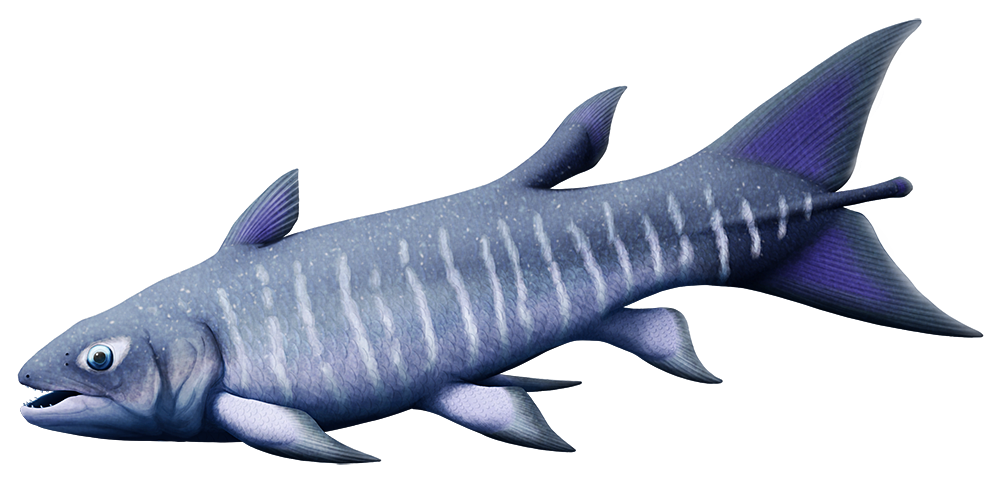
Meet the wonderfully-named Rebellatrix divaricerca, from the Early Triassic of British Columbia, Canada (~251-247 mya). Measuring around 1.3m long (4′3″), its body shape and large symmetrical forked tail suggest it was adapted for fast swimming. Unlike its slow-moving deep-water modern relatives this coelacanth was a speedy oceanic active predator, convergently similar to tuna or some sharks.

Since it lived in the immediate wake of the end-Permian “Great Dying” mass extinction, Rebellatrix may have rapidly evolved from more standard-looking coelacanths to take advantage of a suddenly vacant ecological niche – or it might be part of a more extensive unusual lineage whose other members simply haven’t been discovered yet.

Eospinus

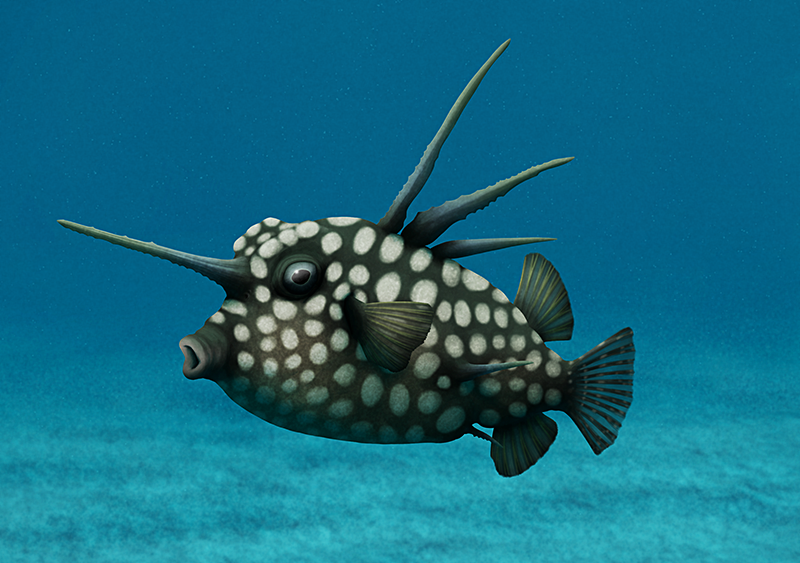
Eospinus daniltshenkoi, a tetraodontiform fish from the early Eocene of Turkmenistan (~56-48 mya). Only about 5cm long (2″), it was a close relative of modern boxfish and triggerfish, as well as a completely extinct group called spinacanthids.

It was heavily armored, with large plate-like scales creating a boxfish-like carapace, but its most distinctive feature was its multiple long spines – three dorsal spines on its back, a fourth on its head resembling a “horn”, a pair of smaller spines on the sides of its body, and one on its underside formed from partially fused vestigial pelvic fins.

Potanichthys

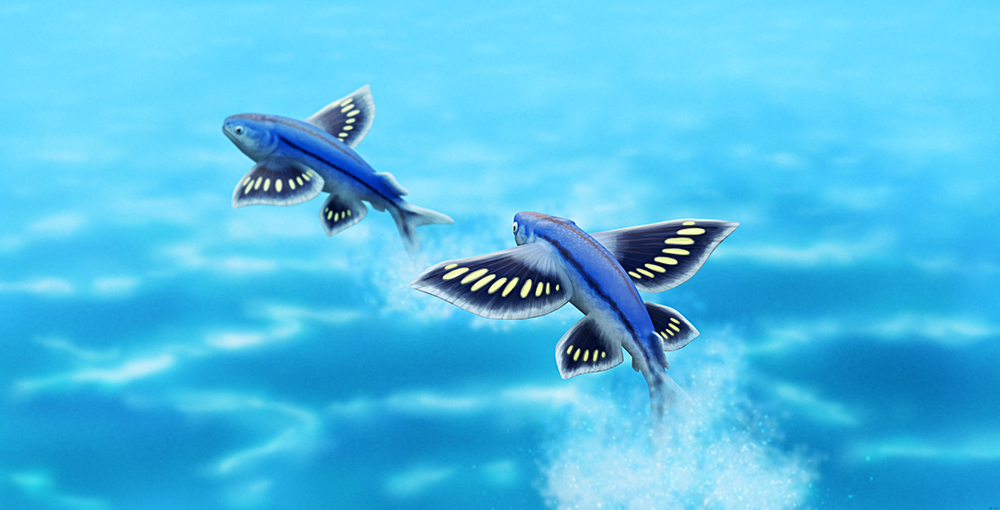
Potanichthys xingyiensis, a fish from the Middle Triassic of China, living around 235-242 million years ago.Measuring about 15cm long (6″), it was one of the oldest known fish capable of aerial gliding – possessing a “four-winged” body plan with enlarged pectoral and pelvic fins, and an asymmetrical tail with a long lower lobe. It was also almost completely scale-less, which may have helped to reduce drag and make it more aerodynamic.

Despite the similar appearance it had no close relation to modern flyingfishes, and was instead a result of convergent evolution in a completely different lineage of the ray-finned fishes.

Edestus

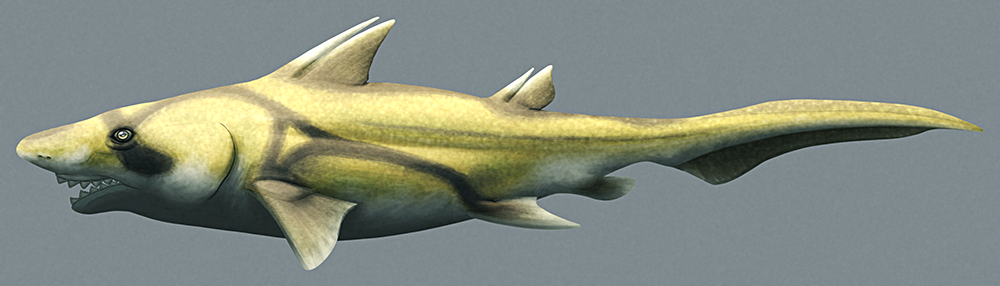
Edestus, a holocephalan fish from the Late Carboniferous (~315-299 mya) of Eurasia and North America. A relative of the “spiral-saw-mouthed” Helicoprion, it continuously grew a single row of teeth in each jaw, creating an arrangement often compared to a pair of pinking shears.

Multiple species of this genus have been named, with varying degrees of tooth bracket curvature, and the largest may have had body sizes similar to modern white sharks – about 6m long (19′8″).

Since Edestus is only known from fossilized tooth brackets, how exactly its jaws worked and what it ate with them is still a mystery. Many reconstructions end up either goofy or horrifying as a result, and so I’ve attempted to make this one look a bit more “normal”. And capable of closing its own mouth.


Edit: This reconstruction was based more on chimaeras than on other eugeneodontids, and is therefore probably very inaccurate. When I originally did this image I wasn’t aware body outlines were known for the group. For a much more accurate version see my 2020 version in the “Weird Heads” series.