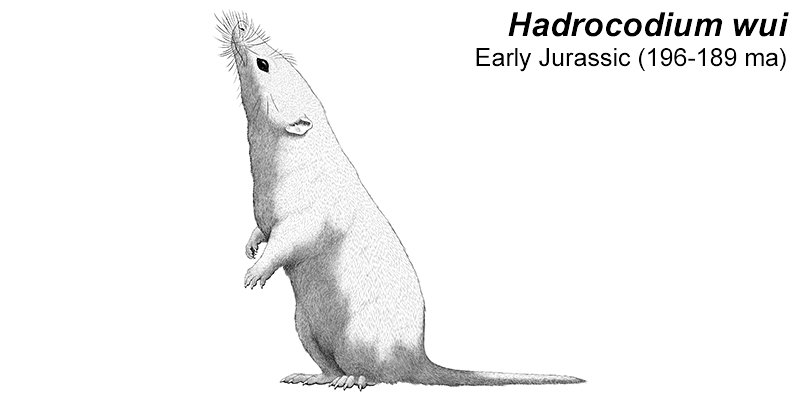
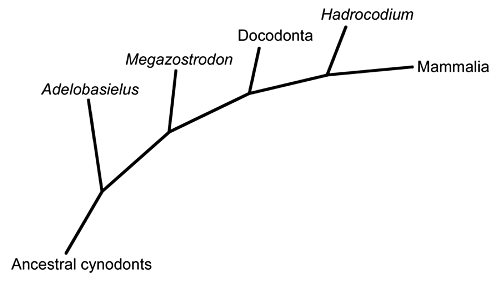
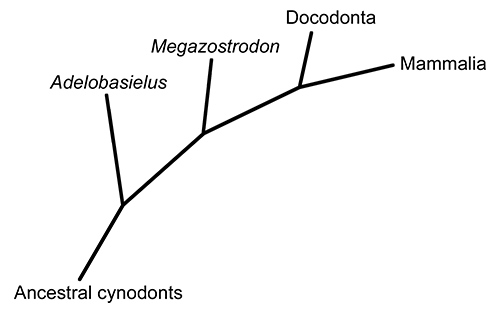
Falling evolutionarily between the docodonts and Mammalia itself, Hadrocodium is an important transitional form in the early mammal family tree. Something very similar to it would have been the common ancestor of all modern mammals.
Living in China during the Early Jurassic (196-189 mya), it was one of the first known mammals to have both an enlarged brain cavity and the characteristic middle ear bones of modern mammals, about 45 million years earlier than such traits were previously thought to have evolved.
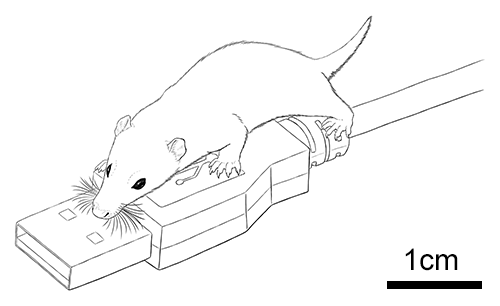
It was also one of the smallest mammals of all time, measuring only about 3cm long (1.2″) – similar in size to the smallest mammals alive today, the bumblebee bat and Etruscan shrew.
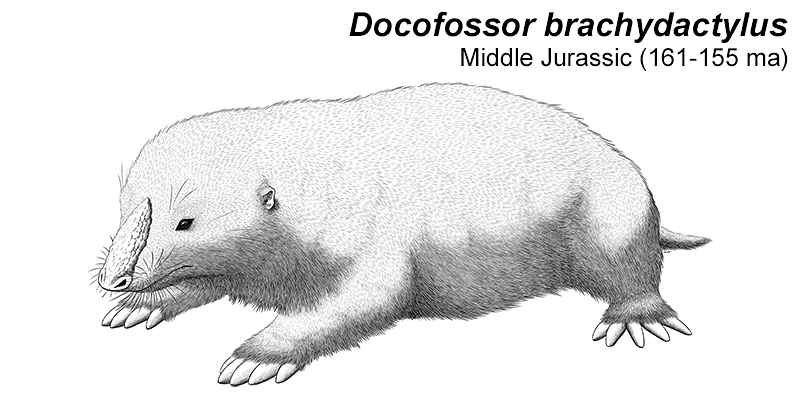
The docodonts didn’t stop at exploiting ecological niches in the trees and water. Another branch of the group specialized into underground burrowing, developing convergent features remarkably similar to modern golden moles.
Docofossor is known from the Middle Jurassic of China (161-155 mya), and measured about 10cm long (4″). It had large shovel-like fingers, strong forelimbs, short sprawling hindlimbs, and pointed teeth adapted for capturing invertebrate prey. (I’ve also given it a patch of protective keratinized skin on its snout here, based on the related Haldanodon.)
It had a reduced number of bones in its fingers, a modification identical to some modern mammals – suggesting that these relatively “primitive” mammals were already using the exact same genes to regulate their anatomical development.
While some docodonts like Agilodocodon were going up into the trees, another branch of the group was specializing into semi-aquatic habits instead.
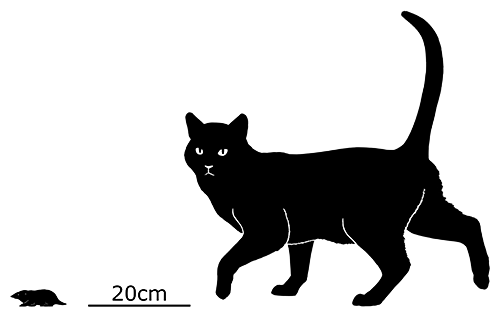
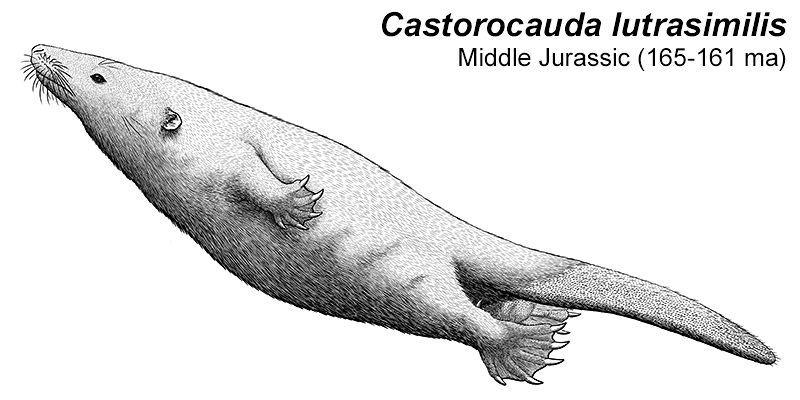
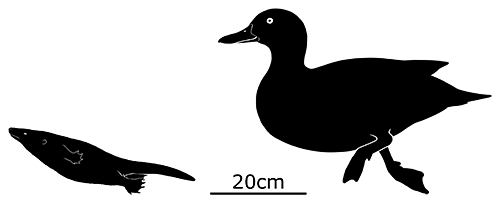
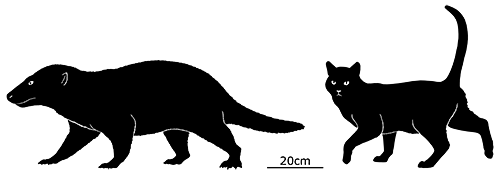
Castorocauda is known from the Middle Jurassic of China (165-161 mya), represented by an exceptionally preserved fossil showing soft tissue and hair impressions. About 40cm long (1′4″), it would have lived in a wetland environment and was well-adapted for swimming, with a flattened scaly beaver-like tail, webbed toes, and a coat of dense fur very similar to that of modern mammals, made up of both guard hairs and underfur.
Its strong forelimbs suggest it was capable of digging burrows, like modern platypus, and its sharp backwards-pointing teeth indicate a diet of slippery prey such as fish and worms.
It was also one of the earliest known mammals with (possibly venomous) spurs on its ankles. This feature is only seen today in monotremes, but seems to have been an ancestral trait common to all early mammals that was later lost in the lineage leading to marsupials and placentals.
Before we get to the actual-Mammalia-mammals, there’s one more group of mammaliaformes who deserve some attention – the docodonts.
Falling evolutionarily just outside of Mammalia itself, docodonts first appeared in the mid-Jurassic and lasted until the Early Cretaceous. They used to only be known from teeth and jaw fragments and were thought to have been fairly generic shrew-like terrestrial insectivores, but more recent discoveries have shown them to have actually been some of the earliest mammals to specialize into diverse habitats.
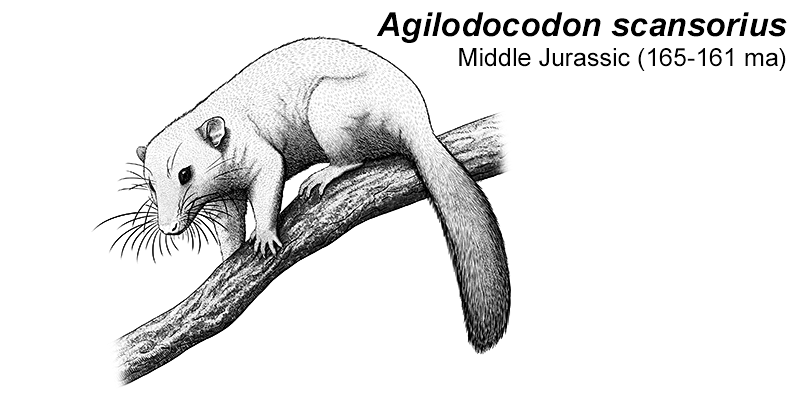
Agilodocodon was adapted for climbing around in trees, making it one of the earliest known arboreal mammals (although not the first climbing synapsid). Living in China during the Middle Jurassic (165-161 mya), it measured about 13cm long (5″) and had sharp gripping claws and flexible wrists and ankles similar to modern climbing mammals like tree squirrels.
When it was first described in 2015 it was suggested that its spade-like front teeth were specialized for gnawing bark and feeding on tree sap – but a later study found that its teeth didn’t really resemble those of any modern sap-eating mammals, and in fact were closer in shape to those of insectivorous marsupials and elephant shrews.
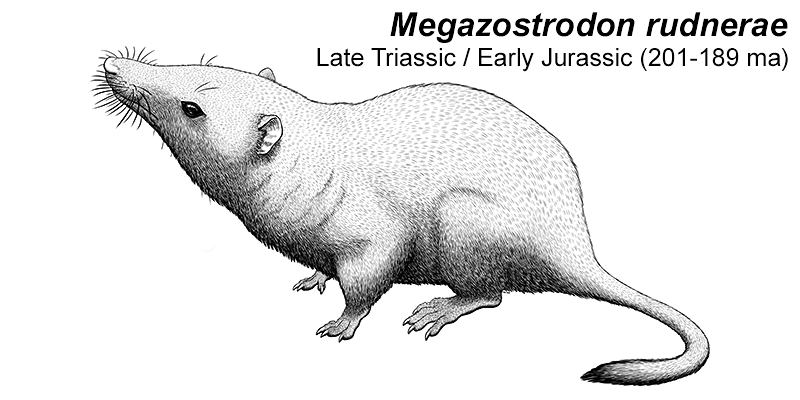
If there’s one Mesozoic mammal that’s been relatively well-mentioned in dinosaur books and popular media for many years, it’s undoubtedly Megazostrodon. Often depicted as “the first mammal”, it actually occupies a point in the mammal evolutionary tree somewhere between the earliest mammaliaformes and the common ancestor of all modern groups.
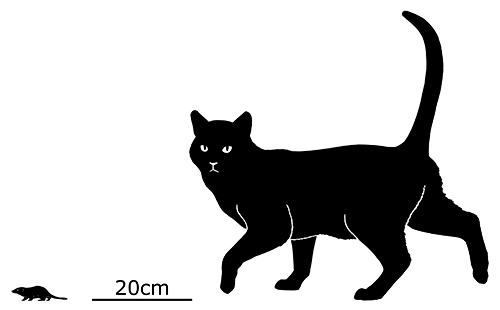
Megazostrodon lived during the very end of the Triassic and the Early Jurassic of South Africa (201-189 mya), and is represented by some near-complete fossil material – a rarity for this sort of small ancient mammal, most of which are only known from teeth and other fragments.
About the size of a mouse, only about 12cm long (5″), it was an insectivore with teeth adapted for chewing and crunching through hard arthropod shells. Enlarged regions of its brain associated with the senses of hearing and smell show it was likely nocturnal, occupying an ecological niche similar to modern shrews.
It probably reproduced similarly to modern monotremes, laying small parchment-shelled eggs and lactating from patches of skin. Fossils of the closely related and similar-looking Morganacudon show evidence of toothless infants and juveniles with a single set of milk teeth, suggesting these were some of the first mammals whose young were entirely dependent on milk during the earliest stages of life.
The exact line between “highly mammal-like cynodonts” and “actual mammals” is very blurry. The transition was gradual and the fossil record is incomplete, and even the definition of “mammal” varies depending on who you ask. Do we take the strictest possible route and only include everything coming after the most recent common ancestor of all living mammals – the “crown group” Mammalia itself? Or do we go broader and also include the closely related Mammaliaformes, which already had some of the defining anatomical features of mammals?
(For the purposes of this theme month I’m considering mammaliaformes to count as mammals, but if you prefer the crown group definition then it’ll be a few more days before we reach Mammalia-proper.)
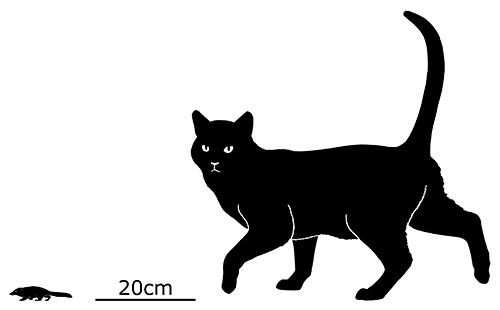
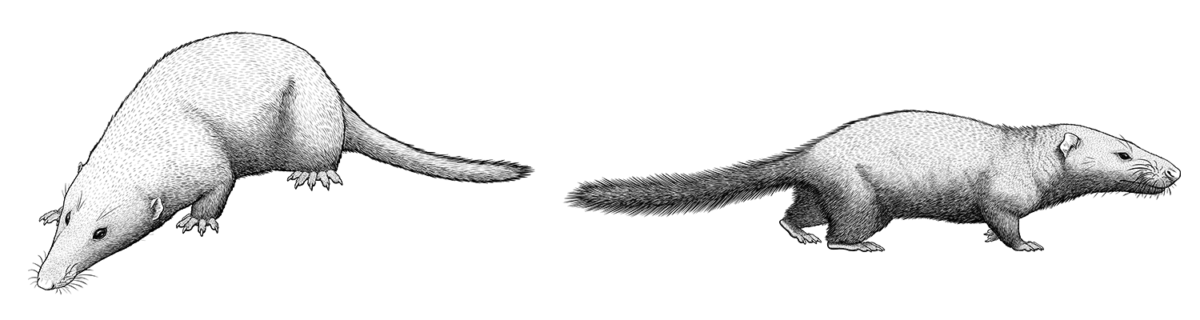
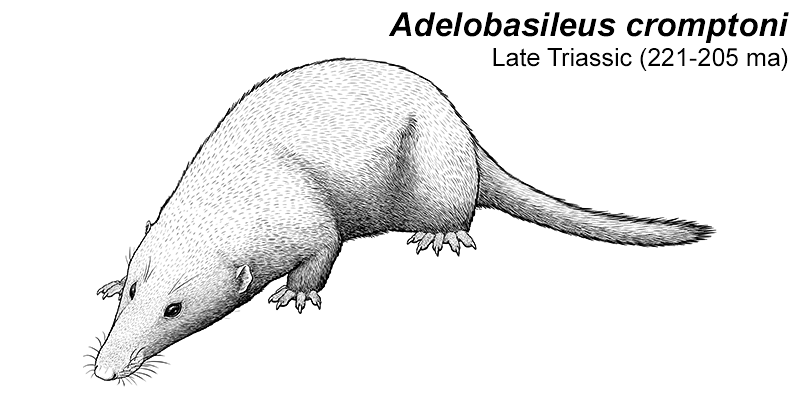
Adelobasileus cromptoni
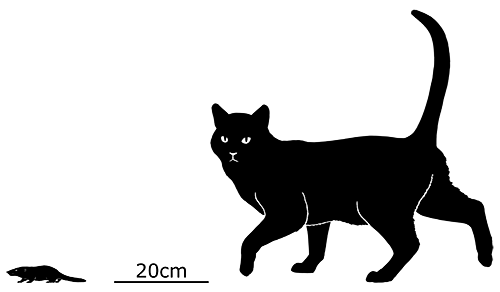
The earliest ancestral mammaliaformes would have looked something like Adelobasileus, a transitional form from the Late Triassic of Texas, USA (221-205 mya). About 10-15cm long (4-6″), it was probably a shrew-like insectivore and may have been close to the start of the hypothetical “nocturnal bottleneck” in mammal evolution – a point where mammal ancestors are thought to have taken up nighttime activity patterns to avoid competition and predation from early dinosaurs.
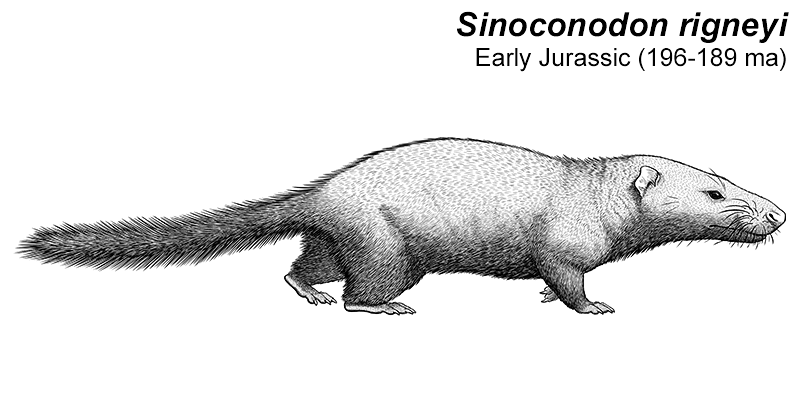
Sinoconodon rigneyi
Sinoconodon is known from the Early Jurassic of China (196-189 mya). Unlike later mammals it seems to have experienced reptile-like continuous slow growth throughout its lifespan, and had multiple replacements of some of its teeth.
Fossils of several different life stages have been found, averaging at similar sizes to Adelobasileus, but the biggest and longest-lived specimens are estimated to have reached the size of a large brown rat at around 35cm long (1′2″) and 500g in weight (~18oz) – big enough to be a weasel-like carnivore feeding on small vertebrate prey.
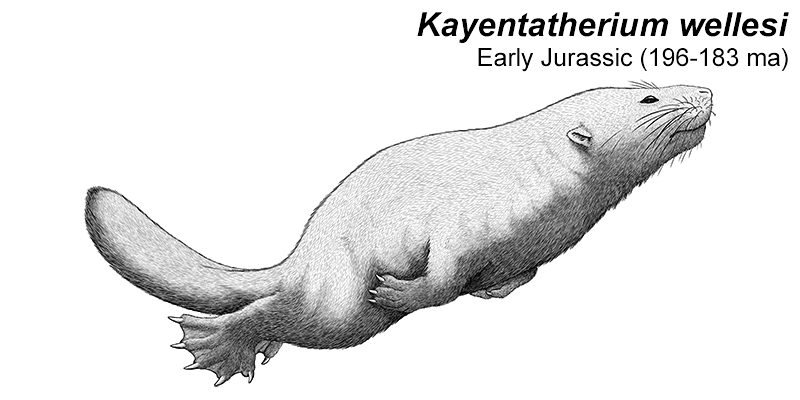
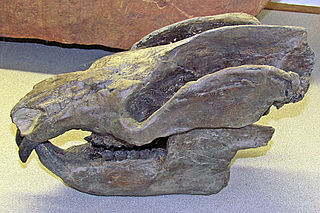
Known from the Early Jurassic of Arizona (196-183 mya), Kayentatherium was part of a group of cynodonts called tritylodontids – very close cousins of the true mammals, specialized for herbivory. They had strong jaw muscles, large incisors, and grinding cheek teeth, an arrangement convergently similar to modern rodents, and were some of the latest-surviving non-mammalian synapsids, persisting into the Early Cretaceous.
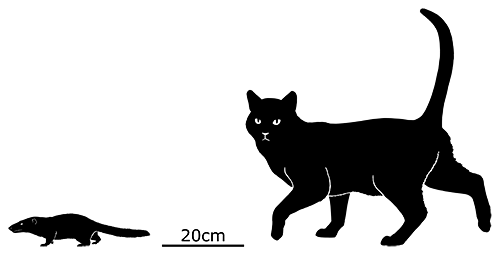
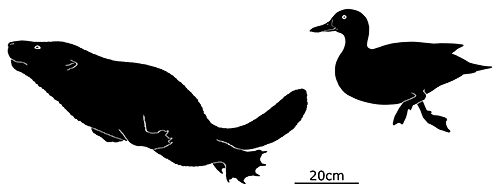
Kayentatherium was one of the larger tritylodontids at just over 1m long (3′3″), and appears to have been semi-aquatic, with oar-shaped hindlimbs and a flattened beaver-like tail. Although not the first non-mammalian synapsid to be interpreted as a swimmer, it was the earliest close relative of the true mammals to develop these sorts of adaptations.
Welcome to March, and the Month of Mesozoic Mammals!
Although traditionally depicted as tiny “boring” shrew-like animals completely overshadowed by the dinosaurs they lived alongside, in the last decade or two we’ve discovered that Mesozoic mammals were actually incredibly diverse. They ranged in size from only a few centimeters to over a meter long, adapted to a wide range of ecological niches, and developed into some of the most successful and long-lived mammal groups of all time.
So this month we’ll be looking at how mammals evolved and experimented during the Age of Dinosaurs, from their earliest Triassic ancestors all the way to the end-Cretaceous extinction.
Starting with…
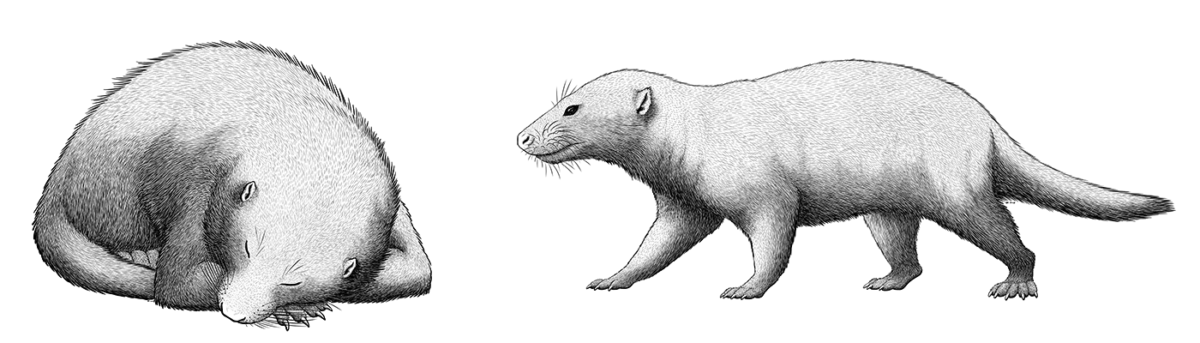
Thrinaxodon & Trucidocynodon
All mammals are synapsids (related to animals like Dimetrodon), and are descended from a group known as the cynodonts.
Cynodonts originated in the Late Permian, about 260 million years ago, and were one of the few synapsid lineages to survive through the devastating Permian-Triassic extinction. Although not quite mammals themselves, their skeletons were already fairly mammal-like, with semi-upright postures, differentiated thoracic and lumbar vertebrae, a secondary palate that allowed them to eat and breathe at the same time, and pits on their snouts suggesting they had well-developed whiskers – which would also imply the presence of a coat of fur, since whiskers are modified hairs.
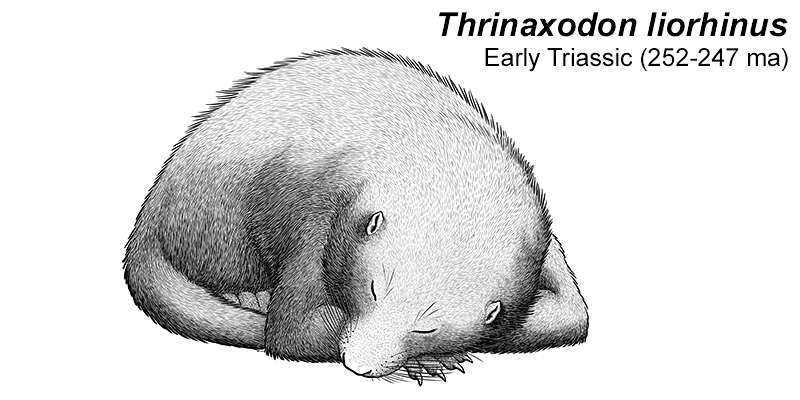
Thrinaxodon liorhinus
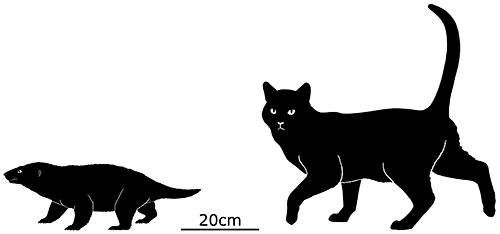
Thrinaxodon was an early cynodont about 50cm long (1′8″), living in the Early Triassic of South Africa and Antarctica shortly after the mass extinction (~252-247 mya).
It was capable of digging, with complete specimens found curled up inside their burrows, including pairs that may indicate some form of social behavior and one instance of sharing with a temnospondyl amphibian.
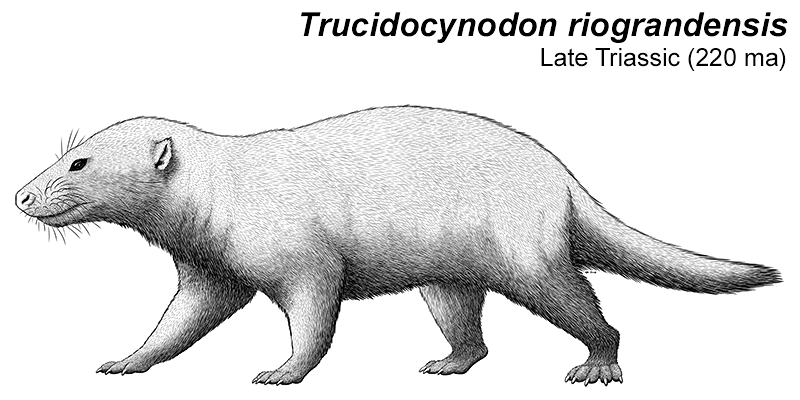
Trucidocynodon riograndensis
Trucidocynodon lived later during the Triassic in Brazil (~220 mya) and was one of the biggest known non-mammalian cynodonts at around 1.2m long (4′).
It had more upright limbs than some of its other relatives, and a semi-digitigrade stance that seems to have been adapted for running, suggesting it was an active predator. Considering it was living at a time when predatory crocodile-relatives and early dinosaurs were thought to be the dominant carnivores, its large size is especially surprising.
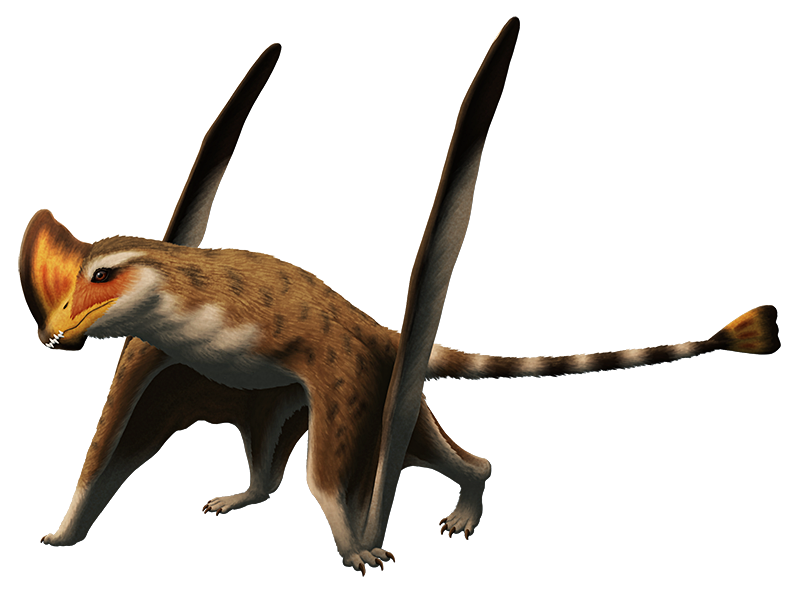
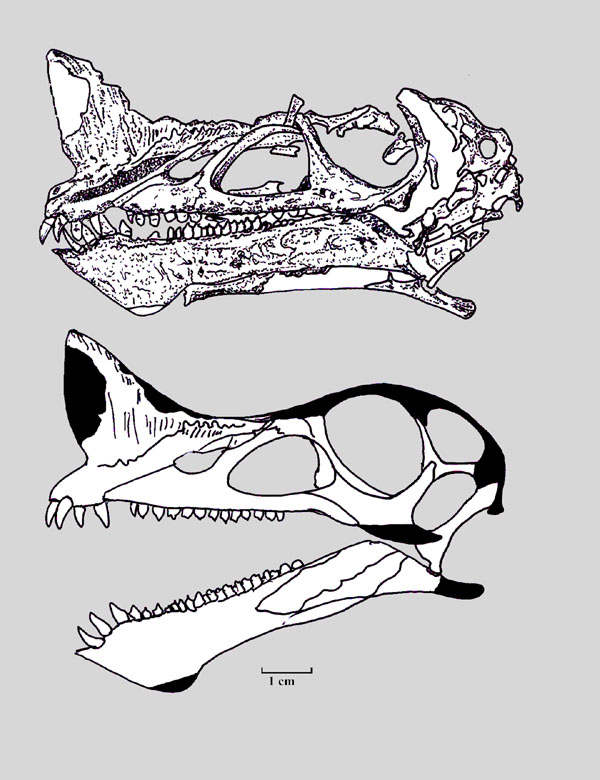
Caviramus schesaplanensis, a pterosaur from the Late Triassic of Switzerland (~205 mya). Known from two fossil specimens – a partial jaw and a much more complete skull and skeleton – it was about the size of a modern raven, with a length of around 60cm (2′) and a wingspan of 1.35m (4′5″).
(The more complete fossil is also sometimes considered to be a separate genus and species, Raeticodactylus filisurensis, depending on which pterosaur specialist you ask. If it was a different animal it still would have been very closely related to Caviramus, though, and the two would likely have looked very similar to each other.)
It had some odd anatomy for an early pterosaur, with proportionally long and slender limbs and a fairly heavily-built skull. There were bony crests on both its upper and lower jaws, with the upper crest probably supporting a much larger soft-tissue structure.
Powerful jaw muscles along with a combination of fang-like teeth at the front of its jaws and and serrated slicing-chewing teeth further back suggest it was specialized for eating particularly tough foods such as hard-shelled invertebrates – and it may even have been omnivorous, capable of eating plant matter as well.
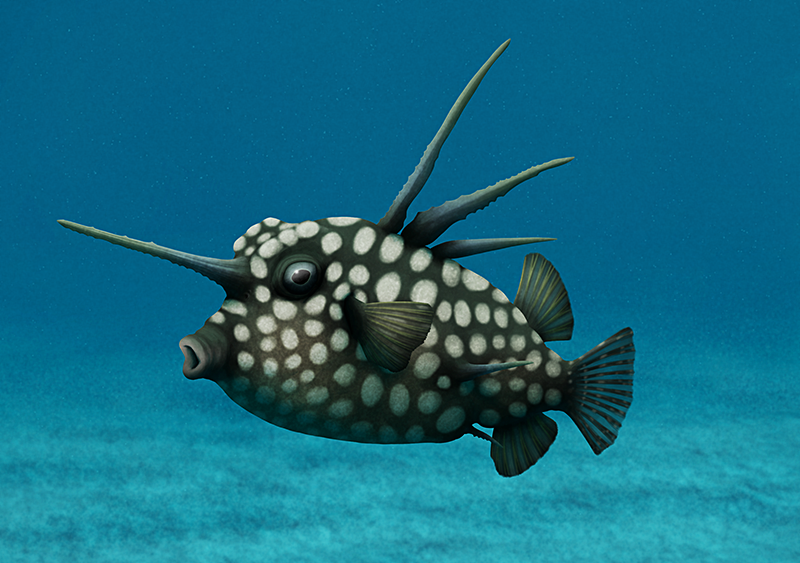
It was heavily armored, with large plate-like scales creating a boxfish-like carapace, but its most distinctive feature was its multiple long spines – three dorsal spines on its back, a fourth on its head resembling a “horn”, a pair of smaller spines on the sides of its body, and one on its underside formed from partially fused vestigial pelvic fins.