It Came From The Wastebasket #03: The Gomphothere In The Room

The three living species of elephants are the last surviving members of the proboscidean lineage – but up until the end of the last ice age about 11,000 years ago their relatives were much more numerous and widespread, found on every continent except Australia and Antarctica. Mammoths are probably the most famous of these recently-extinct proboscideans, closely related to modern Asian elephants, but there were also the more distantly-related stegodonts and mastodons

…And also the gomphotheres.

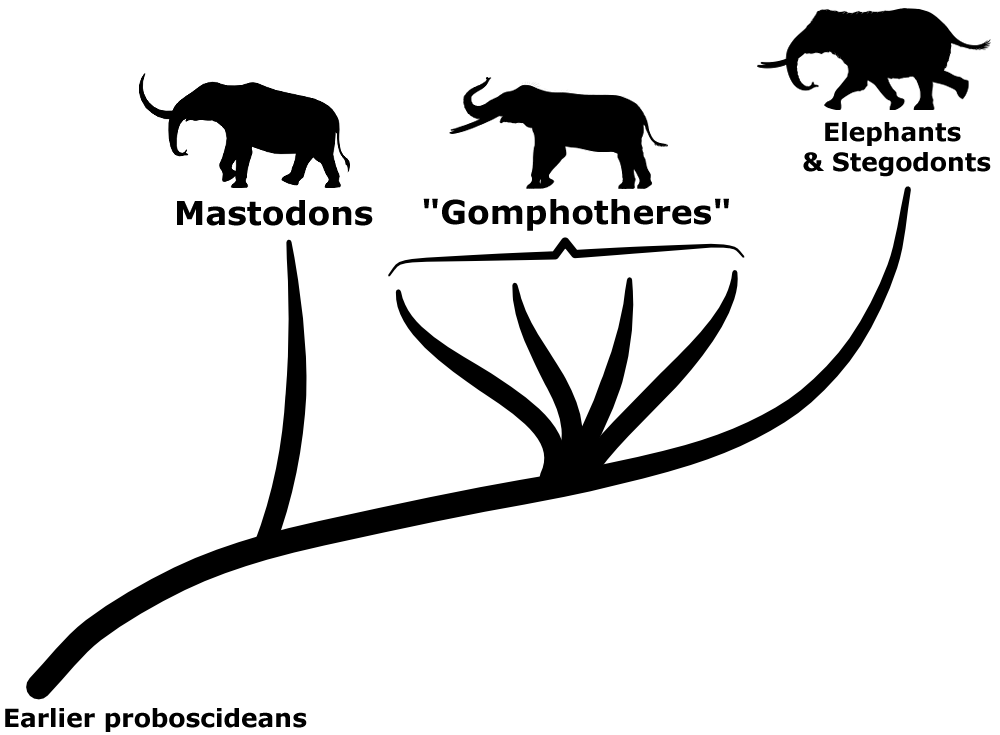
A cladogram showing the traditional classification of gomphotheres as a poorly-defined group evolutionarily between mastodons and modern elephants.

Traditionally any proboscideans that fell into the evolutionary grade between mastodons and elephants-and-stegodonts were all labelled as gomphotheres. As a result by the late 20th century this group ended up as a wastebasket full of elephant-like forms that didn’t easily fit anywhere else, defined more by what they weren’t rather than by any features they all had in common.

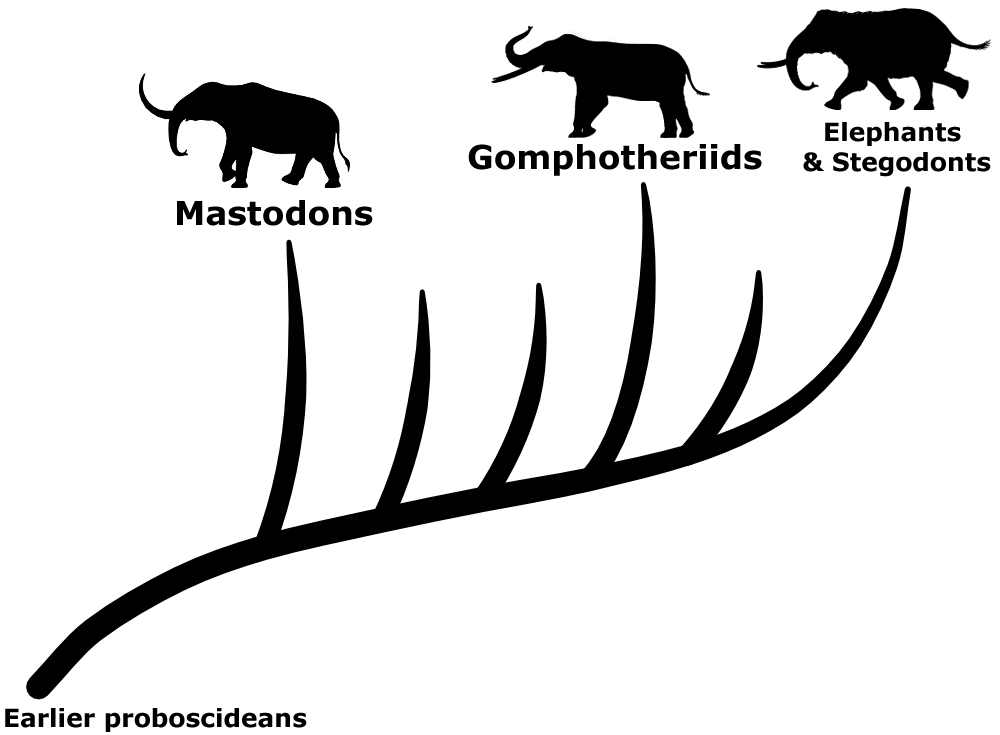
This big collection of gomphotheres was highly diverse. Some species independently evolved similar convergent features, and there was also considerable individual physical variation within species, making the actual taxonomy of these animals very difficult to figure out. But over the last few decades there’s been a lot of revision of proboscidean evolutionary relationships, and gradually the gomphothere wastebasket has been clearing up. Groups like the choerolophodontids, amebelodontids, and anancids have been split off, leaving a more defined lineage of gomphotheres that do have shared anatomical characteristics – distinctive three-lobed trefoil-shaped wear patterns on their molar teeth.

A cladogram showing a more modern classification of gomphotheres, with the gomphotheriids as just one of several different lineages originating between mastodons and modern elephants.

These gomphotheriids were widespread, found across Africa, Europe, Asia, and the Americas – and they were especially successful in the latter. They arrived in North America during the Miocene (~16 million years ago) via the Beringia land bridge, and rapidly spread across the continent and down into Central America. They went on to become the only proboscideans to disperse into South America during the Great American Biotic Interchange, with two different lineages arriving at separate times – Notiomastodon around 2.5 million years ago, and Cuvieronius around 750,000 years ago.

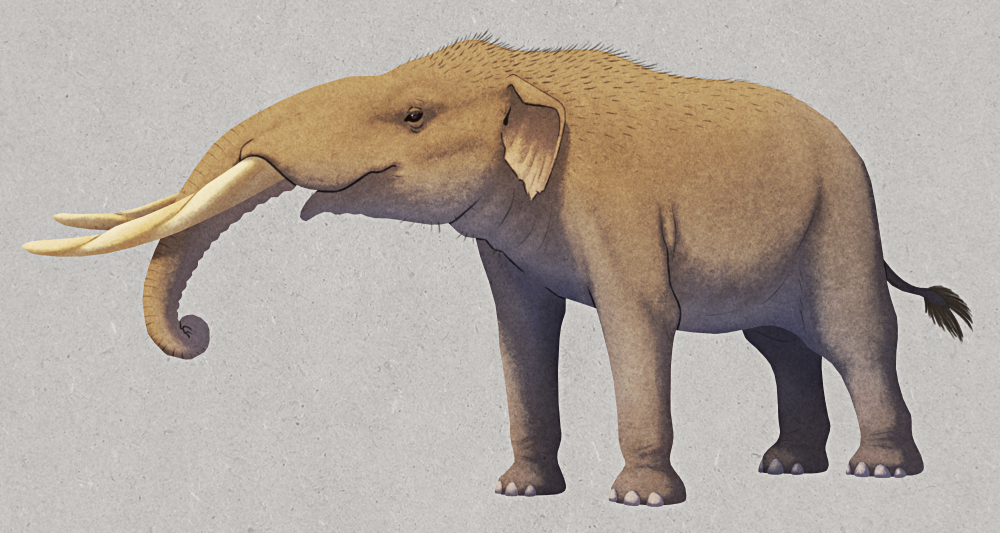
An illustration of Cuvieronius, an extinct elephant-like gomphothere. It has a longer flatter head than modern elephants, and its tusks have a spiral twist to them.
Cuvieronius hyodon, a 2.3m tall (7’7″) South American gomphotheriid with distinctive spiraled tusks.

The exact relationships of the gomphotheriids to other elephant-like proboscideans are still a little uncertain. Both protein sequences and mitochondrial DNA have recently been recovered from 35,000-13,000-year old Notiomastodon specimens, but these studies have given different taxonomic conclusions – with the protein results suggesting gomphotheriids were most closely related to mastodons, and the DNA results suggesting they were much closer to true elephants.

It Came From The Wastebasket #02: What Makes A Monoclonius?

The first fossil remains of Monoclonius crassus were discovered in the Late Cretaceous Judith River fossil beds (~75 million years old) in 1876 in Montana, USA. It was one of the many dinosaur species hurriedly named as part of the Bone Wars, and was described based on a mixture of bones from several different sites.

At first much of this dinosaur’s anatomy was poorly understood, and at first it was misidentified as a hadrosaur. The skull remains were fragmentary and ceratopsians hadn’t yet been identified as a group, so Monoclonius‘ horns weren’t even recognized as being horns and a piece of the frill was initially misinterpreted as part of a breastbone.

Once the much better-preserved Triceratops was discovered in 1889, and the existence of ceratopsians was recognized, Monoclonius was re-examined and identified as a similar dinosaur – and three more species were quickly described within the genus, also based on very fragmentary fossils.

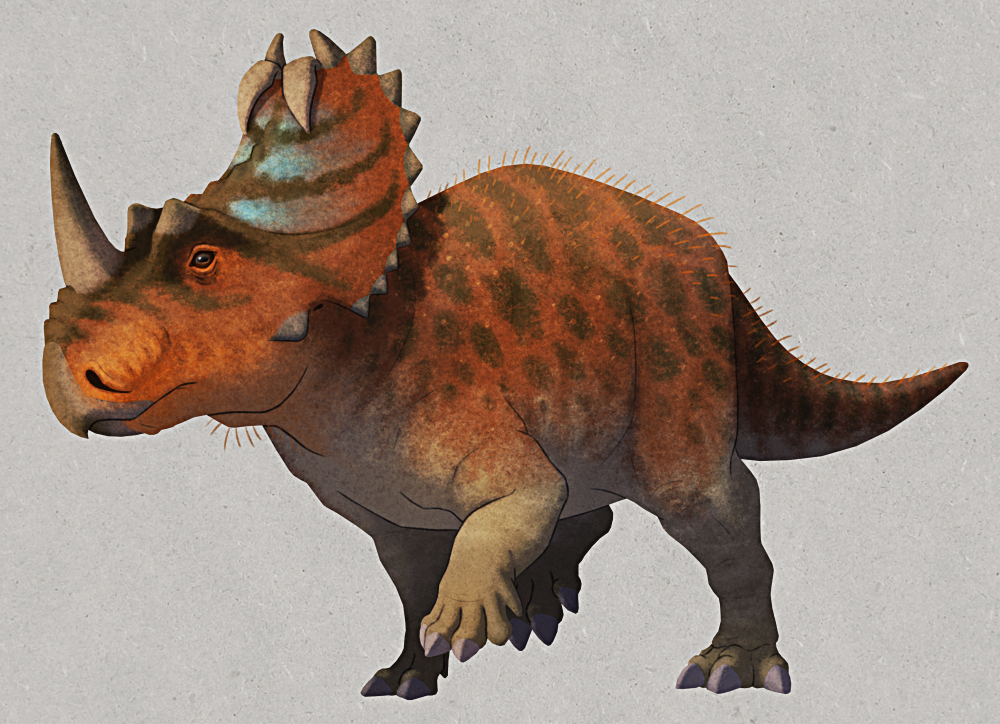
An illustration of Monoclonius, a dubious species of horned ceratopsian dinosaur. It has a parrot-like beak, a long straight nose horn, and a pair of small stubby brow horns. Its large bony neck frill is rimmed with small spikes, with a pair at the very top being longer and curling sharply downwards against the front of the frill. Its body is bulks and quadrupedal with a a thick tapering tail, and there are bumpy scales and sparse short quill-like spines on its back. It's colored mottled orange-and-brown, and there are hints of bright blue on its frill.
Monoclonius crassus

Then for a while afterwards every ceratopsid fossil that wasn’t clearly a Triceratops was then just dumped into Monoclonius, quickly turning the genus into a wastebasket full of dubious indistinct remains.

But then

The new challenger screen from Super Smash Bros Ultimate, with the character silhouette replaced by that of Centrosaurus, a horned ceratopsian dinosaur. Text on the image reads "A new foe has appeared! Challenger approaching!"

Centrosaurus apertus was named in 1904, from the similarly-aged Dinosaur Park Formation in southern Alberta, Canada. It had originally been one of the various species of Monoclonius, but was now claimed to be different enough to deserve its own separate genus name – and this started a decades-long controversy between several paleontologists.

Over the new few decades arguments went back and forth over whether Centrosaurus was actually valid or if it was just a junior synonym of Monoclonius. As more and better ceratopsid fossil material was discovered several other Monoclonius species were eventually split off into their own separate genera, too, creating Styracosaurus, Chasmosaurus, and the somewhat dubious Brachyceratops. But other new species also continued to be lumped into Monoclonius up until 1990, meaning that over its century of existence this wastebasket taxon had at one point or another contained at least 16 different species.

During the 1990s opinion began to turn against Monoclonius, increasingly regarding it as a dubious name. Its original type specimen was a chimera of multiple different individuals (and possibly multiple different species), and it just didn’t have any distinct enough anatomical features to distinguish it from other ceratopsids.

Centrosaurus, meanwhile, was further validated by the discovery of huge bonebeds containing thousands of individuals, making it into one of the best-known of all ceratopsians.

Today Monoclonius’ name remains attached to a few fossil specimens, but only the ones that are too indistinct to classify as anything else. Some “Monoclonius” have also turned out to actually be juveniles and subadults of other ceratopsians – it seems many young centrosaurines had a Monoclonius-like stage in their growth, before they went on to develop their own species’ distinctive horn and frill shapes.

So Monoclonius may never have been a distinct genus at all – it was just a bunch of different ceratopsian teenagers!

It Came From The Wastebasket #01: Is This An Insectivore?

Most of the wastebasket taxa featured this month are completely extinct and known only from fossils, but to start things off let’s take a look at a major example of how even groups with living members could have their classification muddled up for centuries.


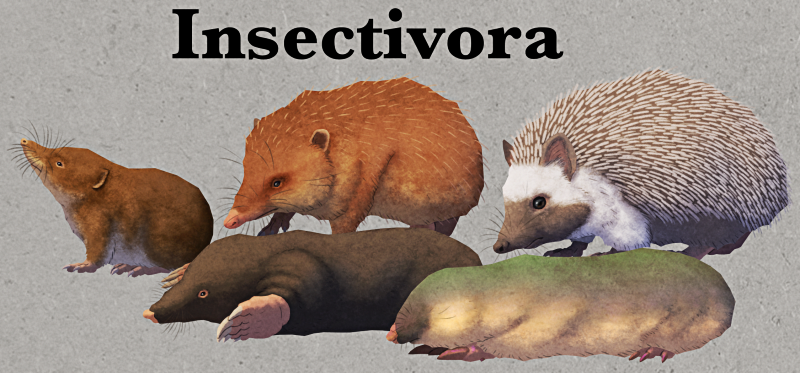
The name Insectivora first came into use in the early 1820s, and was used to refer to various “primitive-looking” small insect-eating mammals, with modern shrews, moles, hedgehogs, tenrecs, and golden moles as the original core members.

An illustration showing the animals that originally made up "Insectivora". From left to right it pictures a shrew, a tenrec, and a hedgehog on the top row, and a mole and a golden mole on the bottom row. Text at top of the the image reads "Insectivora".
Insectivora

Then over the next few decades solenodons, treeshrews, sengis, and colugos all got lumped in with them too.

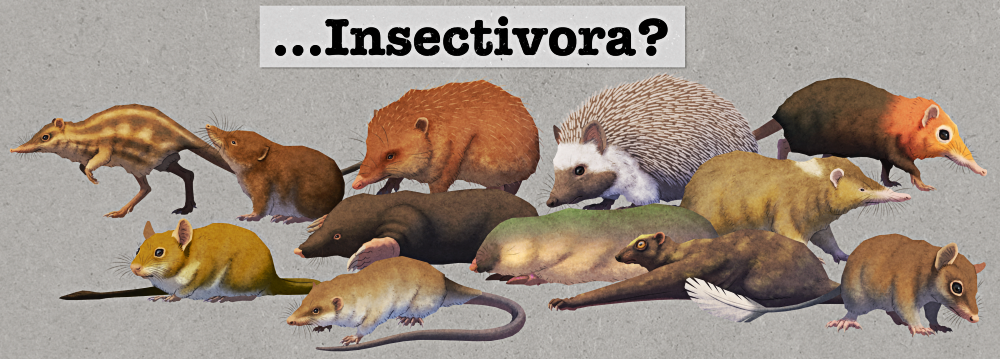
By the early 20th century insectivorans were considered to represent the “primitive” ancestral stock that all other placental mammals had ultimately descended from, and any vaguely similar fossil species also got dumped under the label. Extinct groups like leptictids, cimolestans, adapisoriculids, and apatemyids all went into the increasingly bloated Insectivora, too, making the situation even more of a wastebasket as time went on.

An illustration showing the animals that made up the expanded historical version of "Insectivora". From left to right it pictures a leptictidan, a shrew, a tenrec, a hedgehog, and a sengi on the top row, an apatemyid, a mole, a golden mole, and a solenodon in the middle row, and a cimolestan, a colugo, and a treeshrew on the bottom row. Text at top of the the image reads "…Insectivora?", styled like a typewritten label that has been stuck over the previous image's text.
…Insectivora?

The problem was that the only characteristics that really united these various animals were very generic “early placental mammal” traits – small body size, five clawed digits on the hands and feet, relatively unspecialized teeth, and mostly-insectivorous diets – and attempts at making sense of their evolutionary relationships were increasingly convoluted.

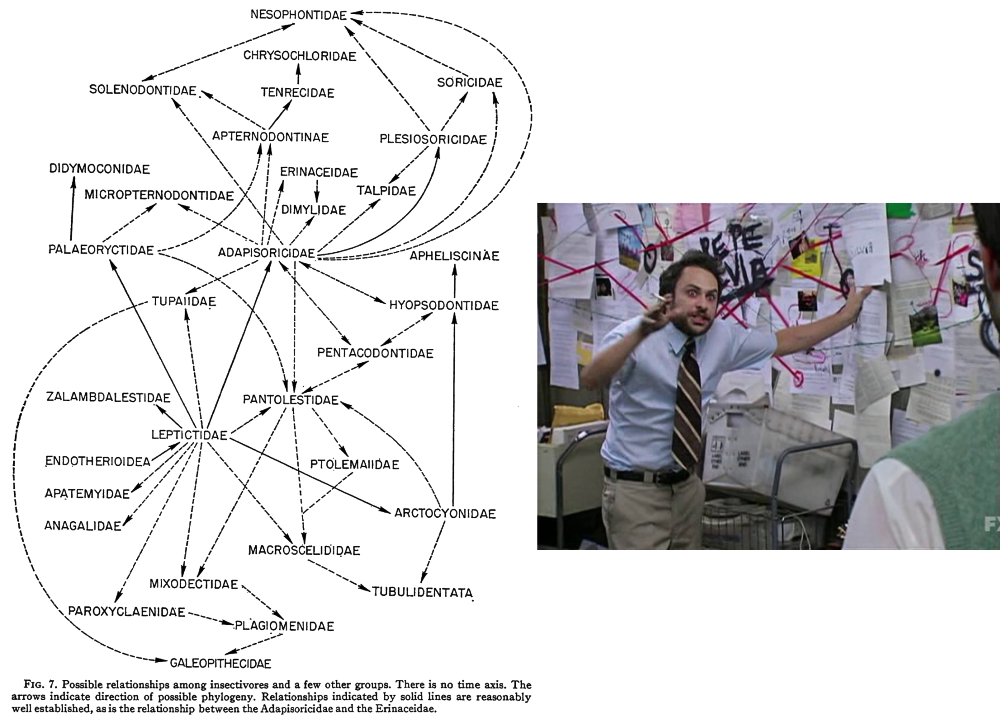
An image of a diagram from a 1967 academic paper, showing a complicated attempt to figure out the evolutionary relationships of "insectivores", with many different group names linked by arrows. For comparison next to it is the "Pepe Silvia" conspiracy wall meme.
…They’re the same image.

(Image sources: http://hdl.handle.net/2246/358 & https://knowyourmeme.com/memes/pepe-silvia)

The rise of cladistic methods from the 1970s onwards resulted in a lot of “insectivores” finally being recognized as unrelated to each other, removing them from the group and paring things back down closer to the name’s original definition. The idea that insectivorans were ancestral to all other placentals was abandoned, instead reclassifying them as being related to carnivorans, and the remaining members were recognized as just retaining a superficially “primitive” mammalian body plan.

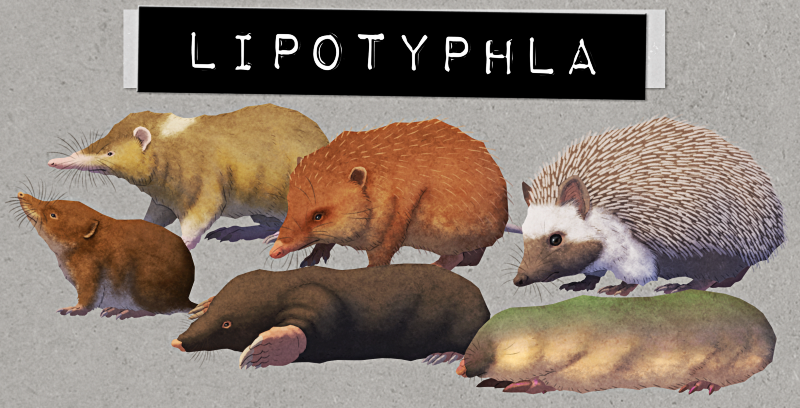
Just shrews, moles, hedgehogs, solenodons, tenrecs, and golden moles were left, and to disassociate from the massive mess that had been Insectivora this version of the group was instead now called Lipotyphla.

An illustration showing the animals that made up "Lipotyphla". From left to right it pictures a solenodon, a tenrec, and a hedgehog on the top row, and a shrew, a mole, and a golden mole on the bottom row. Text at top of the the image reads "Lipotylpha", styled like an embossed label-maker sticker that has been stuck over the previous images' text.
Lipotyphla

But there were still no unique anatomical links between the remaining lipotyphlans. And then once genetic methods became available in the late 1990s, something unexpected happened.

Studies began to suggest that tenrecs and golden moles were actually part of a completely different lineage of placental mammals, the newly-recognized afrotheres, with their closest relatives being sengis and aardvarks. Meanwhile the rest of the lipotyphlans were laurasiatheres, closely related to bats, ungulates, and carnivorans.

Lipotyphla was suddenly split in half. For a while it was unclear if even the remaining shrew-mole-hedgehog-solenodon group was still valid – hedgehogs’ relationships were especially unstable in some studies – but by the mid-2000s things began to settle down into their current state.

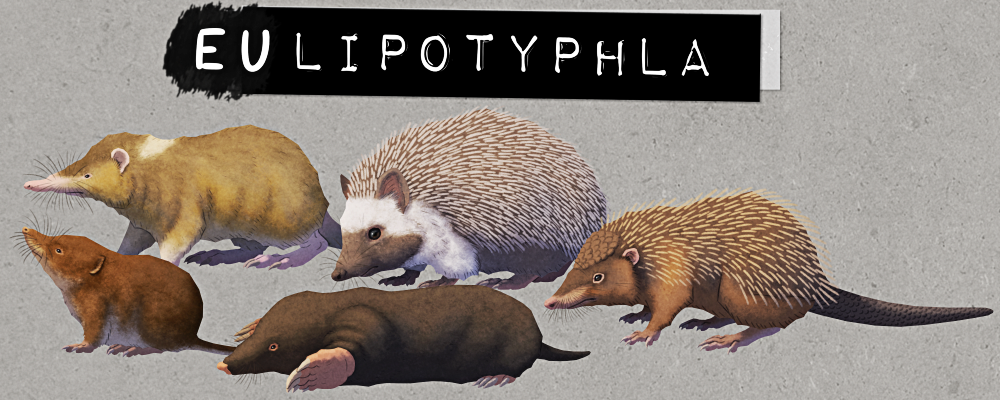
Finally, after almost 200 years of confusion, the insectivore wastebasket has (hopefully) now been cleaned up. The remaining “true lipotyphlans” do seem to all be part of a single lineage, united by their genetics rather than by anatomical features, and are now known as Eulipotyphla.

A few fossil groups like nyctitheriids and amphilemurids are generally also still included, but since this classification is based just on their anatomy it isn’t entirely certain. The only exception to this are the nesophontids, which went extinct recently enough that we’ve actually recovered ancient DNA from them and confirmed they were eulipotyphlans closely related to solenodons.

An illustration showing the animals that now make up Euipotyphla. From left to right it pictures a solenodon, and a hedgehog on the top row, and a shrew, a mole, and an amphilemurid on the bottom row. Text at top of the the image reads "Eulipotylpha", with the letters "E" and "U" hastily scribbled onto the front of the previous image's text.
Eulipotyphla

And a bonus image with species IDs:

Continue reading “It Came From The Wastebasket #01: Is This An Insectivore?”

It Came From The Wastebasket

Taxonomy – the naming, description, and classification of living things – is one of the foundations of biology and ecology. We need to know what things are in order to properly understand them and their evolutionary relationships, and without that we can’t build up an accurate picture of the true diversity of life on Earth.

Taxonomy of living species is also vital for conservation efforts, recognizing unique species that would otherwise go unnoticed. Accidentally using the same name for multiple things can easily mask the decline and potential extinction of critically endangered populations – for example, if we’d just assumed all Galápagos giant tortoises were exactly the same we’d never have realized that Lonesome George was the last known individual of the Pinta Island subspecies, or made efforts to find living hybrid descendants of his kind.

Meanwhile the paleontological taxonomy of fossils helps us to understand where things came from, and to identify long-term trends of evolution, diversity, and extinction over time. The history of life shows us how different types of organisms coped with changing conditions in the past, so we can try to predict how current climate change will affect the biosphere in the present and future.

But sometimes species don’t neatly fit into our classification system. Maybe they’re rather “generic” or “primitive” examples of that type of organism and don’t really have many unique or specialized features, or maybe the scientists describing them just weren’t able to classify them more specifically at the time, but either way they often end up with the same fate: dumped into a wastebasket taxon.

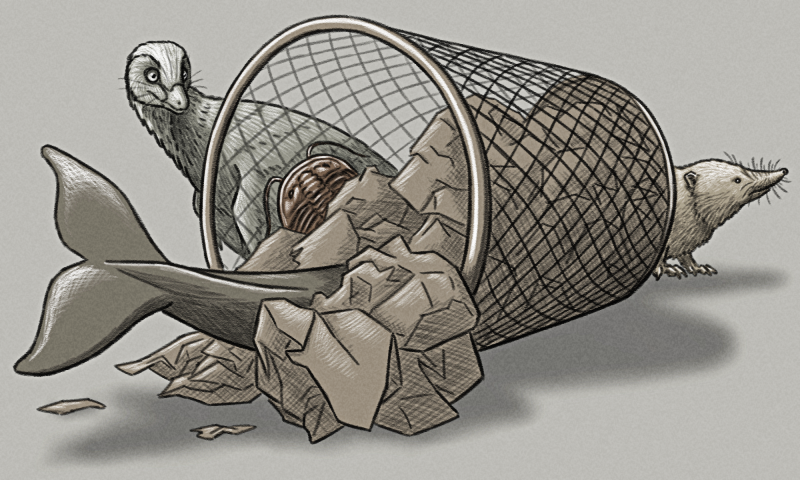
A pencil sketch of a wire mesh waste-paper basket, tipped over on its side with crumpled pieces of paper spilling out. A whale's tail and a trilobite are poking out of the trash, while a bird-like feathered dinosaur and a shrew-like mammal peer around the sides of the toppled basket.

Wastebaskets aren’t natural lineages, just a default label for things that don’t seem to fit anywhere else, and they’re basically somebody else’s problem to sort out later. Sometimes they can even end up containing things that superficially look very similar to each other but later turn out to not even be closely related at all.

This can be especially bad in paleontology, where there’s often only poorly-preserved and fragmentary fossils to work with and usually no way to verify evolutionary relationships with modern genetic analysis. This can result in wastebaskets getting especially bad if left unchecked – like how for a while in the 19th and 20th centuries many fragmentary theropod dinosaurs were just dumped into Megalosaurus, resulting in over 50 dubious species that eventually needed to be carefully reevaluated, renamed, and reclassified.

Every weekday this October we’ll be looking at a different example of these sort of taxonomic tangles – so I’ll see you all on Monday with one the worst historical wastebaskets…

Spectember 2022 #04: Aquatic Brontotheres

Squeezing in one last bonus #Spectember post this year!

This one isn’t based on a specific prompt, but instead is a companion piece to a previous one.


While North American brontotheres were adapting to the spread of grasslands, some of their Asian cousins took a very different evolutionary path through the rest of the Cenozoic.

Continue reading “Spectember 2022 #04: Aquatic Brontotheres”

Spectember 2022 #03: Swimming Hummingbirds

Today’s #Spectember concepts come from three submitters: anonymous, Jonas Werpachowski, and Novaraptoria.

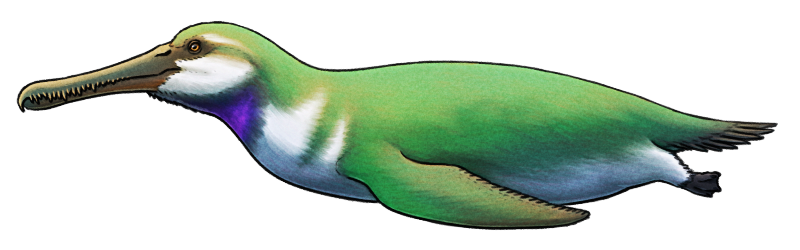
A digital illustration of a speculative future aquatic bird descended from hummingbirds, laying on its belly. It has a long beak with tooth-like serrations that give it a crocodilian appearance. Its body is penguin-like, with large flipper-wings, and it has relatively tiny webbed feet and a stubby tail. Its plumage is iridescent green and white, with a bright purple patch on its throat.
Humdertaker (Suchomergus pollinctor)

Despite having a convergent resemblance to penguins or gannetwhales, the humdertaker (Suchomergus pollinctor) is actually a distant descendant of modern hummingbirds.

Continue reading “Spectember 2022 #03: Swimming Hummingbirds”

Spectember 2022 #02: ‘Modern’ Brontotheres and Paraceratheres

Today’s #Spectember concept is a combination of a couple of anonymous submissions:

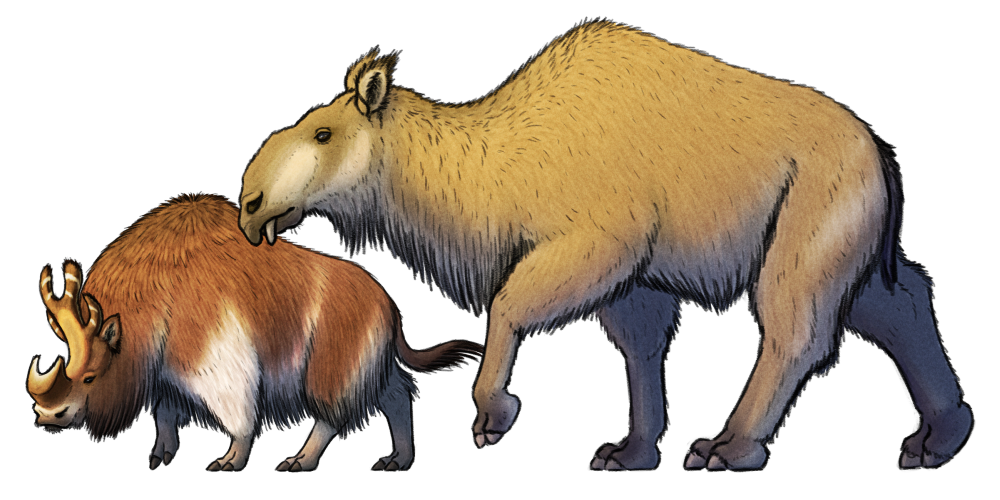
A digital illustration of two speculative hoofed mammals, descended from extinct brontotheres and paraceratheres. One resembles a hairy rhinoceros with an odd U-shaped horn on its nose and a fork-like bony "horn" on the back of its head. The other looks like a chunky camel with a moose-like bulbous nose and short downward-pointing protruding tusks.
Crowned brontothere (left) and woolly paracerathere (right)

These two animals are the descendants of brontotheres and paraceratheres, almost the last living representatives of their kinds, hanging on in the equivalent of modern-day times in a world similar to our own.

Continue reading “Spectember 2022 #02: ‘Modern’ Brontotheres and Paraceratheres”

Spectember 2022 #01: Arboreal Ornithopod

Despite some minor delays, it’s time once again for #Spectember – when I dive back into the big pile of speculative evolution concepts that you all submitted to me in 2020, and try to get through a few more of the backlog.

(…There’s still over 50 of them left. This is going to take a while.)

So today’s concept comes from an anonymous submitter, who requested an arboreal ornithopod dinosaur:

Continue reading “Spectember 2022 #01: Arboreal Ornithopod”

Retro vs Modern #23: Spinosaurus aegyptiacus

Spinosaurid teeth were first found in the 1820s in England, but were misidentified as belonging to crocodilians. It wasn’t until nearly a century later that Spinosaurus aegyptiacus was discovered and recognized as a dinosaur – and it would be another century after that before we really started to learn anything about it.


1910s

The first fossils of Spinosaurus were discovered in Egypt in the 1910s. With only a few fragments of its skeleton known it was an enigma right from the start, hinting at a large and very strange theropod dinosaur with crocodile-like teeth, an oddly-shaped lower jaw, and elongated neural spines on its vertebrae that seemed to be part of a huge sail.

A few possible extra fragments were found in the 1930s, but overall these few pieces were all that was known of Spinosaurus for a long time.

The fossils were kept in the Paleontological Museum in Munich, Germany,a building that was severely damaged during a bombing raid in World War II. Many important specimens were destroyed, including Spinosaurus, and only the published drawings and descriptions of the bones remained.

So for the next several decades Spinosaurus remained a very poorly-understood mystery. During this period it was generally depicted as a generic “carnosaur“, often modeled on something like Megalosaurus, in the standard-for-the-time tripod pose and with a Dimetrodon-like sail on its back.

Interestingly a 1930s skeletal reconstruction shows Spinosaurus with an unusually long torso and fairly short legs, details that are surprisingly modern despite the retro posture.


1990s

In the 1980s some partial snout bones from Niger were recognized as having similarities with the jaw of Spinosaurus. Around the same time the fairly complete skeleton of Baryonyx was discovered, and along with further spinosaurid discoveries in the mid-to-late 1990s a decent idea of what Spinosaurus might have looked like began to emerge.

It was reconstructed with a long kinked crocodilian-like snout, a ridged bony crest in front of its eyes, an S-curved neck, and large thumb claws on its hands – an interpretation that was heavily popularized by Jurassic Park III in the early 2000s, bringing this enigmatic dinosaur to public attention and portraying it as a fearsome super-predator bigger than Tyrannosaurus.


2020s

Despite attempts to locate more complete Spinosaurus remains, only fragments continued to be found, and it remained a frustratingly poorly-known species even into the early 2010s.

Finally, in 2014, almost a full century after it was first described and named, Spinosaurus started to reveal its secrets with the announcement of the discovery of the most complete skeleton so far, discovered in the Kem Kem fossil beds in Morocco. Its body was still only partially represented, but it included skull fragments, part of a hand, a complete leg and pelvis, some sail spines, and several vertebrae from the neck, back, and tail.

And nobody was expecting what these pieces revealed.

It had a very long torso and proportionally short stumpy legs, and was reconstructed with a huge distinctive “M-shaped” sail on its back. Its feet had flat-bottomed claws and its “dewclaw” toe was enlarged into an extra weight-bearing digit – adaptations for spreading its weight over soft muddy ground, and suggesting its feet may also have been webbed. Initially it was also presented as possibly being quadrupedal, due to how far forward its center of mass seemed to be, reviving an odd idea from the late 20th century.

Along with its long crocodile-like head and conical teeth, this was interpreted as evidence it was a semiaquatic fish-eating swimming animal – potentially making it the first known semiaquatic non-avian dinosaur. Spinosaurids had been suggested to be specialized piscivores before, especially since Baryonyx had been found with fish scales in its stomach, but they were generally assumed to be more like modern grizzly bears, wading into water to hunt but not being habitual swimmers. Spinosaurus’ weird croco-duck proportions, however, seemed like they might be much more suited to watery habitats than to the land.

Since Spinosaurus had become a popular dinosaur with the general public by that point, the discovery was big news – and a big controversy for a while. It was so bizarre that some paleontologists were skeptical of the radical new interpretation, wondering if the measurements of the skeleton were correct or if the short legs were even from the same individual or the same species as the rest of the bones.

After a while the new proportions were accepted as fairly accurate, and over the next few years attention turned to instead figuring out just how this animal worked and how aquatic it actually was. An earlier isotope analysis of its teeth supported a semiaquatic lifestyle similar to crocodiles and turtles, but a buoyancy study argued that it might not have been able to dive below the water suface and its sail made floating unstable – but also found that its center of mass was closer to its hips than previously calculated, suggesting it could walk bipedally after all.

Then in 2020 came another surprise: more of the tail of the new specimen had been found, and it was just as weird as the rest of Spinosaurus. Its tail was a huge vertically flattened paddle-like fin supported by long thin neural spines and chevrons, resembling a giant eel or newt more than a dinosaur and also giving some more weight to the idea that it was a swimmer.

Our modern view of Spinosaurus is still evolving, and likely to be full of even more surprises in the future as we discover more about this unique dinosaur. But we at least know it lived in what is now North Africa during the Late Cretaceous, about 99-93 million years ago, and whether it was a swimmer or wading generalist predator it was one of the largest known theropods to ever live, estimated to have reached around 16m long (~52ft).

While the “M-shaped” sail reconstruction has been popularized by the recent discoveries, the exact shape of this structure is still unknown. Like with other sailbacked animals it’s also not clear what it was for, with ideas including temperature regulation, visual display, supporting a fatty hump, and a potential hydrodynamic adaptation.

EDIT: And while I was working on this entry (late March 2022) I missed that another study had just come out with more anatomical support for swimming Spinosaurus!

Retro vs Modern #22: Tyrannosaurus rex

Probably the most famous and popular dinosaur of all time, Tyrannosaurus rex is also the only species commonly known by both its full scientific name and its abbreviation T. rex.


1900s-1960s

Fragments of what we now know are Tyrannosaurus fossils were first found in the Western United States in the 1870s, but it wasn’t until the early 1900s that a couple of partial skeletons were discovered and recognized as belonging to a new species of huge carnivorous theropod.

With its charismatic and memorable name meaning “tyrant lizard king” it was an immediate hit with the general public, portrayed as the “king of the dinosaurs” in pop culture and as the dramatic nemesis of Triceratops.

Like other bipedal dinosaurs of the time it was depicted in an upright kangaroo-like tripod pose, cold-blooded and lizard-like. Sometimes it was also shown with three-fingered hands, since its arms were poorly known for a long time – and while the closely-related tyrannosaurid Gorgosaurus was known to have had just two fingers, this wasn’t confirmed for Tyrannosaurus until the late 1980s.


1990s

During the 1970s and the early Dinosaur Renaissance it became obvious that bipedal dinosaurs like Tyrannosaurus couldn’t have stood so sharply upright without dislocating their hips and tail vertebrae.

Jurassic Park was influential in introducing this new corrected posture to the general public in the early 1990s, presenting a powerful and active predator with a more bird-like horizontal stance and its tail acting as a counterbalance. Reconstructions inspired by this portrayal became standard for Tyrannosaurus during the 1990s (although the old-style tripod remains in public consciousness even decades later), and while it didn’t tend to get as heavily shrinkwrapped as some other species it was still common for a while to push its belly ribs in as much as possible to make its bulky body look skinnier and more “athletic”.

The 1980s and 1990s were also a time when discoveries of new Tyrannosaurus specimens began to become much more frequent, improving knowledge of the species’ anatomy, biology, and life history. Some, like Sue, Stan, and the Dueling Dinosaurs, would also unfortunately end up becoming highly controversial, tied up in legal disputes for years and sold for multi-million-dollar prices.


2020s

After the explosion of feathered non-avian dinosaur specimens from China in the mid-1990s, eventually the small feathered tyrannosauroid Dilong was discovered in the early 2000s, followed by the much larger-bodied Yutyrannus in the early 2010s.

While these tyrannosauroids weren’t particularly closely related to Tyrannosaurus itself, the question of potential tyrant fuzz still began to loom, and for a while in the 2010s highly fluffy T. rex interpretations were popular in paleoart. But in the late 2010s a study of known skin impressions from Tyrannosaurus and several of its closer relatives showed that small pebbly scales were known from various parts of the body, and suggested that these particular dinosaurs were most likely primarily scaly. Sparser fluff was still possible on parts of the body, however, similar to the hair on modern elephants, and it’s also possible that juveniles were much fuzzier.

(While this is disappointing for fans of huge fatbird T. rex, it’s also a great example of the scientific process. The skin impressions hadn’t ever been properly described before this point, and the scaly interpretation had mostly been an assumption. Speculative fluffiness prompted all the skin evidence to actually be consolidated, and now we know a lot more about Tyrannosaurus’ potential outward appearance than we did before.)

Arguments about lips in theropod dinosaurs also went back and forth during the 2010s, with interpretations ranging from tight-skinned crocodilian-like snouts with exposed teeth to fleshy lizard-like lips similar to modern Komodo dragons. There’s not really a consensus yet, but since most non-beaked tetrapods do have lips the safe bet is still that dinosaurs like Tyrannosaurus would have had them too. 

Our modern view of Tyrannosaurus is a much chunkier animal than older interpretations, with  more extensive soft tissue, properly-positioned belly ribs showing that it had a barrel-shaped pot-bellied body, and its tail being thicker-muscled than previously thought.

Living across western North America – then the island continent of Laramidia – during the very end of the Cretaceous, about 68-66 million years ago, it was one of the largest terrestrial carnivores to ever live. The very biggest known specimens are estimated to have been as much as 13m long (~43′), with the proportionally large head making up around 1.5m of that (~5′).

Its skull was boxy at the back but narrow along the snout, allowing its forward-facing eyes to have hawk-like stereoscopic vision. Large fenestrae and a “honeycomb” of air spaces reduced the weight of the skull, while reinforced fused bones strengthened it, and Tyrannosaurus is estimated to have had an incredibly powerful bone-crushing bite force.

It had a highly developed sense of smell, and its hearing was geared towards low-frequency sounds. The texture of its skull bones suggests it may also have had thick toughened keratinous skin and bumps over its face, which might have been involved in head-shoving and headbutting behaviors.

Although proportionally tiny for its overall size, its arms were still rather beefy, with large areas for muscle attachment with “meathook” claws that may have been used to hold onto struggling prey.

As a heavily-built bulky carnivore it probably wasn’t especially fast, and its legs were adapted for energy-efficient walking rather than running. It may have been a long-distance stalker, only using short bursts of speed in a final ambush – and like most large carnivores it would have also opportunistically scavenged on carcasses, too.

Specimens once argued to belong to a separate smaller species of tyrannosaur, Nanotyrannus, are now generally accepted as actually being juvenile Tyrannosaurus. They show a surprising amount of physical change as these animals aged, starting out leaner-built with longer legs more suited for speed, slender more delicate snouts, and only developing the characteristic chunky adult proportions during a huge growth spurt in their mid-to-late teens.

Meanwhile, the latest big controversy over this dinosaur as of March 2022 (because there’s always something) is a study proposing splitting Tyrannosaurus into three separate species: T. rex, T. imperator, and T. regina. It doesn’t seem to be going down well, but much like the feather situation it probably at least means we’re going to see a lot of further investigation over the next few years.