Spectember Interlude: Mr. Dixon’s Wild Ride

The rhinogrades were the start of larger-scale speculative evolution works, but what truly popularized the genre to the general public are undoubtedly the works of Scottish geologist Dougal Dixon.

His 1981 book After Man was a “zoology of the future” using over a hundred speculative species to demonstrate the principles of evolution. Set 50 million years from now in the world of the Posthomic period, humans are long gone and the hardy survivors of a prior mass extinction have diversified and convergently evolved to fill vacant ecological niches, including rabbits becoming ungulate-like animals, penguins becoming giant whale-like creatures, and rats taking on the role of canid-like predators.

Some of the more outlandish creations have become infamous over the years and may seem cliché by modern standards – like the giant flightless predator bats – but when it was first published it was revolutionary, and there’s still a certain charm to it all even if the artwork isn’t quite as good as it could have been. Despite Dixon himself being a talented artist, the publisher chose to have all the final images created by other illustrators based on the original concepts. (And the updated 2018 edition goes as far as replacing a couple of images that the author was especially unhappy with.)

The success of After Man led to two “sequels” a few years later. In 1988 The New Dinosaurs took the premise of the K-Pg mass extinction never happening and used “an alternative evolution” to explain the geographical distribution of species. Inspired by the dinosaur renaissance, some of its fictional creations arguably predicted later paleontological discoveries – many species are depicted as extensively fuzzy (including ornithischians!) and aren’t too terribly shrinkwrapped for the time, and there are then-unknown concepts like small arboreal climbing theropods, giraffe-like ground pterosaurs, and semi-aquatic beaver-like mammals coexisting alongside the dinosaurs.

But at the same time much of it just hasn’t aged very well, with a lot of the paleontological basis of the The New Dinosaurs having become horrendously outdated over the last thirty years. Many of the species are also rather lumpy-looking and unappealing, and some are just direct stand-ins for recent mammals. For example, Australia is home to both kangaroo-like and koala-like dinosaurs for no apparent reason other than Australia just being Like That, and South America features very specific anteater, manatee, glyptodont, and sabertooth predator analogues.

Then came Man After Man in 1990. Initially intended to be a direct sequel to After Man, Dixon’s original concept would have shown the impact of humans arriving in the Posthomic period, escaping their dying overpopulated civilization by time-traveling into the far future and promptly causing ecological devastation and a mass extinction all over again.

But that was not to be.

Instead the publisher pushed Man After Man in a very different direction, and it became an “anthropology of the future” chronicling the evolution of post-human species genetically engineered to adapt to climate change. Rather grotesque and full of dystopian nightmare fuel, even Dixon himself has called it “a disaster of a project”.

(It also suffers from what may be plagiarism, with some of the designs looking worryingly close to those of another project that had been pitched several years previously by Wayne Barlowe. It remains unclear how much involvement and control Dixon actually had with Man After Man after the drastic change in concept, or whether he was even aware of this similarity.)

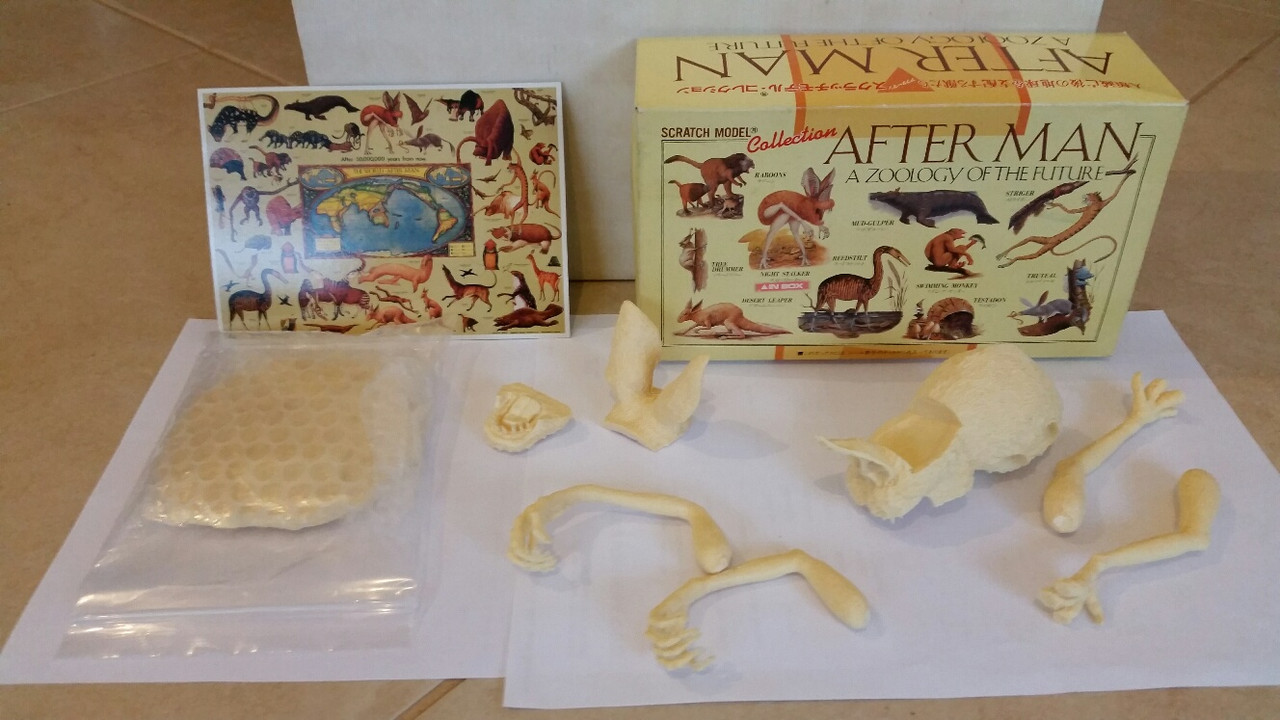
Some of Dixon’s works became especially popular in Japan, with After Man being adapted into both a stop-motion documentary and an animated short, and even having merchandise, and a manga version of The New Dinosaurs.

Later Dixon was a consultant and creature designer on the 2002 documentary series The Future Is Wild, a sort of “spiritual successor” to After Man – although due to the rights to After Man being held by Dreamworks at the time, none of his previous creations could be used. Depicting various ecosystems 5 million, 100 million, and 200 million years in the future, this series featured memorable speculative species such as whale-like gannets, giant carnivorous bats, sauropod-sized tortoises, four-winged birds, aerial fish, and arboreal squid.

The Future Is Wild was also adapted into both a manga and a Canadian-produced animated children’s series. There were plans over the years for a sequel documentary series, a feature film version, and then more recently a full reboot (including that VR game with the questionably-designed titan dolphin), but all seem to have succumbed to development hell.

Eventually Dixon’s original premise for Man After Man was reworked into Greenworld in 2010 (so far only ever published in Japanese), using his own artwork and changing the setting to an Earth-like exoplanet populated by animals descended from radially-symmetrical starfish-like ancestors. A generation ship carrying thousands of humans fleeing a devastated Earth arrive and colonize the planet – and over the next few centuries repeat history by exploiting the native lifeforms and putting Greenworld through multiple ecological catastrophes, causing a mass extinction that leaves the entire biosphere in ruins.

At some point another project called Microplatia was also developed for a planned exhibition on alien life at the Science Museum in London, but due to sponsorship issues was never completed.

Tomorrow: an expedition to a different alien world.

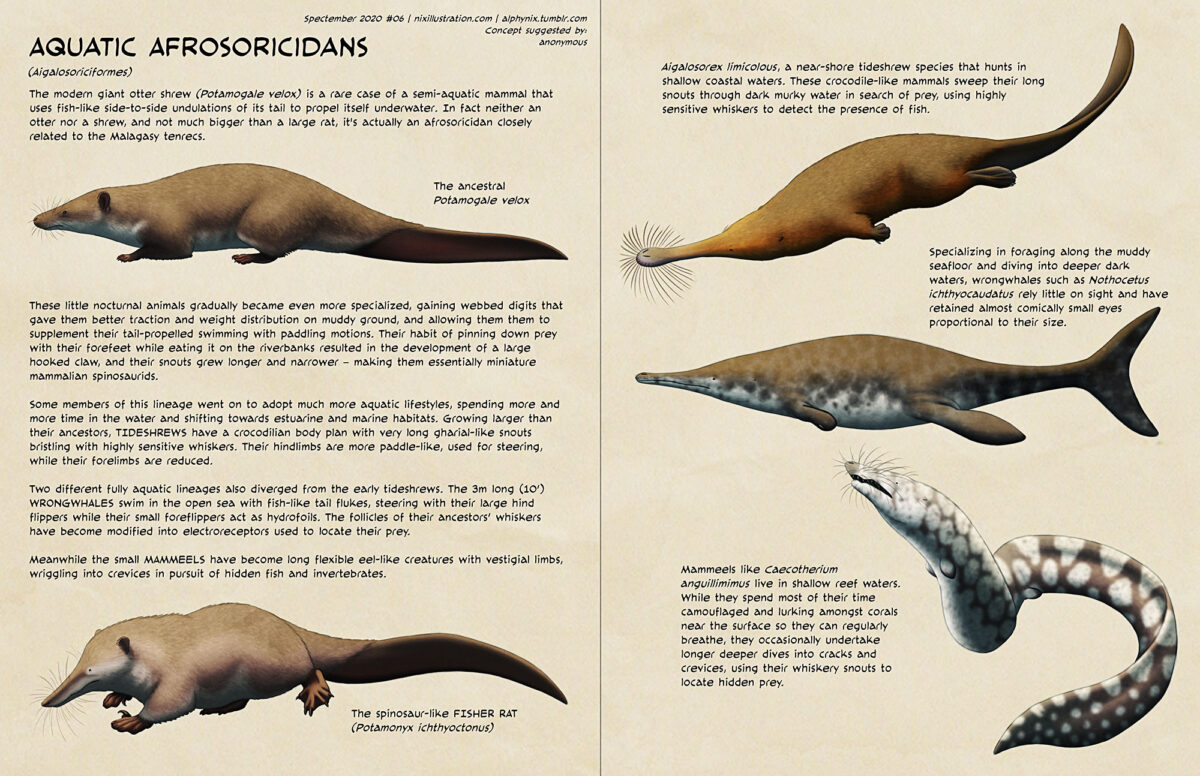
Spectember #06: Aquatic Afrosoricidans

(The submitted prompt here was “some kind of fully aquatic non cetacean or dugong mammal with a different bodyplan”.)

Transcript for the text on the image under the cut:

Continue reading “Spectember #06: Aquatic Afrosoricidans”

Spectember Interlude: The Saga of the Snouters

Harald Stümpke’s 1957 book Bau und Leben der Rhinogradentia (translated into English in 1967 as The Snouters: Form and Life of the Rhinogrades) is a detailed description of the anatomy, developmental biology, ecology, evolution, and taxonomy of a bizarre order of mammals known as the Rhinogradentia.

Descended from shrew-like ancestors isolated from the rest of the world during the Late Cretaceous, the lack of other animal competition on the remote Hi-yi-yi Archipelago resulted in the rhinogrades diversifying into a huge range of ecological niches. They were unique in having developed a “nasorium”, an appendage derived from the snout that was used for functions such as locomotion and feeding, and their recorded species included sedentary insectivores, ear-winged fliers, parasites, large mammoth-like herbivores, aquatic filter-feeders, flower-mimics, and miniscule planarian-like creatures with such simplified anatomy that they barely even resembled vertebrates anymore.

Sadly the entire island chain suffered ecological disaster shortly after its “discovery” by the Western world. An accidentally introduced cold virus wiped out both the indigenous inhabitants and several species of rhinograde, and then a few years later nearby nuclear weapons testing caused the entire archipelago to subside beneath the ocean’s surface – taking with it all the remaining endemic wildlife and every scientist studying them, who’d all been gathered on one of the islands for a scientific conference at the time.

(The snouters were of course an entirely fictional group of speculative animals, actually created by German zoologist Gerolf Steiner. Originating as a joke in the mid-1940s based on the nonsense poem The Nasobame, the rhinogrades were further developed and used by Steiner as an educational tool to illustrate the particular weirdness of how animals evolve and diversify in island environments – and also the fragility of those isolated ecosystems – before eventually being published in book form.

Initially the snouter book was presented with absolutely no admission of its fictional nature, and with its larger scope and dry scientific tone it can be argued to be one of the first “true” works of the speculative evolution genre. Over the years the rhinogrades have also become a beloved biological in-joke, occasionally appearing in otherwise serious publications or in April Fool’s Day stories.)

Before we move on, a rare case of speculative botany deserves a mention: Leo Lionni’s 1977 book Parallel Botany, a detailed catalogue of the history and study of an entire kingdom of strange plant-like lifeforms that appear to have only tenuous interactions with both human perception and spacetime itself. Some are invisible to the eye but show up in photographs (or vice versa), some violate the usual rules of distance and perspective, some only retroactively come into existence after discovery of their names, and almost all of them disintegrate upon being touched.

Next week: the start of the “modern” spec evo movement.

Spectember Interlude: Origins of Speculative Evolution

The concept of speculative evolution is probably about as old as the recognition of natural selection itself. In the first edition of On The Origin of Species in 1859, Charles Darwin speculated about swimming bears eventually becoming whale-like animals as a hypothetical example of the evolutionary process in action:

“In North America the black bear was seen by Hearne swimming for hours with widely open mouth, thus catching, like a whale, insects in the water. Even in so extreme a case as this, if the supply of insects were constant, and if better adapted competitors did not already exist in the country, I can see no difficulty in a race of bears being rendered, by natural selection, more and more aquatic in their structure and habits, with larger and larger mouths, till a creature was produced as monstrous as a whale.”

(This passage was widely ridiculed at the time, and most of it was removed from later editions, but compared to many modern spec projects a whale-bear doesn’t actually seem that weird!)

But it was the science fiction genre that really got things going, with H.G. Wells’ 1895 novel The Time Machine and its depiction of a future time when humans have diverged into two new species: the docile pampered Eloi and the underground-dwelling predatory Morlocks. A later chapter in the book also gives a glimpse of an even further future populated by huge terrestrial crabs – and, in some editions, small rabbit-like animals that are the distant descendants of the Eloi.

Various other works experimented with similar fictional creatures over the next few decades, both Earth-based and alien, although usually on a small scale with only a handful of species. Edgar Rice Burrough’s Barsoom and Pellucidar series featured slightly more developed speculative faunas inhabiting Mars and the interior of a hollow Earth, and Olaf Stapledon’s Last and First Men detailed a future history of humans across eighteen different species and two billion years of time.

Then, in the late 1950s came the publication of a book with some much more rigorous evolutionary worldbuilding… where we’ll continue tomorrow.