Month of Mesozoic Mammals #08: Tiny Transitional

Hadrocodium

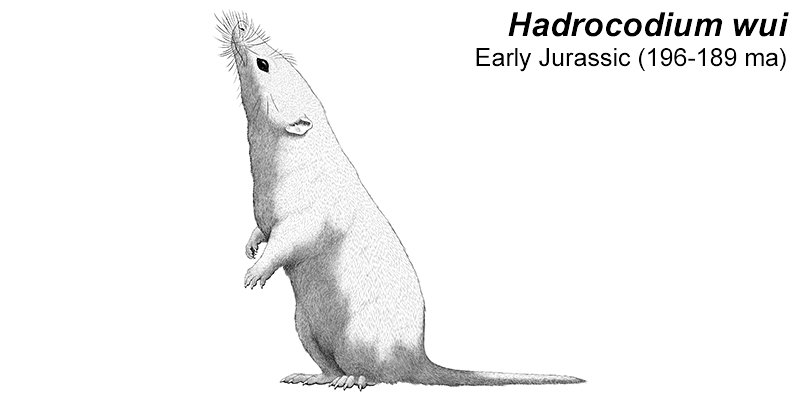
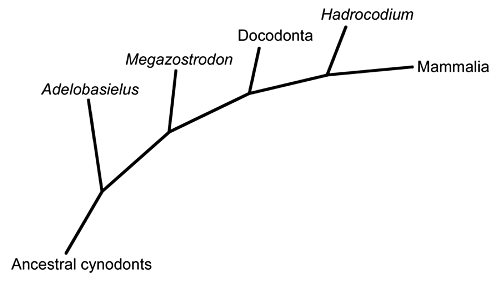
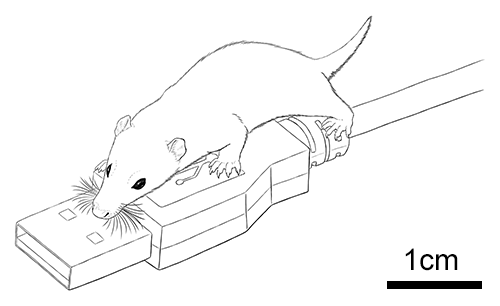
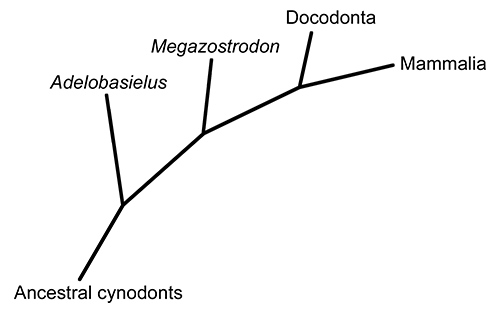
Falling evolutionarily between the docodonts and Mammalia itself, Hadrocodium is an important transitional form in the early mammal family tree. Something very similar to it would have been the common ancestor of all modern mammals.

Living in China during the Early Jurassic (196-189 mya), it was one of the first known mammals to have both an enlarged brain cavity and the characteristic middle ear bones of modern mammals, about 45 million years earlier than such traits were previously thought to have evolved.

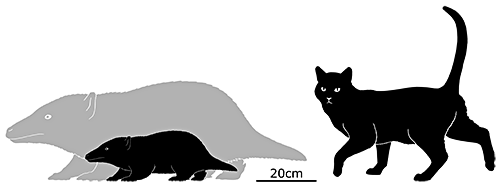
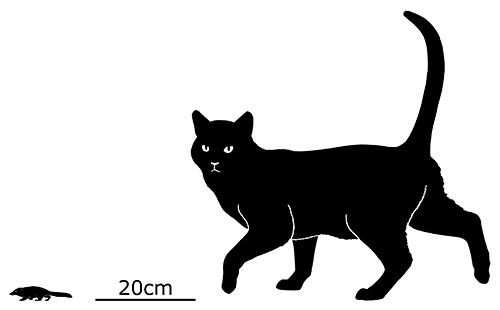
It was also one of the smallest mammals of all time, measuring only about 3cm long (1.2″) – similar in size to the smallest mammals alive today, the bumblebee bat and Etruscan shrew.

Month of Mesozoic Mammals #07: Digging Down

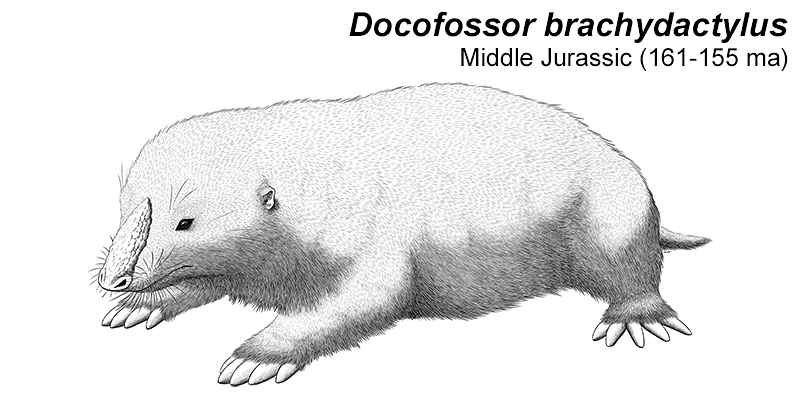
Docofossor

The docodonts didn’t stop at exploiting ecological niches in the trees and water. Another branch of the group specialized into underground burrowing, developing convergent features remarkably similar to modern golden moles.

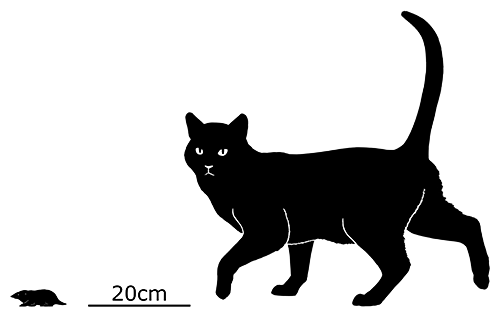
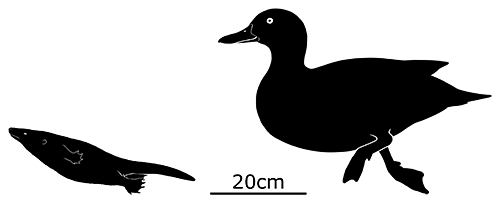
Docofossor is known from the Middle Jurassic of China (161-155 mya), and measured about 10cm long (4″). It had large shovel-like fingers, strong forelimbs, short sprawling hindlimbs, and pointed teeth adapted for capturing invertebrate prey. (I’ve also given it a patch of protective keratinized skin on its snout here, based on the related Haldanodon.)

It had a reduced number of bones in its fingers, a modification identical to some modern mammals – suggesting that these relatively “primitive” mammals were already using the exact same genes to regulate their anatomical development.

Month of Mesozoic Mammals #06: Going for a Swim

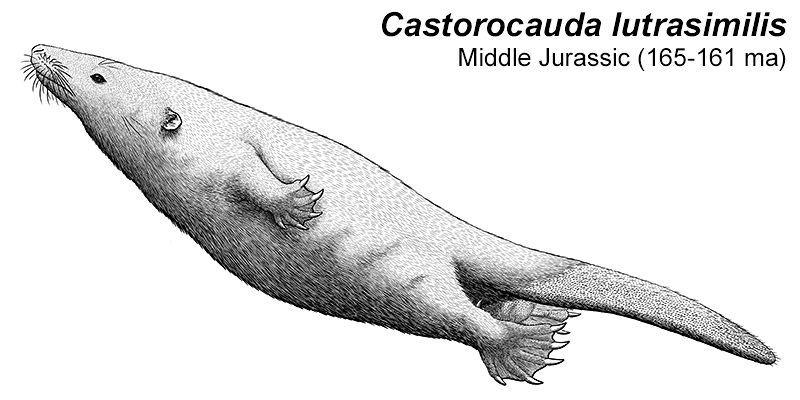
Castorocauda

While some docodonts like Agilodocodon were going up into the trees, another branch of the group was specializing into semi-aquatic habits instead.

Castorocauda is known from the Middle Jurassic of China (165-161 mya), represented by an exceptionally preserved fossil showing soft tissue and hair impressions. About 40cm long (1′4″), it would have lived in a wetland environment and was well-adapted for swimming, with a flattened scaly beaver-like tail, webbed toes, and a coat of dense fur very similar to that of modern mammals, made up of both guard hairs and underfur.

Its strong forelimbs suggest it was capable of digging burrows, like modern platypus, and its sharp backwards-pointing teeth indicate a diet of slippery prey such as fish and worms.

It was also one of the earliest known mammals with (possibly venomous) spurs on its ankles. This feature is only seen today in monotremes, but seems to have been an ancestral trait common to all early mammals that was later lost in the lineage leading to marsupials and placentals.

Month of Mesozoic Mammals #05: Climbing Trees

Agilodocodon

Before we get to the actual-Mammalia-mammals, there’s one more group of mammaliaformes who deserve some attention – the docodonts.

Falling evolutionarily just outside of Mammalia itself, docodonts first appeared in the mid-Jurassic and lasted until the Early Cretaceous. They used to only be known from teeth and jaw fragments and were thought to have been fairly generic shrew-like terrestrial insectivores, but more recent discoveries have shown them to have actually been some of the earliest mammals to specialize into diverse habitats.

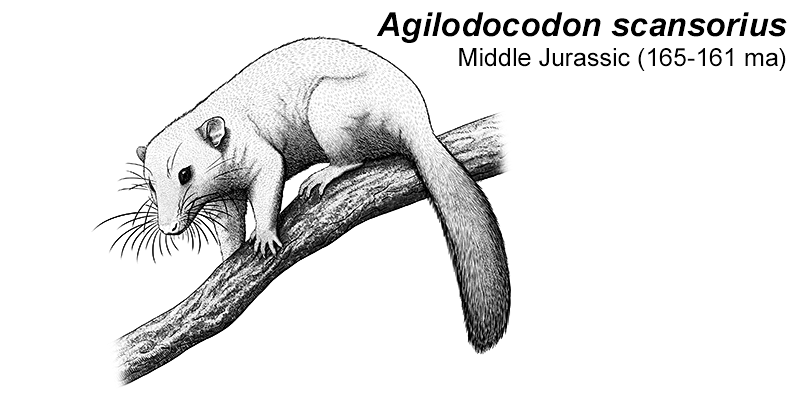
Agilodocodon was adapted for climbing around in trees, making it one of the earliest known arboreal mammals (although not the first climbing synapsid). Living in China during the Middle Jurassic (165-161 mya), it measured about 13cm long (5″) and had sharp gripping claws and flexible wrists and ankles similar to modern climbing mammals like tree squirrels.

When it was first described in 2015 it was suggested that its spade-like front teeth were specialized for gnawing bark and feeding on tree sap – but a later study found that its teeth didn’t really resemble those of any modern sap-eating mammals, and in fact were closer in shape to those of insectivorous marsupials and elephant shrews.

Month of Mesozoic Mammals #04: The Famous One

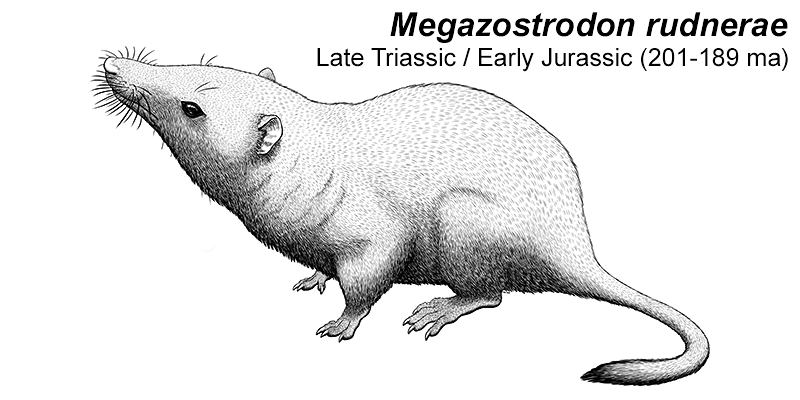
Megazostrodon

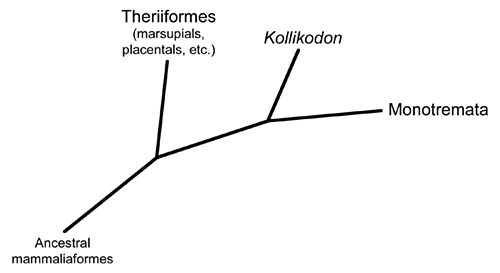
If there’s one Mesozoic mammal that’s been relatively well-mentioned in dinosaur books and popular media for many years, it’s undoubtedly Megazostrodon. Often depicted as “the first mammal”, it actually occupies a point in the mammal evolutionary tree somewhere between the earliest mammaliaformes and the common ancestor of all modern groups.

Megazostrodon lived during the very end of the Triassic and the Early Jurassic of South Africa (201-189 mya), and is represented by some near-complete fossil material – a rarity for this sort of small ancient mammal, most of which are only known from teeth and other fragments.

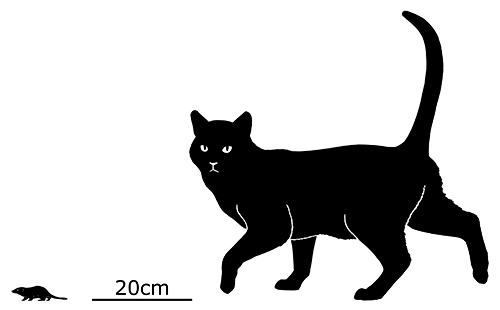
About the size of a mouse, only about 12cm long (5″), it was an insectivore with teeth adapted for chewing and crunching through hard arthropod shells. Enlarged regions of its brain associated with the senses of hearing and smell show it was likely nocturnal, occupying an ecological niche similar to modern shrews.

It probably reproduced similarly to modern monotremes, laying small parchment-shelled eggs and lactating from patches of skin. Fossils of the closely related and similar-looking Morganacudon show evidence of toothless infants and juveniles with a single set of milk teeth, suggesting these were some of the first mammals whose young were entirely dependent on milk during the earliest stages of life.

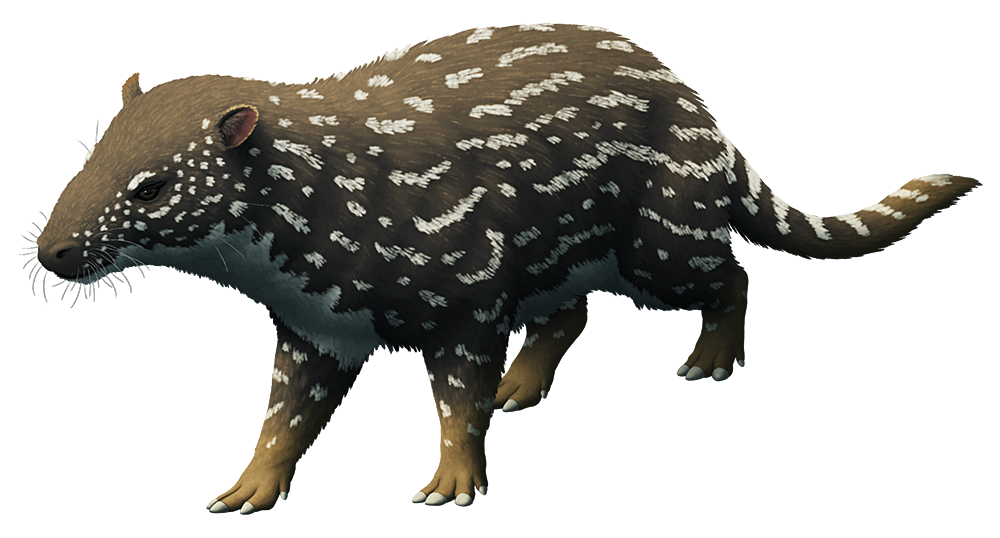
Phenacodus

Phenacodus primaevus, a mammal from the Late Paleocene to Middle Eocene of North America and Europe (~60-48 mya). About 1.5m long (5′), it’s thought to have been one of the earliest known odd-toed ungulates, walking on its middle three hoofed toes.

Its teeth were adapted for a diet of mostly plant matter, although it may also have been opportunistically omnivorous.

Another species in the same genus, Phenacodus intermedius, had a skull structure that suggests it might have had a muscular prehensile upper lip – or perhaps even a short tapir-like proboscis.

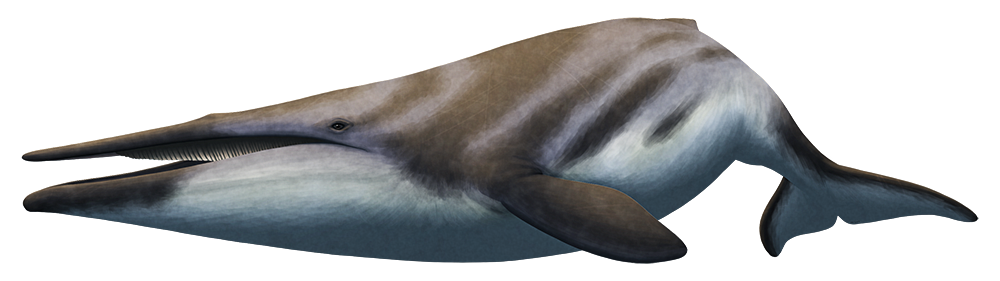
Waharoa

Waharoa ruwhenua, a whale from the Late Oligocene of New Zealand (~27-25 mya). Part of an early branch of the baleen whale lineage, it’s known from partial remains of an adult and a couple of juveniles and would have reached a full size of about 6m long (19′8″).

It had an unusually long flattened snout, with its nostrils further forward than modern whales, and only had baleen in the back half of its mouth – an interesting comparison to the intermixed teeth-and-baleen of some other early mysticetes. It’s not clear whether it had any vestigial teeth in the front of its jaws, although a single possible tooth has been found associated with its close relative Tokarahia.

The rather delicate nature of Waharoa’s jawbones suggests it wasn’t capable of rapid lunges at swarms of its small prey, instead probably using slow-cruising surface skim-feeding similar to modern right whales.

Thoatherium

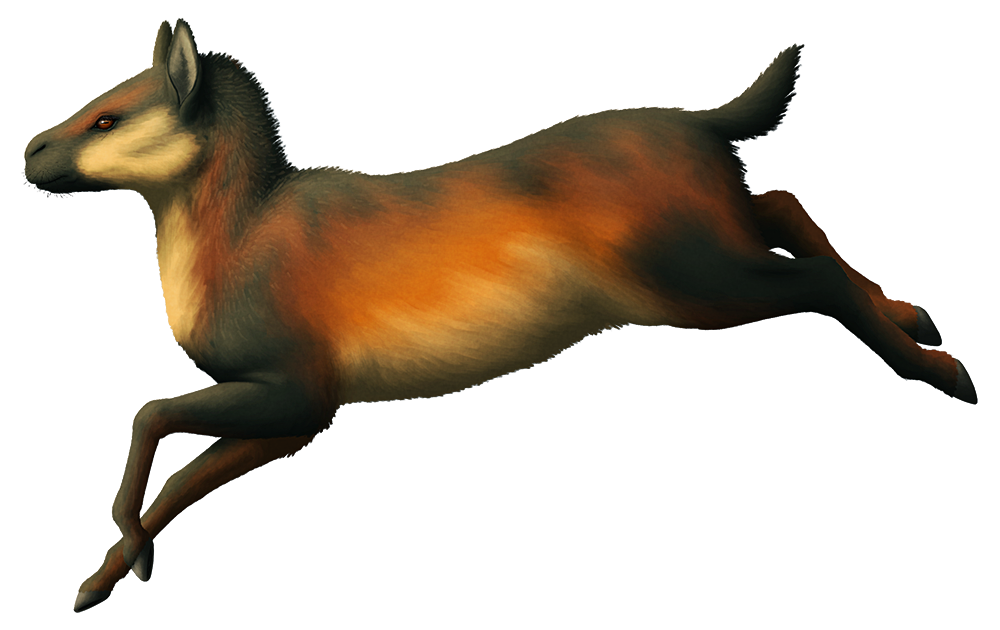
While this animal might look like some sort of deer or horse, it was actually only distantly related to any modern hoofed mammals.

This is Thoatherium from the Early Miocene (~17-16 mya) of Argentina. About 70cm long (2′3″), it was related to the weird llama-like Macrauchenia and was part of an extinct group of ungulates (the Meridiungulata) which evolved during South America’s time as an isolated island continent.

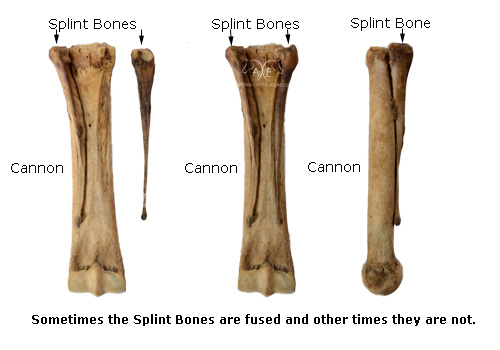
It was adapted for fast running, with long legs and only a single horse-like hoof on each foot – but it was even more one-toed than modern horses are, having no remaining “splint bones” from vestigial side toes.

Inermorostrum

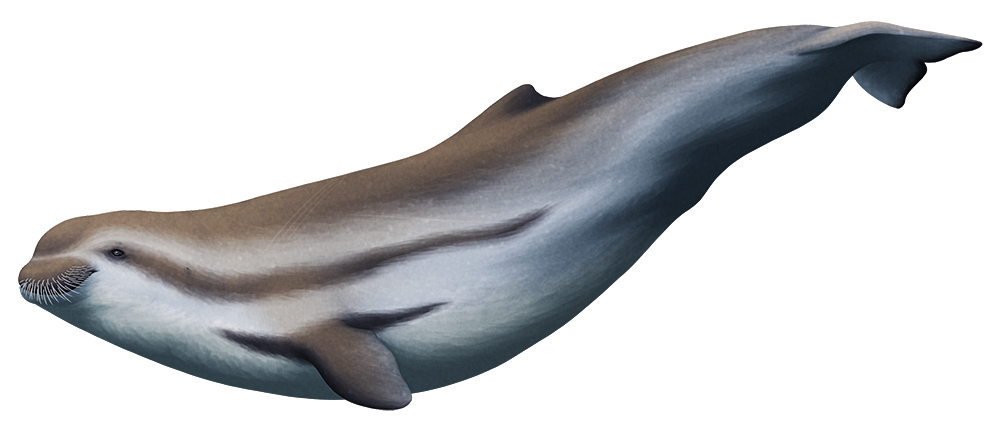
Inermorostrum xenops, a recently-named ancient cetacean!

Living about 30 million years ago in shallow coastal waters around the southeast USA, in what is now South Carolina, it was a member of one of the very earliest groups of toothed whales known as the xenorophids. Although only very distantly related to modern forms, xenorophids show evidence of being able to echolocate, suggesting the ability was probably ancestral to all toothed whales.

Estimated to have measured about 1m long (3′3″), Inermorostrum had a very short downturned snout and was completely toothless – specialized adaptations for suction feeding on small soft-bodied creatures on the seafloor.

Unusually for a toothed whale it also had proportionally large infraorbital foramina, openings in the bones of its snout for blood vessels and nerves to pass through. This suggests the presence of well-developed fleshy lips and possibly whiskers (as illustrated here), or maybe even an electroreceptive sense similar to some modern dolphins.

Ampelomeryx

Ampelomeryx ginsburgi, a palaeomerycid ungulate from the Early Miocene of France (~17 mya). About the size of a deer, around 1m tall at the shoulder (3′3″), it was a distant relative of modern giraffids.

Males sported three distinctive ossicone-like ‘horns’ – two over their eyes and a third forked one at the back of the skull – and protruding tusks like some modern deer, which probably served a similar purpose in fights against each other.