Jakapil

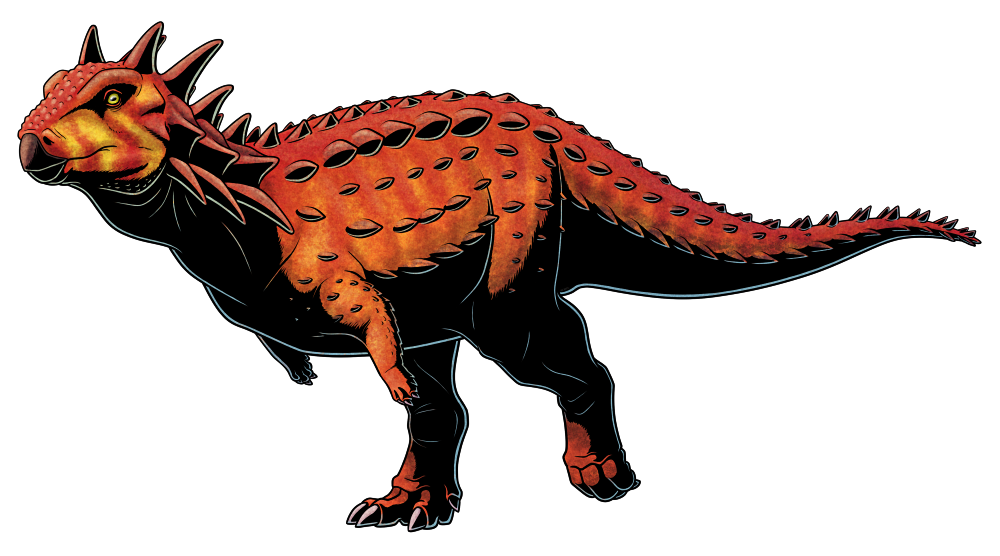
The thyreophorans were heavily armored ornithischian dinosaurs, with their most famous representatives being the stegosaurs and the ankylosaurs. Earlier members of the group were all small bipedal animals covered in rows of prickly osteoderms, and until now these “primitive” forms were known only from the early-to-mid Jurassic, around 200-165 million years ago.

But now the recent discovery of Jakapil kaniukura is suggesting a lineage of early thyreophorans actually survived for much much longer than previously thought – all the way into the Late Cretaceous, about 97-94 million years ago.

Just 1.5m long (5′), Jakapil lived in what is now southern Argentina, in an ancient desert with a braided river system. It was bipedal, with a short beak, small arms, and a body bristling with spiky armor, and its unusually deep lower jaw and heavily worn teeth indicate it fed on rather tough vegetation that required a lot of chewing to process.

It’s currently only known from somewhat fragmentary remains, so reconstructions of its full appearance are rather speculative and there’s already been some dispute about whether Jakapil actually was a thyreophoran. One proposal is that it shared a lot of anatomical features with early ceratopsians instead, which if true would make it an incredibly weird armored ceratopsian, and also the first definitive member of that group from South America. But the ceratopsian-like features could also just be due to convergent evolution – and a Jakapil-like dinosaur might actually help explain the only other known dubious South American “ceratopsian” Notoceratops, and the similarly-disputed Australian Serendipaceratops.

But whatever it was – late-surviving basal thyreophoran, southern armored ceratopsian, or even a previously unknown lineage of ornithishcians entirely new to science – it’s an exciting and unexpected discovery.

Rajasaurus

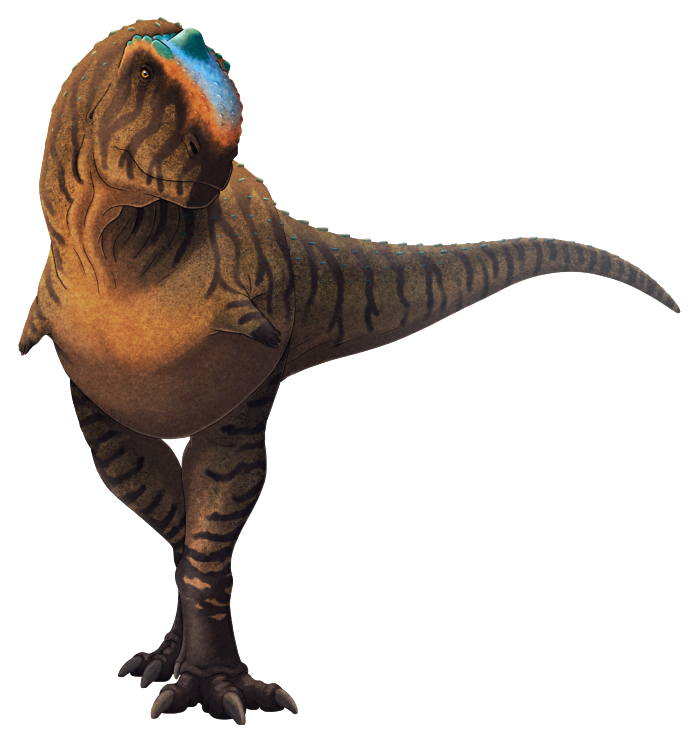
Abelisaurids were a group of theropod dinosaurs characterized by short snouts, bony ornamentation on their skulls, tiny stiff arms, and stocky legs. Known mostly from the southern continents of Gondwana, they were the dominant predators in these regions and are thought to have been specialized hunters of titanosaurian sauropods.

Rajasaurus narmadensis lived in what is now western India during the Late Cretaceous, about 67 million years ago. Around 7m long (23′), it had very rough-textured thickened bone on the top of its snout, along with a short rounded horn on its forehead that was probably used for display or headbutting behaviors.

India at this time was an isolated island continent located off the east coast of Africa, and Rajasaurus‘ ancestors probably island-hopped across from then-nearby Madagascar – where its closest known relative lived, the very similar-looking Majungasaurus.

Annakacygna

Around 11 million years ago, during the late Miocene, much of what is now northern Honshu in Japan was submerged under fairly deep ocean waters. This offshore environment was inhabited by a variety of ancient sea-going tetrapods such as turtles, desmostylians, seal-like allodesmines, archaic baleen whales, and early oceanic dolphins… and also one very unexpected bird.

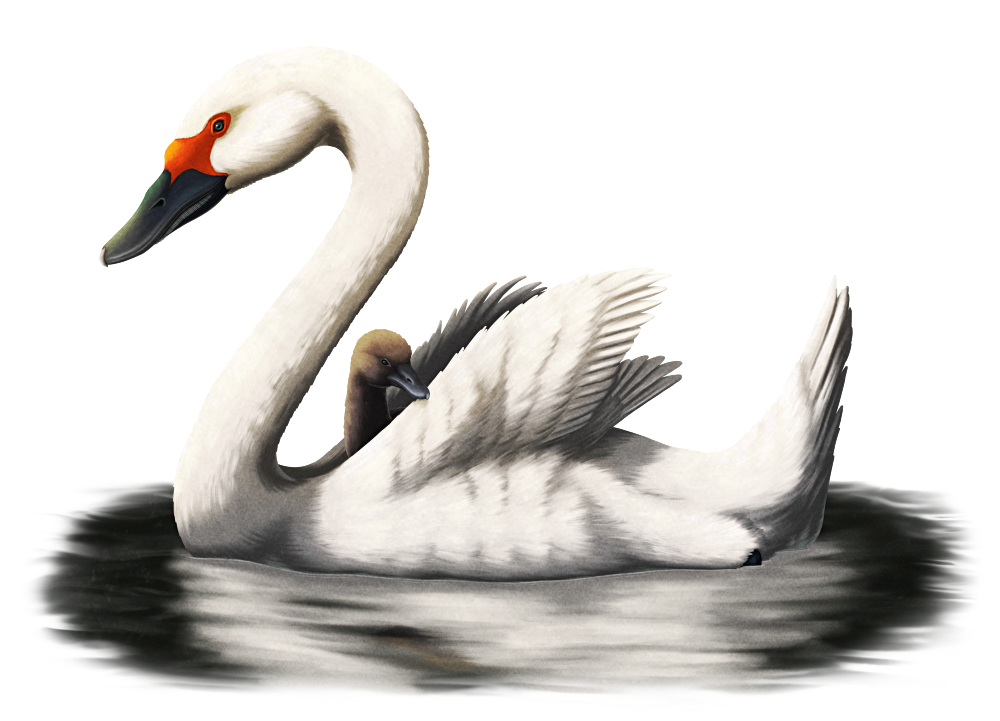
Meet the flightless marine swan.

Annakacygna hajimei, also known as the Annaka short-winged swan, was the same size as a modern black swan at about 1.2m long (~4′), but had a combination of features unlike any of of its living close relatives. Its head was proportionally large, and it had a long spoon-shaped bill like a shoveler duck, lined with comb-like structures for filter-feeding on plankton. It also had widened hips that would have helped keep it stable floating in rough waters, its tail was highly mobile and muscular, and its feet resembled those of diving birds like loons.

With thickened heavy bones and shortened forearms it was clearly completely unable to fly, but its reduced wings appear to have been highly specialized rather than just vestigial. Its shoulders were extra flexible while its wrists had a more limited range of motion, allowing it to fold its wings into a distinctive half-raised position similar to modern mute swans.

It probably used its wings and tail to perform elaborate “busking” visual displays, and also to carry and protect its young on its back while out at sea – basically making itself into a living swan boat.

Sierraceratops

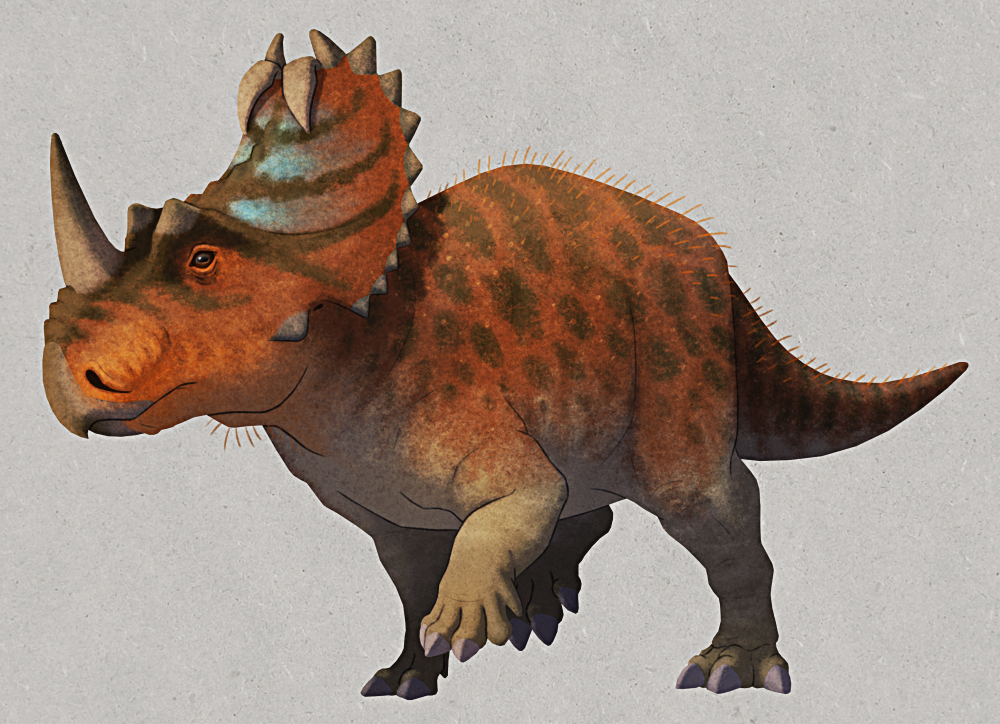
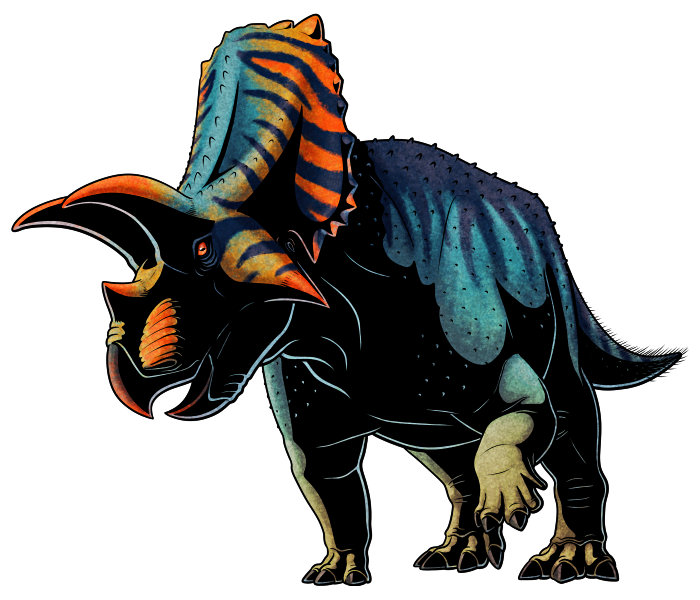
In the late 1990s a partial skeleton of a ceratopsian was discovered in New Mexico, USA. These remains were initially thought to belong to Torosaurus, but after more of the specimen was recovered in the mid-2010s it became clear the bones actually represented an entirely new species of horned dinosaur – officially named in 2022 as Sierraceratops turneri.

Sierraceratops lived during the Late Cretaceous, around 72 million years ago, in what at the time was the southern region of the island continent of Laramidia. About 4.6m long (~15′), it had fairly short chunky brow horns, long pointed cheek horns, and a relatively large frill.

It was part of a unique lineage of ceratopsians that were endemic to southern Laramidia, with its closest known relatives being Bravoceratops from western Texas and Coahuilaceratops from northern Mexico.

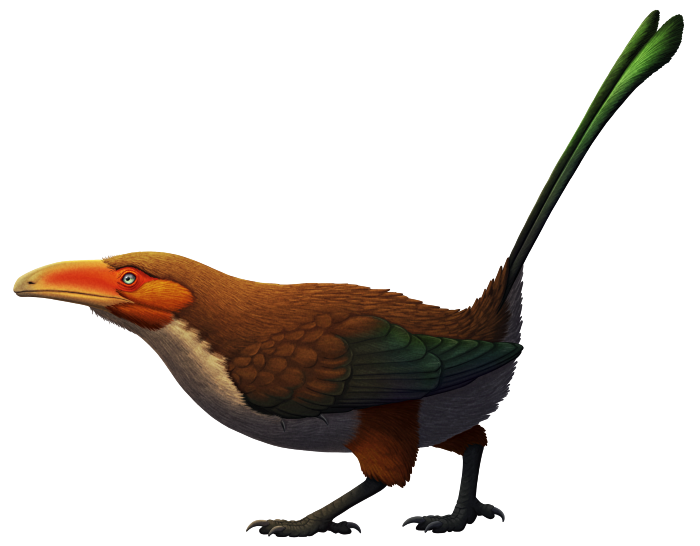
Falcatakely

Modern birds’ upper beaks are made up mostly from skull bones called the premaxilla, but the snouts of their earlier non-avian dinosaur ancestors were instead formed by large maxilla bones.

And Falcatakely forsterae here had a very unusual combination of these features.

Living in Madagascar during the Late Cretaceous, about 70-66 million years ago, it was around 40cm long (1’4″) and was part of a diverse lineage of Mesozoic birds known as enantiornitheans. These birds had claws on their wings and usually had toothy snouts instead of beaks, and many species also had ribbon-like display feathers on their tails instead of lift-generating fans.

Falcatakely had a long tall snout very similar in shape to a modern toucan, unlike any other known Mesozoic bird, with the surface texture of the bones indicating it was also covered by a keratinous beak. But despite this very “modern” face shape the bone arrangement was still much more similar to other enantiornitheans – there was a huge toothless maxilla making up the majority of the beak, with a small tooth-bearing premaxilla at the tip.

This suggests that there was more than one potential way for early birds to evolve modern-style beaks, and there may have been much more diversity in these animals’ facial structures than previously thought.

Amargasaurus

Amargasaurus cazaui was a sauropod dinosaur with a very distinctive-looking skeleton, sporting a double row of long bony spines along its neck and back. It lived in what is now Argentina during the Early Cretaceous, about 129-122 million years ago, and was fairly small compared to many other sauropods, reaching about 10m in length (~33′) with a proportionally short neck compared to its body size.

And despite being known from fairly complete skeletal remains there’s still a lot we don’t know about this dinosaur – especially what was actually going on with those vertebral spines. While it’s sometimes been depicted with skin sails over the spines, for the last couple of decades the general opinion has trended towards them being more likely to have been covered by spiky keratinous horn-like sheaths.

But recently that’s been brought back into question. A detailed study of the microscopic bone structure of Amargasaurus‘ spines shows no evidence for keratin attachment and instead found textures associated with skin coverings, along with an extensive web of ligaments connecting the spines to each other along each row.

So maybe it had big flashy sails after all!

April Fools 2022: The Aquatic Dinosaur That Wasn’t

So, Spinosaurus wasn’t technically the first known aquatic non-avian dinosaur.

That title instead temporarily went to Compsognathus corallestris.

While the idea that hadrosaurs and sauropods were wallowing swamp-dwellers had been completely abandoned at the start of the Dinosaur Renaissance, the new view of dinosaurs as active sophisticated animals led to a surprising aquatic hypothesis during the early days of this paleontological revolution.

A specimen of the small theropod Compsognathus discovered in southeastern France in the early 1970s was only the second skeleton ever found of this dinosaur, and came over a century after the first. It was initially thought to represent a new species since it was about 50% larger than the German specimen of Compsognathus longipes, and it seemed to have something very unusual going on with its hands – its forelimbs were somewhat poorly-preserved and distorted, and had traces of some sort of large fleshy structure around the hands that was interpreted as representing elongated three-fingered flippers used for swimming.

This wasn’t necessarily as ridiculous of an idea as it might sound. Compsognathus lived during the Late Jurassic, about 150 million years ago, at a time when Europe was a group of islands in a shallow tropical sea. A semiaquatic dinosaur specialized to swim and dive, hunting the abundant aquatic prey in its environment, and easily able to island-hop all around the European archipelago seemed at least somewhat plausible, and reconstructions of fin-handed C. corallestris even appeared in several popular dinosaur books of the time.

But it didn’t last.

Within just a few years doubt was being cast on this idea, and further studies of both known Compsognathus skeletons in the late 1970s and early 1980s concluded that C. corallestris was actually a fully-grown adult individual of the juvenile C. longipes. The French Compsognathus had normal-looking hands for its kind after all, with two large clawed fingers and a vestigial third finger, and the “flipper” impressions had just been ripples in the fossil slab.

For a long time after that the general view became that there just weren’t any aquatic non-avian dinosaurs at all – but more recent discoveries like the new Spinosaurus material and Halszkaraptor are starting to suggest that some of these animals were much more at home in the water than previously thought.

Something resembling Compsognathus corallestris might still surprise us in the future.

Retro vs Modern #23: Spinosaurus aegyptiacus

Spinosaurid teeth were first found in the 1820s in England, but were misidentified as belonging to crocodilians. It wasn’t until nearly a century later that Spinosaurus aegyptiacus was discovered and recognized as a dinosaur – and it would be another century after that before we really started to learn anything about it.


1910s

The first fossils of Spinosaurus were discovered in Egypt in the 1910s. With only a few fragments of its skeleton known it was an enigma right from the start, hinting at a large and very strange theropod dinosaur with crocodile-like teeth, an oddly-shaped lower jaw, and elongated neural spines on its vertebrae that seemed to be part of a huge sail.

A few possible extra fragments were found in the 1930s, but overall these few pieces were all that was known of Spinosaurus for a long time.

The fossils were kept in the Paleontological Museum in Munich, Germany,a building that was severely damaged during a bombing raid in World War II. Many important specimens were destroyed, including Spinosaurus, and only the published drawings and descriptions of the bones remained.

So for the next several decades Spinosaurus remained a very poorly-understood mystery. During this period it was generally depicted as a generic “carnosaur“, often modeled on something like Megalosaurus, in the standard-for-the-time tripod pose and with a Dimetrodon-like sail on its back.

Interestingly a 1930s skeletal reconstruction shows Spinosaurus with an unusually long torso and fairly short legs, details that are surprisingly modern despite the retro posture.


1990s

In the 1980s some partial snout bones from Niger were recognized as having similarities with the jaw of Spinosaurus. Around the same time the fairly complete skeleton of Baryonyx was discovered, and along with further spinosaurid discoveries in the mid-to-late 1990s a decent idea of what Spinosaurus might have looked like began to emerge.

It was reconstructed with a long kinked crocodilian-like snout, a ridged bony crest in front of its eyes, an S-curved neck, and large thumb claws on its hands – an interpretation that was heavily popularized by Jurassic Park III in the early 2000s, bringing this enigmatic dinosaur to public attention and portraying it as a fearsome super-predator bigger than Tyrannosaurus.


2020s

Despite attempts to locate more complete Spinosaurus remains, only fragments continued to be found, and it remained a frustratingly poorly-known species even into the early 2010s.

Finally, in 2014, almost a full century after it was first described and named, Spinosaurus started to reveal its secrets with the announcement of the discovery of the most complete skeleton so far, discovered in the Kem Kem fossil beds in Morocco. Its body was still only partially represented, but it included skull fragments, part of a hand, a complete leg and pelvis, some sail spines, and several vertebrae from the neck, back, and tail.

And nobody was expecting what these pieces revealed.

It had a very long torso and proportionally short stumpy legs, and was reconstructed with a huge distinctive “M-shaped” sail on its back. Its feet had flat-bottomed claws and its “dewclaw” toe was enlarged into an extra weight-bearing digit – adaptations for spreading its weight over soft muddy ground, and suggesting its feet may also have been webbed. Initially it was also presented as possibly being quadrupedal, due to how far forward its center of mass seemed to be, reviving an odd idea from the late 20th century.

Along with its long crocodile-like head and conical teeth, this was interpreted as evidence it was a semiaquatic fish-eating swimming animal – potentially making it the first known semiaquatic non-avian dinosaur. Spinosaurids had been suggested to be specialized piscivores before, especially since Baryonyx had been found with fish scales in its stomach, but they were generally assumed to be more like modern grizzly bears, wading into water to hunt but not being habitual swimmers. Spinosaurus’ weird croco-duck proportions, however, seemed like they might be much more suited to watery habitats than to the land.

Since Spinosaurus had become a popular dinosaur with the general public by that point, the discovery was big news – and a big controversy for a while. It was so bizarre that some paleontologists were skeptical of the radical new interpretation, wondering if the measurements of the skeleton were correct or if the short legs were even from the same individual or the same species as the rest of the bones.

After a while the new proportions were accepted as fairly accurate, and over the next few years attention turned to instead figuring out just how this animal worked and how aquatic it actually was. An earlier isotope analysis of its teeth supported a semiaquatic lifestyle similar to crocodiles and turtles, but a buoyancy study argued that it might not have been able to dive below the water suface and its sail made floating unstable – but also found that its center of mass was closer to its hips than previously calculated, suggesting it could walk bipedally after all.

Then in 2020 came another surprise: more of the tail of the new specimen had been found, and it was just as weird as the rest of Spinosaurus. Its tail was a huge vertically flattened paddle-like fin supported by long thin neural spines and chevrons, resembling a giant eel or newt more than a dinosaur and also giving some more weight to the idea that it was a swimmer.

Our modern view of Spinosaurus is still evolving, and likely to be full of even more surprises in the future as we discover more about this unique dinosaur. But we at least know it lived in what is now North Africa during the Late Cretaceous, about 99-93 million years ago, and whether it was a swimmer or wading generalist predator it was one of the largest known theropods to ever live, estimated to have reached around 16m long (~52ft).

While the “M-shaped” sail reconstruction has been popularized by the recent discoveries, the exact shape of this structure is still unknown. Like with other sailbacked animals it’s also not clear what it was for, with ideas including temperature regulation, visual display, supporting a fatty hump, and a potential hydrodynamic adaptation.

EDIT: And while I was working on this entry (late March 2022) I missed that another study had just come out with more anatomical support for swimming Spinosaurus!

Retro vs Modern #22: Tyrannosaurus rex

Probably the most famous and popular dinosaur of all time, Tyrannosaurus rex is also the only species commonly known by both its full scientific name and its abbreviation T. rex.


1900s-1960s

Fragments of what we now know are Tyrannosaurus fossils were first found in the Western United States in the 1870s, but it wasn’t until the early 1900s that a couple of partial skeletons were discovered and recognized as belonging to a new species of huge carnivorous theropod.

With its charismatic and memorable name meaning “tyrant lizard king” it was an immediate hit with the general public, portrayed as the “king of the dinosaurs” in pop culture and as the dramatic nemesis of Triceratops.

Like other bipedal dinosaurs of the time it was depicted in an upright kangaroo-like tripod pose, cold-blooded and lizard-like. Sometimes it was also shown with three-fingered hands, since its arms were poorly known for a long time – and while the closely-related tyrannosaurid Gorgosaurus was known to have had just two fingers, this wasn’t confirmed for Tyrannosaurus until the late 1980s.


1990s

During the 1970s and the early Dinosaur Renaissance it became obvious that bipedal dinosaurs like Tyrannosaurus couldn’t have stood so sharply upright without dislocating their hips and tail vertebrae.

Jurassic Park was influential in introducing this new corrected posture to the general public in the early 1990s, presenting a powerful and active predator with a more bird-like horizontal stance and its tail acting as a counterbalance. Reconstructions inspired by this portrayal became standard for Tyrannosaurus during the 1990s (although the old-style tripod remains in public consciousness even decades later), and while it didn’t tend to get as heavily shrinkwrapped as some other species it was still common for a while to push its belly ribs in as much as possible to make its bulky body look skinnier and more “athletic”.

The 1980s and 1990s were also a time when discoveries of new Tyrannosaurus specimens began to become much more frequent, improving knowledge of the species’ anatomy, biology, and life history. Some, like Sue, Stan, and the Dueling Dinosaurs, would also unfortunately end up becoming highly controversial, tied up in legal disputes for years and sold for multi-million-dollar prices.


2020s

After the explosion of feathered non-avian dinosaur specimens from China in the mid-1990s, eventually the small feathered tyrannosauroid Dilong was discovered in the early 2000s, followed by the much larger-bodied Yutyrannus in the early 2010s.

While these tyrannosauroids weren’t particularly closely related to Tyrannosaurus itself, the question of potential tyrant fuzz still began to loom, and for a while in the 2010s highly fluffy T. rex interpretations were popular in paleoart. But in the late 2010s a study of known skin impressions from Tyrannosaurus and several of its closer relatives showed that small pebbly scales were known from various parts of the body, and suggested that these particular dinosaurs were most likely primarily scaly. Sparser fluff was still possible on parts of the body, however, similar to the hair on modern elephants, and it’s also possible that juveniles were much fuzzier.

(While this is disappointing for fans of huge fatbird T. rex, it’s also a great example of the scientific process. The skin impressions hadn’t ever been properly described before this point, and the scaly interpretation had mostly been an assumption. Speculative fluffiness prompted all the skin evidence to actually be consolidated, and now we know a lot more about Tyrannosaurus’ potential outward appearance than we did before.)

Arguments about lips in theropod dinosaurs also went back and forth during the 2010s, with interpretations ranging from tight-skinned crocodilian-like snouts with exposed teeth to fleshy lizard-like lips similar to modern Komodo dragons. There’s not really a consensus yet, but since most non-beaked tetrapods do have lips the safe bet is still that dinosaurs like Tyrannosaurus would have had them too. 

Our modern view of Tyrannosaurus is a much chunkier animal than older interpretations, with  more extensive soft tissue, properly-positioned belly ribs showing that it had a barrel-shaped pot-bellied body, and its tail being thicker-muscled than previously thought.

Living across western North America – then the island continent of Laramidia – during the very end of the Cretaceous, about 68-66 million years ago, it was one of the largest terrestrial carnivores to ever live. The very biggest known specimens are estimated to have been as much as 13m long (~43′), with the proportionally large head making up around 1.5m of that (~5′).

Its skull was boxy at the back but narrow along the snout, allowing its forward-facing eyes to have hawk-like stereoscopic vision. Large fenestrae and a “honeycomb” of air spaces reduced the weight of the skull, while reinforced fused bones strengthened it, and Tyrannosaurus is estimated to have had an incredibly powerful bone-crushing bite force.

It had a highly developed sense of smell, and its hearing was geared towards low-frequency sounds. The texture of its skull bones suggests it may also have had thick toughened keratinous skin and bumps over its face, which might have been involved in head-shoving and headbutting behaviors.

Although proportionally tiny for its overall size, its arms were still rather beefy, with large areas for muscle attachment with “meathook” claws that may have been used to hold onto struggling prey.

As a heavily-built bulky carnivore it probably wasn’t especially fast, and its legs were adapted for energy-efficient walking rather than running. It may have been a long-distance stalker, only using short bursts of speed in a final ambush – and like most large carnivores it would have also opportunistically scavenged on carcasses, too.

Specimens once argued to belong to a separate smaller species of tyrannosaur, Nanotyrannus, are now generally accepted as actually being juvenile Tyrannosaurus. They show a surprising amount of physical change as these animals aged, starting out leaner-built with longer legs more suited for speed, slender more delicate snouts, and only developing the characteristic chunky adult proportions during a huge growth spurt in their mid-to-late teens.

Meanwhile, the latest big controversy over this dinosaur as of March 2022 (because there’s always something) is a study proposing splitting Tyrannosaurus into three separate species: T. rex, T. imperator, and T. regina. It doesn’t seem to be going down well, but much like the feather situation it probably at least means we’re going to see a lot of further investigation over the next few years.

Retro vs Modern #21: Deinonychus antirrhopus

Deinonychus antirrhopus was one of the most significant dinosaur discoveries of the 20th century, kicking off the Dinosaur Renaissance and the recognition of the evolutionary link between maniraptoran theropods and modern birds.


1960s

The first remains of this species were discovered in North America in the 1930s, but at the time the fossils weren’t officially described or named. It wasn’t until the 1960s that more specimens were found in Montana, representing at least three preserved individuals, and paleontologist John Ostrom recognized that there was something very special about this dinosaur.

In contrast to the prevailing view at the time that theropods were all upright tail-dragging “sluggish lizards” this was clearly a highly specialized and active predator, with a huge sickle-shaped claw on each foot and a long stiff tail for balance – inspiring its scientific name’s meaning of “counterbalancing terrible claw”.

And while the very first reconstruction of Deinonychus might seem retro to modern eyes, at the time it was revolutionary and it went on to become an iconic representation of the species for the next couple of decades. Drawn by Robert Bakker, who was Ostrom’s student at the time, it depicted a lizard-like creature with its body held in a horizontal pose and its tail held out straight behind it. Its head was portrayed as more domed than we now know Deinonychus’ skull to have been, and its neck was up in an alert posture while the animal ran at full sprint, with its sickle-claws held up away from the ground to keep them sharp.

A few years later further discoveries showed a highly bird-like pelvis and hands very similar to those of Archaeopteryx, triggering the Dinosaur Renaissance reinterpretation of dinosaurs as active warm-blooded animals, and the revival of the 19th century idea that they were the ancestors of birds.


1980s-1990s

As the “birds are dinosaurs” idea began to gain acceptance with increasing amounts of anatomical evidence, some paleontologists in the 1980s began to also suspect that highly bird-like dromaeosaurids like Deinonychus might have also been feathered. Some reconstructions during this time showed this to varying degrees, particularly those drawn by Bakker and by Gregory Paul – but it didn’t really catch on more widely at first, for one very big reason:

Jurassic Park happened.

Dromaeosaurs hadn’t been well-known dinosaurs to the general public before that point, but the 1993 JP “raptors” were an instant hit in pop culture. Physically based much more on Deinonychus than on Velociraptor, and exemplifying the renaissance view of dinosaurs in major media for the first time, the movie’s fully scaled and oversized version of these animals dominated popular depictions for years afterwards. Even the most rigorous and anatomically accurate artwork showcasing their bird-like features still usually kept them completely naked to retain that familiar reptilian appearance.

Most 1990s attempts at any feathering tended towards being as sparse as possible – often along with the shrinkwrapping typical for the era – at best being decent for the time but what we’d now deride as “half-assed”, and at worst being “a few token quills on the back of the head”.

Deinonychus fossils found in association with Tenontosaurus were also interpreted as being evidence of cooperative pack hunting behavior during this time, and it became a common paleoart meme to depict the large herbivore being constantly swarmed by ravenous raptors.


2020s

The mid-1990s discovery of fully-feathered dinosaurs like Sinosauropteryx in China, followed a few years later by raptors with wing-feathered arms like Sinornithosaurus, gradually began to put the fluff back onto dinosaurs like Deinonychus.

(…At least in reasonably scientific paleoart. The much much stronger and ongoing resistance from popular culture is far too big a subject to get into here. But maybe, just maybe, we’re finally hitting a turning point there?)

Early attempts at properly feathering dinosaurs were a bit awkward, usually looking rather like a bunch of scruffy greasy hair glued onto a scaly raptor, a dinosaur wearing fuzzy pajamas, or like the old “bird-lizard” depictions of Archaeopteryx. Even into the early 2010s some paleoart memes were still common in depictions of dromaeosaurs, but increasingly better understanding of their anatomy and plumage arrangements over the last decade or so has brought us to a much more birdlike interpretation of these animals – with paleoartists like Emily Willoughby being especially influential in popularizing the modern view of dinosaurs like Deinonychus.

We now know Deinonychus lived during the Early Cretaceous, about 115-108 million years ago, in what is now the Mountain West and South Central United States. Up to around 3.4m long (11′), it stood about 1m tall (3’3″), similar in size to a large dog.

It had blade-like teeth in its jaws, and forward-facing eyes with stereoscopic vision. Its three-fingered arms would have been covered by wing-like feathers, and its tail probably had feathers all the way along its length and was stiffened but not totally inflexible.

It may have used the sickle-claws on its feet to pin down struggling prey, eating it alive while flapping its wings and waving its tail for balance. And while often depicted as an extremely fast-runner, its leg proportions and foot anatomy suggest it was actually built more for walking and had an especially strong grip strength in its feet, trading speed for power and probably being more of an ambush predator – often being compared to a “giant ground-hawk”.

Pack hunting has been called into question recently, too, arguing that the Tenontosaurus sites may actually represent crocodile-like or Komodo dragon-like behavior with mobs of scavenging individuals congregating at a carcass. But other evidence from trackways and Utahraptor does offer potential support for pack behavior in raptors, so it’s still open to interpretation.