It Came From The Wastebasket #01: Is This An Insectivore?

Most of the wastebasket taxa featured this month are completely extinct and known only from fossils, but to start things off let’s take a look at a major example of how even groups with living members could have their classification muddled up for centuries.


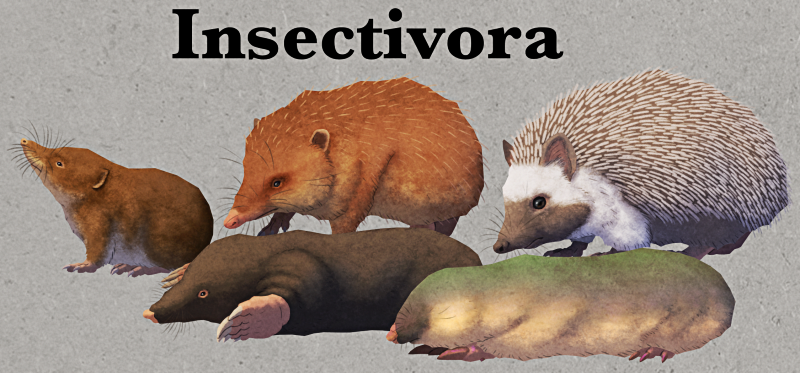
The name Insectivora first came into use in the early 1820s, and was used to refer to various “primitive-looking” small insect-eating mammals, with modern shrews, moles, hedgehogs, tenrecs, and golden moles as the original core members.

An illustration showing the animals that originally made up "Insectivora". From left to right it pictures a shrew, a tenrec, and a hedgehog on the top row, and a mole and a golden mole on the bottom row. Text at top of the the image reads "Insectivora".
Insectivora

Then over the next few decades solenodons, treeshrews, sengis, and colugos all got lumped in with them too.

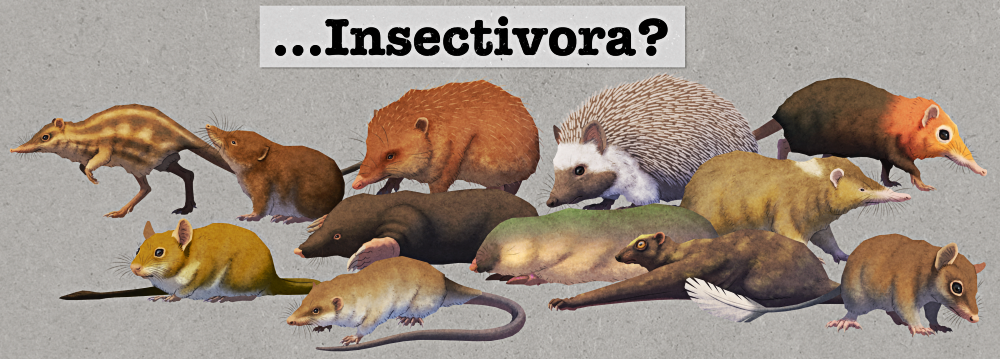
By the early 20th century insectivorans were considered to represent the “primitive” ancestral stock that all other placental mammals had ultimately descended from, and any vaguely similar fossil species also got dumped under the label. Extinct groups like leptictids, cimolestans, adapisoriculids, and apatemyids all went into the increasingly bloated Insectivora, too, making the situation even more of a wastebasket as time went on.

An illustration showing the animals that made up the expanded historical version of "Insectivora". From left to right it pictures a leptictidan, a shrew, a tenrec, a hedgehog, and a sengi on the top row, an apatemyid, a mole, a golden mole, and a solenodon in the middle row, and a cimolestan, a colugo, and a treeshrew on the bottom row. Text at top of the the image reads "…Insectivora?", styled like a typewritten label that has been stuck over the previous image's text.
…Insectivora?

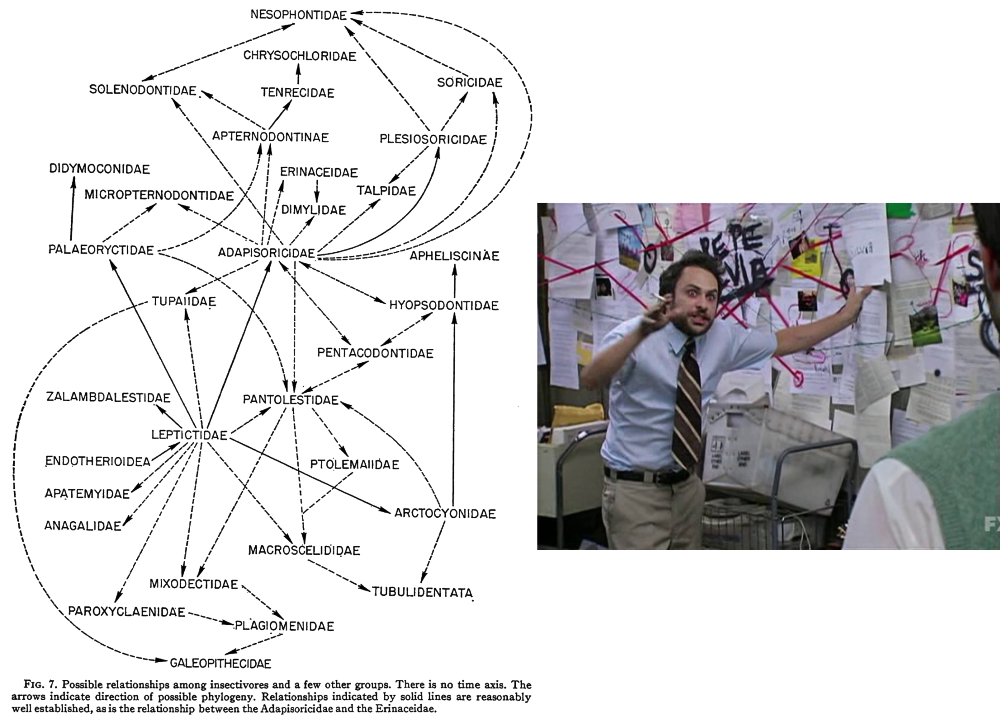
The problem was that the only characteristics that really united these various animals were very generic “early placental mammal” traits – small body size, five clawed digits on the hands and feet, relatively unspecialized teeth, and mostly-insectivorous diets – and attempts at making sense of their evolutionary relationships were increasingly convoluted.

An image of a diagram from a 1967 academic paper, showing a complicated attempt to figure out the evolutionary relationships of "insectivores", with many different group names linked by arrows. For comparison next to it is the "Pepe Silvia" conspiracy wall meme.
…They’re the same image.

(Image sources: http://hdl.handle.net/2246/358 & https://knowyourmeme.com/memes/pepe-silvia)

The rise of cladistic methods from the 1970s onwards resulted in a lot of “insectivores” finally being recognized as unrelated to each other, removing them from the group and paring things back down closer to the name’s original definition. The idea that insectivorans were ancestral to all other placentals was abandoned, instead reclassifying them as being related to carnivorans, and the remaining members were recognized as just retaining a superficially “primitive” mammalian body plan.

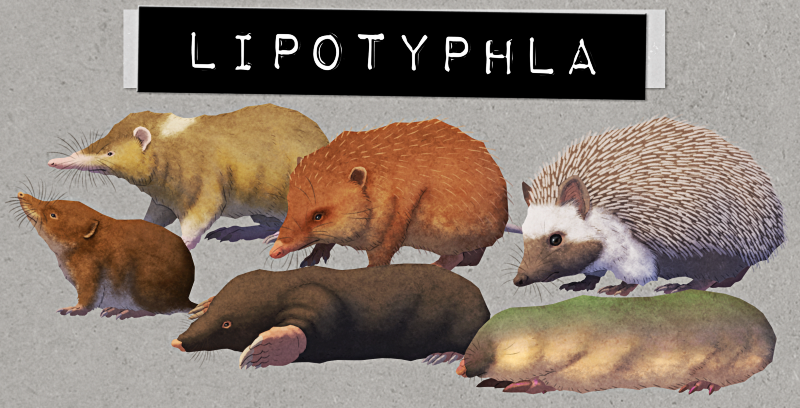
Just shrews, moles, hedgehogs, solenodons, tenrecs, and golden moles were left, and to disassociate from the massive mess that had been Insectivora this version of the group was instead now called Lipotyphla.

An illustration showing the animals that made up "Lipotyphla". From left to right it pictures a solenodon, a tenrec, and a hedgehog on the top row, and a shrew, a mole, and a golden mole on the bottom row. Text at top of the the image reads "Lipotylpha", styled like an embossed label-maker sticker that has been stuck over the previous images' text.
Lipotyphla

But there were still no unique anatomical links between the remaining lipotyphlans. And then once genetic methods became available in the late 1990s, something unexpected happened.

Studies began to suggest that tenrecs and golden moles were actually part of a completely different lineage of placental mammals, the newly-recognized afrotheres, with their closest relatives being sengis and aardvarks. Meanwhile the rest of the lipotyphlans were laurasiatheres, closely related to bats, ungulates, and carnivorans.

Lipotyphla was suddenly split in half. For a while it was unclear if even the remaining shrew-mole-hedgehog-solenodon group was still valid – hedgehogs’ relationships were especially unstable in some studies – but by the mid-2000s things began to settle down into their current state.

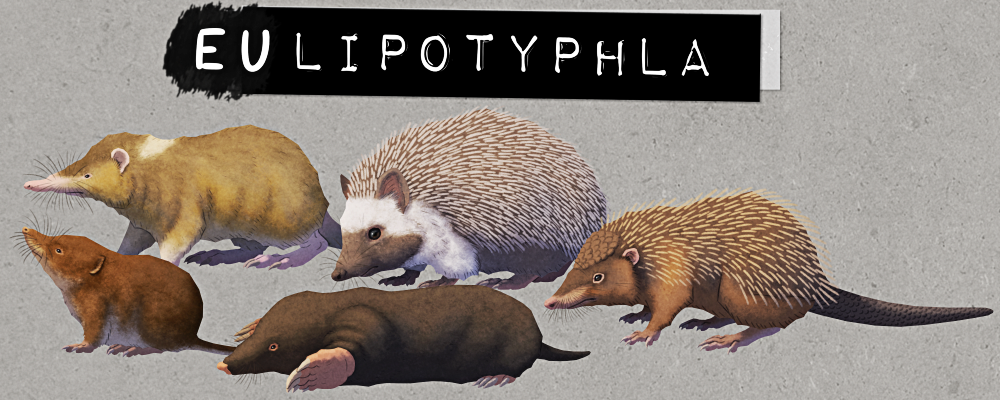
Finally, after almost 200 years of confusion, the insectivore wastebasket has (hopefully) now been cleaned up. The remaining “true lipotyphlans” do seem to all be part of a single lineage, united by their genetics rather than by anatomical features, and are now known as Eulipotyphla.

A few fossil groups like nyctitheriids and amphilemurids are generally also still included, but since this classification is based just on their anatomy it isn’t entirely certain. The only exception to this are the nesophontids, which went extinct recently enough that we’ve actually recovered ancient DNA from them and confirmed they were eulipotyphlans closely related to solenodons.

An illustration showing the animals that now make up Euipotyphla. From left to right it pictures a solenodon, and a hedgehog on the top row, and a shrew, a mole, and an amphilemurid on the bottom row. Text at top of the the image reads "Eulipotylpha", with the letters "E" and "U" hastily scribbled onto the front of the previous image's text.
Eulipotyphla

And a bonus image with species IDs:

Continue reading “It Came From The Wastebasket #01: Is This An Insectivore?”

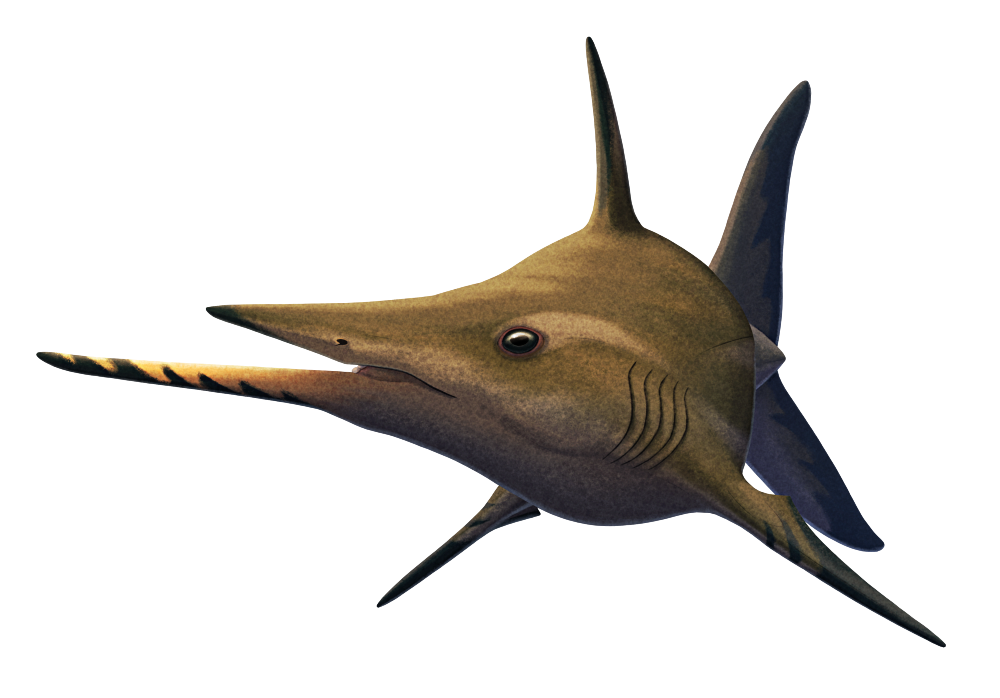
Ornithoprion

The eugeneodonts were a group of cartilaginous fish that convergently resembled sharks but were actually much closer related to modern chimaeras. They had unique “tooth whorls” in their jaws, and the most famous member of the group is probably Helicoprion, whose bizarre buzzsaw-like tooth arrangement was only properly understood within the last decade.

Ornithoprion hertwigi here was one of the first eugeneodonts found with fossilized skull material, and helped with the early understanding of just how their weird jaw anatomy actually worked.

It lived during the Late Carboniferous, about 315-307 million years ago, in a shallow tropical sea that covered what is now southwestern Indiana, USA.

At only around 50cm long (~1’8″) it was one of the smaller eugeneodonts, and along with a small Helicoprion-like tooth whorl it also had a distinctive highly elongated chin. Similar to modern halfbeak fish this structure may have served a sensory function, helping Ornithoprion to detect prey in dark or murky waters.

Jakapil

The thyreophorans were heavily armored ornithischian dinosaurs, with their most famous representatives being the stegosaurs and the ankylosaurs. Earlier members of the group were all small bipedal animals covered in rows of prickly osteoderms, and until now these “primitive” forms were known only from the early-to-mid Jurassic, around 200-165 million years ago.

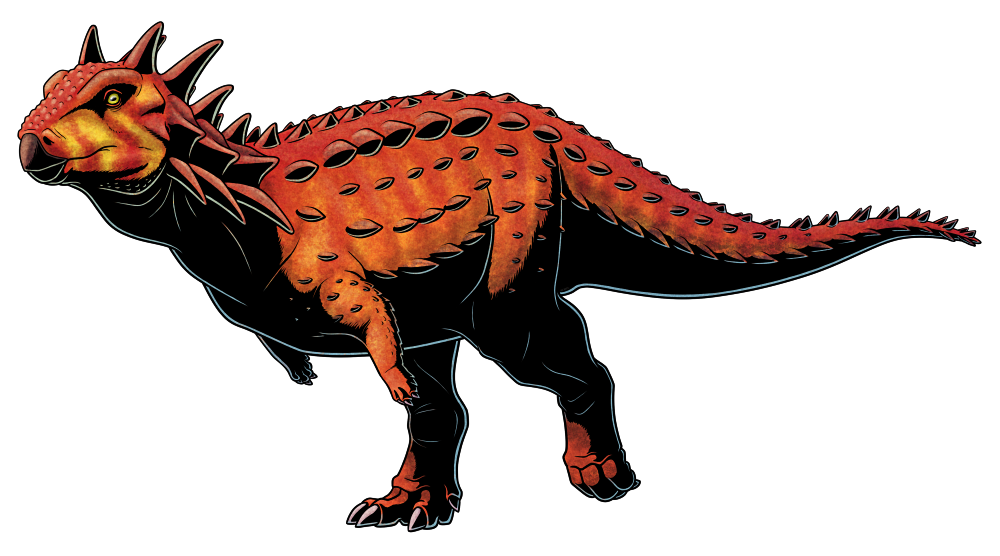
But now the recent discovery of Jakapil kaniukura is suggesting a lineage of early thyreophorans actually survived for much much longer than previously thought – all the way into the Late Cretaceous, about 97-94 million years ago.

Just 1.5m long (5′), Jakapil lived in what is now southern Argentina, in an ancient desert with a braided river system. It was bipedal, with a short beak, small arms, and a body bristling with spiky armor, and its unusually deep lower jaw and heavily worn teeth indicate it fed on rather tough vegetation that required a lot of chewing to process.

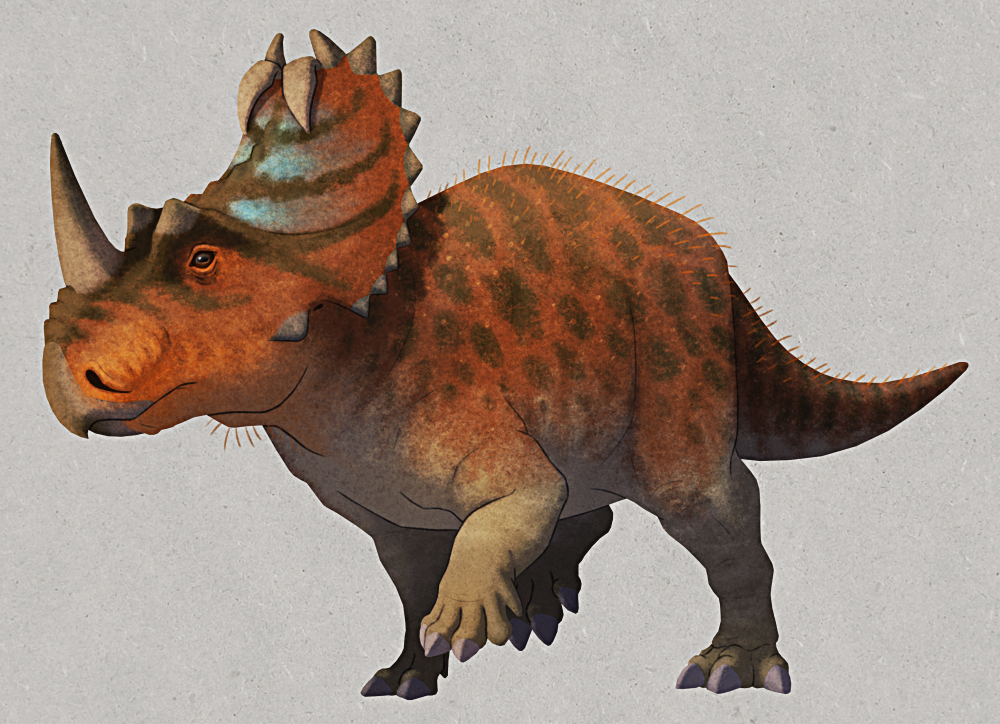
It’s currently only known from somewhat fragmentary remains, so reconstructions of its full appearance are rather speculative and there’s already been some dispute about whether Jakapil actually was a thyreophoran. One proposal is that it shared a lot of anatomical features with early ceratopsians instead, which if true would make it an incredibly weird armored ceratopsian, and also the first definitive member of that group from South America. But the ceratopsian-like features could also just be due to convergent evolution – and a Jakapil-like dinosaur might actually help explain the only other known dubious South American “ceratopsian” Notoceratops, and the similarly-disputed Australian Serendipaceratops.

But whatever it was – late-surviving basal thyreophoran, southern armored ceratopsian, or even a previously unknown lineage of ornithishcians entirely new to science – it’s an exciting and unexpected discovery.

Slavoia

Slavoia darevskii was a lizard that lived in what is now Mongolia and Kazakhstan during the Late Cretaceous, about 85-70 million years ago.

Around 12cm long ~(4.75″), it had a compact skull, small eyes, a short neck, shovel-like hands, an elongated body and slightly reduced hind limbs – all features that indicate it was a burrowing animal, digging tunnels and feeding on underground invertebrates.

Its exact relationships are uncertain, but recent studies have suggested it was an early amphisbaenian, representing a point in the group’s evolution before the full loss of their legs and the development of their extremely long worm-like shape.

Rajasaurus

Abelisaurids were a group of theropod dinosaurs characterized by short snouts, bony ornamentation on their skulls, tiny stiff arms, and stocky legs. Known mostly from the southern continents of Gondwana, they were the dominant predators in these regions and are thought to have been specialized hunters of titanosaurian sauropods.

Rajasaurus narmadensis lived in what is now western India during the Late Cretaceous, about 67 million years ago. Around 7m long (23′), it had very rough-textured thickened bone on the top of its snout, along with a short rounded horn on its forehead that was probably used for display or headbutting behaviors.

India at this time was an isolated island continent located off the east coast of Africa, and Rajasaurus‘ ancestors probably island-hopped across from then-nearby Madagascar – where its closest known relative lived, the very similar-looking Majungasaurus.

Auroralumina

Cnidarians – a group of animals that includes modern corals, sea anemones, sea pens, jellyfish, hydra, and a couple of parasitic forms – are one of the most ancient animal lineages, originating at least 580 million years ago in the Ediacaran period.

Actual identifiable fossils of cnidarians that old are incredibly rare, however, and until now there was only one example – the small polyp-like Haootia from Canada.

But a second definite Ediacaran cnidarian has now been described: Auroralumina attenboroughii.

It was discovered in Charnwood Forest, England, in the very same site where the first recognized Precambrian fossils were found in the 1950s. About 20cm tall (~8″) it dates to around 560 million years ago and was made up of a pair of forking stiff-walled tubes which expanded into wide four-sided goblet-like shapes full of stubby tentacles. These densely-tentacled crowns would have been used to capture tiny planktonic organisms from the water around it, making it the current earliest known example of a predatory animal.

The one known fossil specimen has an incomplete base, so it’s uncertain if this was actually the full life appearance of Auroralumina or if it was even larger with more branches and goblets. And although it was preserved in deep-water sediments, it appears to have originated from much shallower waters, being swept down into the depths during a volcanic eruption.

While it superficially resembled a sea anemone, details of its anatomy suggest it was actually much closer related to medusozoans, having similar traits to the immobile polyp stage of the jellyfish life cycle. Its four-way symmetry and boxy shape may also link it to the enigmatic conulariids.

It’s not clear if it was able to bud off swimming medusa stages like its modern relatives – that might be an evolutionary innovation that came along later – but it at least shows that a basic medusozoan body plan was already in place around 20 million years earlier than previously thought.

Annakacygna

Around 11 million years ago, during the late Miocene, much of what is now northern Honshu in Japan was submerged under fairly deep ocean waters. This offshore environment was inhabited by a variety of ancient sea-going tetrapods such as turtles, desmostylians, seal-like allodesmines, archaic baleen whales, and early oceanic dolphins… and also one very unexpected bird.

Meet the flightless marine swan.

Annakacygna hajimei, also known as the Annaka short-winged swan, was the same size as a modern black swan at about 1.2m long (~4′), but had a combination of features unlike any of of its living close relatives. Its head was proportionally large, and it had a long spoon-shaped bill like a shoveler duck, lined with comb-like structures for filter-feeding on plankton. It also had widened hips that would have helped keep it stable floating in rough waters, its tail was highly mobile and muscular, and its feet resembled those of diving birds like loons.

With thickened heavy bones and shortened forearms it was clearly completely unable to fly, but its reduced wings appear to have been highly specialized rather than just vestigial. Its shoulders were extra flexible while its wrists had a more limited range of motion, allowing it to fold its wings into a distinctive half-raised position similar to modern mute swans.

It probably used its wings and tail to perform elaborate “busking” visual displays, and also to carry and protect its young on its back while out at sea – basically making itself into a living swan boat.

Palaeosinopa

Cimolestans were one of the major mammal lineages that survived through the K-Pg mass extinction 66 million years ago. Closely related to early placentals, they had a burst of diversification during the first half of the Cenozoic and rapidly evolved into a wide range of specialized forms – some uniquely weird, and others convergently resembling more familiar modern animals like squirrels, bears, ground sloths, and hippos.

And one group known as the pantolestids were incredibly otter-like.

(Because synapsids love them some lutrinization.)

Palaeosinopa didelphoides here lived during the mid-Eocene, about 52 million years ago, in what is now the Mountain West region of the USA. It was similar in size to a small otter, about 1m long (3’3″), and had a streamlined body with a well-muscled neck, short powerful forelimbs, slightly longer hindlimbs, and a very long tail.

Inhabiting a subtropical lake ecosystem, it probably swam using both hindlimb paddling and otter-like tail undulations. Its strong jaws and teeth suggest it was specialized for crunching hard shellfish prey, but so far preserved gut contents have only shown fish bones and scales. Fairly large claws indicate it was also able to dig out burrows similarly to modern otters and beavers.

Although pantolestids were never particularly common animals they were quite widespread, expanding their range from their evolutionary origins in North America across to Europe and eventually into Asia. A cooling and drying climate at the end of the Eocene seems to have driven most of the group into extinction alongside all their other cimolestan relatives – but a few of the Asian species clung on slightly longer as the very last of their kind, with the last known fossils dating to about 28 million years ago in the early Oligocene.

Stanleycaris

Radiodonts were early arthropods with specialized frontal appendages, disc-like mouths, complex compound eyes, and swimming flaps along the sides of their bodies. Once considered to be bizarre “weird wonders” of the Cambrian Explosion that represented a failed evolutionary experiment, we now know that they were actually a highly diverse and successful lineage that lasted for at least 120 million years.

While some radiodonts were the largest animals of their time periods, Stanleycaris hirpex here was one of the smallest known members of the group – although at around 10cm long (~4″) it was still respectably big compared to most other Cambrian animals.

Discovered in the Canadian Burgess Shale deposits (~508 million years ago), it was originally known only from isolated frontal appendages and mouthparts, and had been assumed to be a fairly typical member of the hurdiid family. But the recent discovery of over 200 new fossils, including some exceptionally well-preserved full body specimens, has catapulted it directly from being poorly-known into now being one of the most completely known of all radiodonts.

And it had a very big surprise for us, right in the middle of its face.

It turns out that Stanleycaris had a huge third eye, unlike anything ever seen in a radiodont before. A large unpaired eye was also part of the five-eyed arrangement in opabiniids and Kylinxia, and finding a similar example in radiodonts too raises the possibility that this sort of well-developed “median eye” may have been more widespread in early arthropods than previously thought.

Along with the third eye, some of the Stanleycaris specimens preserve fine internal details of its nervous system and show that its brain was made up of two segments instead of the three seen in modern arthropods. It also had gills positioned on its underside, unlike most other radiodonts which had them on their backs.

Ericiolacerta

The synapsids were an incredibly successful and diverse group during the Permian period, but after the devastating “Great Dying” mass extinction event 252 million years ago only three lineages survived into the Triassic – the cynodonts (close relatives and ancestors of modern mammals), the dicynodonts (beaked tusked weirdos who briefly took over the world), and the therocephalians.

Therocephalians were close relatives of cynodonts, and convergently evolved several very mammal-like anatomical features in their skulls, teeth, and limbs. But unlike their cousins this lineage never fully recovered in the Triassic, and they ultimately disappeared completely around 242 million years ago.

Ericiolacerta parva was one of these short-lived Mesozoic therocephalians, known from the early Triassic (~252-247 million years ago) of South Africa and Antarctica, in regions that were connected at the time as part of the supercontinent of Pangaea. It was a fairly small animal, about 20cm long (~8″), with small sharp teeth that indicate it mainly fed on insects, and semi-opposable thumbs and inner toes that suggest it was also a capable climber.

Holes in the bones of its snout would have carried numerous nerves and blood vessels, which may be evidence of sensitive fleshy lips and possibly whiskers. And while there’s no direct evidence of fur in therocephalians, they do appear to have been active warm-blooded animals – and possible fossilized synapsid hair from the Permian period suggests fuzziness might have been ancestral to all of the “protomammal” lineages that survived into the Triassic.