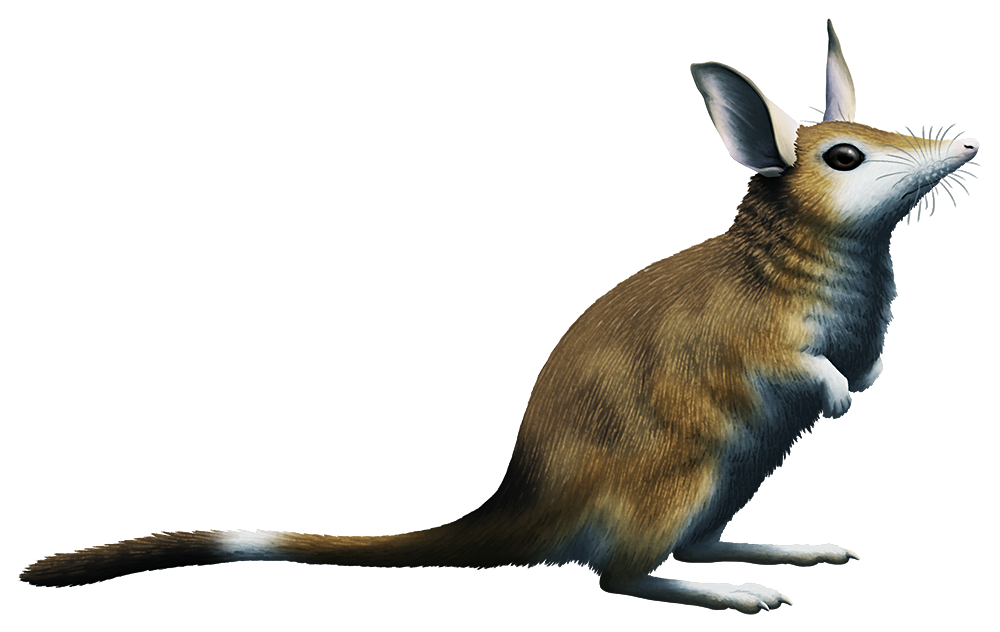
Almost-Living Fossils Month #18 – Metatherians Everywhere

While modern marsupials are native only to Australasia and the Americas, they’re part of a larger grouping of mammals known as metatherians that were once found around most of the world. Thought to have originated in Asia, perhaps as far back as the Late Jurassic (~160 mya), the ancestral metatherians spread to Europe and the Americas during the Cretaceous and gave rise to multiple different lineages, ranging from small sabertoothed carnivores to otter-like swimmers to the main mammalian predators of Cenozoic South America.

True marsupial fossils didn’t appear in the fossil record until the start of the Paleocene (~65 mya), but some of their closest evolutionary “cousins” – the herpetotheriids – originated a little earlier in the Late Cretaceous, around 70-66 million years ago.

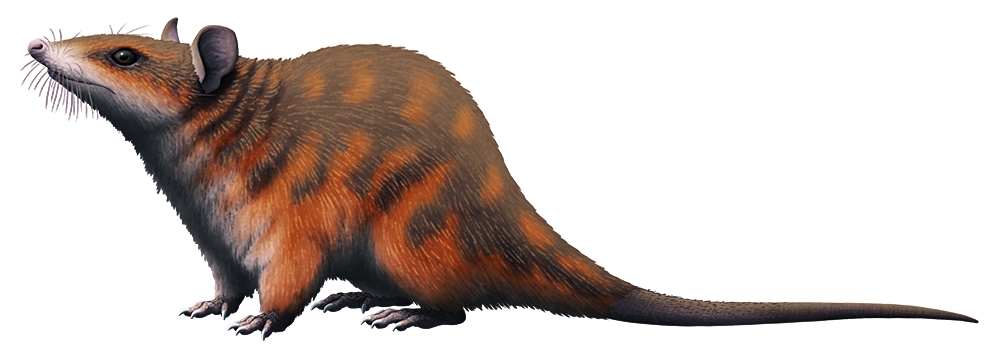
Herpetotheriids were small opossum-like animals found in North America, Asia, Europe, and Africa. They were more terrestrial than the opossums they resembled, adapted for running on the ground rather than climbing, but were probably similarly opportunistic omnivores eating a wide variety of foods.

They survived through the end-Cretaceous extinction and seem to have actually been quite common in the northern continents for most of the Cenozoic. They also weren’t the only metatherians in those regions, living alongside another group called the peradectids which were true marsupials closely related to opossums.

In North America the native metatherians all went extinct sometime around the early Miocene (~20 mya) – although the continent would later be recolonized by opossums from South America during the Great American Interchange. Meanwhile the African herpetotheriids disappeared around the same time, but the European and Asian metatherians continued on into a little longer into the mid-Miocene.

Amphiperatherium frequens was one of the last known members of the herpetotheriids, living in Europe during the early-to-mid Miocene (~20-13 mya). It was about the size of a small rat, around 15-20cm long (6-8″), and seems to have mainly inhabited warm humid environments.

Although the disappearance of the northern metatherians has traditionally been blamed on them being out-competed by placental mammals, the fact that they survived alongside placentals just fine for over 45 million years suggests that something else pushed them over the brink. Their extinction may in fact be more linked to the ongoing drying and cooling climate trends in the latter half of the Cenozoic.

The herpetotheriid’s extinction seems to have happened soon after the Middle Miocene disruption, a sudden shift towards cooler temperatures that may have altered their local ecosystems too quickly for them to adapt. The peradectids hung on until at least 11 million years ago, with some of the last members known from Southeast Asia, but they may have likewise fallen victim to further episodes of global cooling towards the end of the Miocene and into the Pliocene.

Almost-Living Fossils Month #15 – Digging Dryolestoids

First appearing in the mid-Jurassic, about 168 million years ago, a group of mammals called dryolestoids were some of the closest known relatives to the therians (the group that contains modern marsupials and placentals). They were found throughout North America, Eurasia, and North Africa up until the Early Cretaceous (~125 mya), but then mostly disappeared from the northern continents and instead migrated into South America – where they went on to flourish and became some of the most common mammals in the continent by the Late Cretaceous.

Although mostly known from only teeth and jaw fragments, the dryolestoids seem to have been a pretty diverse group of mammals during the Mesozoic, adapting to a variety of different diets and lifestyles ranging from small insectivores to relatively large herbivores.

Most of them died out in the end-Cretaceous mass extinction, except for the dog-sized herbivorous Peligrotherium which survived until 59 million years ago in the Early Paleocene… and one other known example from much much later into the Cenozoic.

Despite being absent from the fossil record for over 40 million years, the dryolestoids reappeared again in the Early Miocene of Patagonia (~21-17.5 mya) with a single late-surviving member: Necrolestes patagonensis.

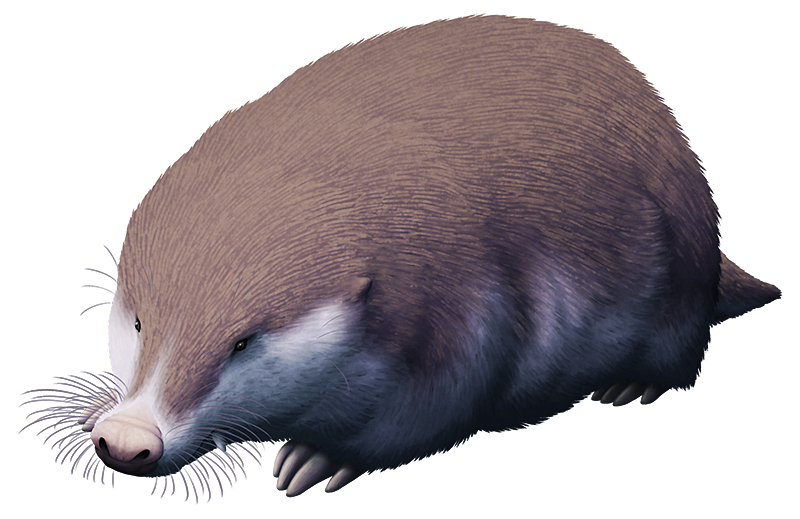
The known Necrolestes fossils are surprisingly well-preserved compared to most other dryolestoids, with about a third of its skeleton represented. It was a small mole-like burrowing animal, about 10-15cm long (4-6″), with large canine teeth and an upturned snout. The cartilage in its nose was ossified into bone, strengthening it and probably supporting a pad of thick toughened skin – and also suggesting that it was a “head-lift digger”, using its snout like a shovel to dig through the soil.

While it superficially resembled the earlier mole-like dryolestoid Paurodon, it was actually much closer related to more generalist Mesozoic forms like the sabertoothed Cronopio.

After Necrolestes there’s no further evidence of dryolestoids living any closer to modern day. Much like the late-surviving gondwanatheres they lived alongside, these last dryolestoids may have specialized themselves so much that they couldn’t cope with sudden environmental changes, and the Middle Miocene extinction could have finished them off entirely.

Almost-Living Fossils Month #11 – The Lost Island Murderer

The modern solenodons, today found only on the Caribbean/Antillean islands of Cuba and Hispaniola, represent the last living survivors of a very ancient branch of placental mammals. Although they’re part of the eulipotyphlans – the lineage that also contains shrews, moles, and hedgehogs – their last common ancestor with the other members of that group dates back to over 70 million years ago.

And during their early evolutionary history, somewhere between the Late Cretaceous and mid-Eocene (~68-43 mya), the ancestors of the solenodons diverged into two different lineages: the solenodons themselves, and the nesophontids.

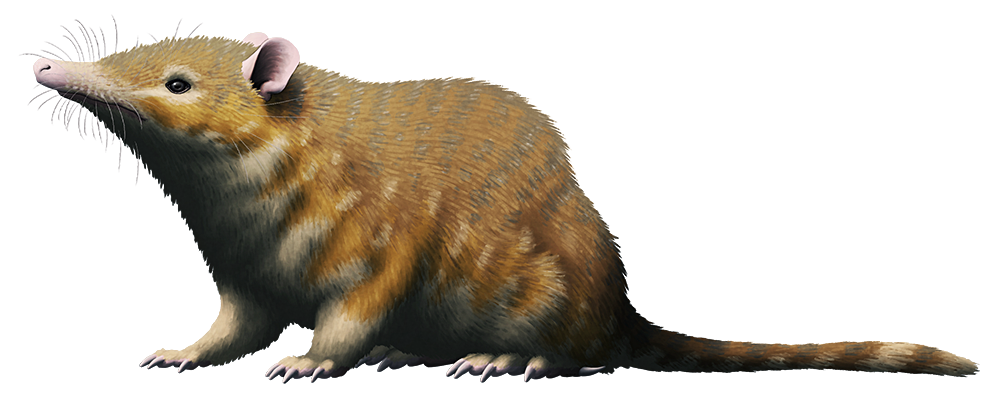
Known only from skulls and jumbled partial skeletal remains, nesophontids seem to have been fairly similar to their solenodon cousins. They would have been shrew-like in appearance, varying in total size from 5 to 20cm long (2-8″), with slender flexible snouts that they used to sniff out their small invertebrate prey. They also probably had a venomous bite like the solenodons, since their canine teeth had distinctive grooves for injecting toxic saliva.

Their remains have been found in various islands around the Caribbean, in Cuba, Hispaniola, Puerto Rico, the United States Virgin Islands, and the Cayman Islands. Between six and twelve different species are represented, all in a single genus called Nesophontes (meaning “island murderer”) – and all of the known specimens are actually subfossils from the Holocene, dating to less than 12,000 years old.

These relatively young ages mean that pieces of nesophontid DNA have been successfully recovered from bones within preserved owl pellets, which is how we could confirm their close relationship to solenodons and the dates of their ancestors’ probable divergence. But we have absolutely no idea about the rest of their family history during the entire Cenozoic, such as how and when they originally colonized the Caribbean or whether they had any other extinct relatives in the Americas.

(There is one possible partial specimen from a piece of Dominican amber, dating to the Oligocene or Early Miocene, 29-18 million years ago, but it’s not clear whether it’s a nesophontid, a solenodon, or something else entirely.)

Nesophontes edithae was the only species of nesophontid living in Puerto Rico and the United States Virgin Islands. It was the largest known member of the genus, at least 20cm long (8″), and may have been able to reach such a size due to the absence of competition from solenodons on those particular islands.

Along with its relatives around the Caribbean it seems to have survived frustratingly close to modern times, even existing alongside indigenous humans, with some remains only about 500 years old. But when the islands were colonized by Europeans from the 1490s onwards, the combination of the introduction of invasive Old World rats, new predators like domestic cats and dogs, and extensive deforestation probably killed off the nesophontids very quickly (along with all but two of the solenodon species).

Despite claims of fresh-looking remains in owl pellets and searches for surviving populations, there’s currently no convincing evidence for any living nesophontids, and radiocarbon dating has never found anything younger than 500-600 years old. 

Almost-Living Fossils Month #04 – The Last Multis

Known almost exclusively from the southern continents of Gondwana – hence their name – the gondwanatheres were part of a widespread and very long-lived group of mammals known as multituberculates.

Although multis resembled placental rodents, and gave birth to tiny undeveloped young in a similar manner to marsupials, they originated much further back in the mammal evolutionary tree. They existed by at least the Early Jurassic (~183 mya), and their ancestry may go even further back into the Late Triassic (~220 mya) if they were descended from haramiyidans.

Multis survived the end-Cretaceous extinction and became very diverse through the first half of the Cenozoic, until a combination of factors such as climate shifts, new types of vegetation, and the evolution of new mammalian predators (and possibly also competition from placental rodents) resulted in most of them going extinct by the Early Oligocene (~33 mya) – with only the gondwanatheres surviving past that point in the then-isolated continent of South America.

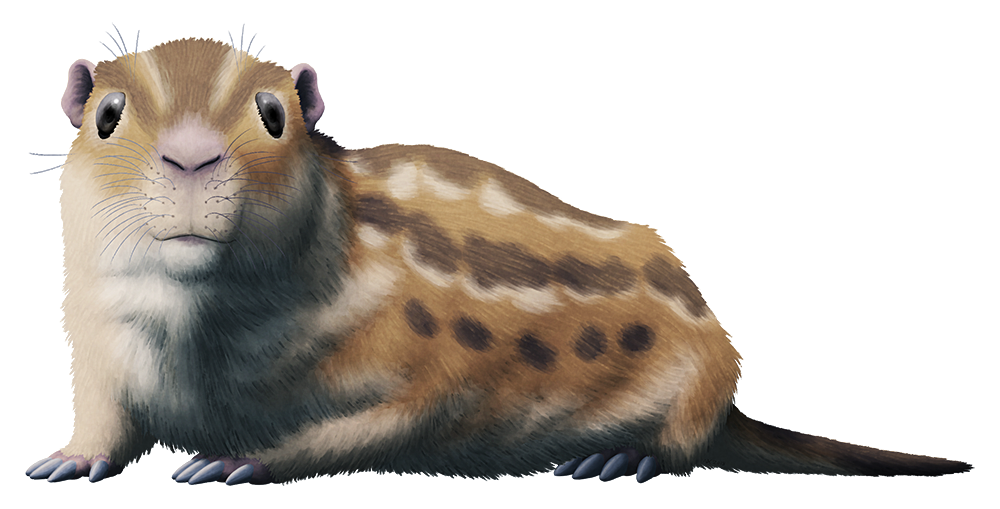
Patagonia peregrina was the very last known gondwanathere in the fossil record, living just 21-17.5 million years ago in the Early Miocene of Argentina. Although only teeth and jaw fragments have been found so far, it was probably about 15cm long (6″) and would have been a burrowing herbivore similar to modern gophers or tuco-tuco. Its ever-growing rodent-like teeth were adapted for grazing on tough grasses in its savanna-like habitat, and it would have lived alongside several other now-extinct types of mammal – but we’ll be getting to those ones later in the month.

Since it seems like these last gondwanatheres had survived by retreating into a rather specialized ecological niche, they sadly probably didn’t persist for very long beyond the time of Patagonia. A wave of extinctions associated with sudden climate cooling about 14 million years ago may well have been the final blow to the once-successful lineage of the multituberculates.

Almost-Living Fossils Month #01

It’s finally time for “Almost-Living” Fossils Month!

There are various modern species that we call “living fossils” because they’ve survived for very long periods of geological time, but there are also plenty of long-lived and successful groups that didn’t quite manage to make it to the present day.

For all of August I’ll be doing six posts on this topic a week (taking a break on Sundays), and the basic criteria for entries are that a featured organism has to be part of a group that:

• originated in the Mesozoic or earlier
• existed for at least 50 million years
• and survived through the end-Cretaceous mass extinction, only to go extinct later in the Cenozoic

So, let’s begin with…


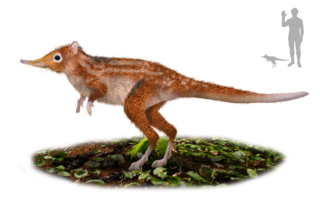
An illustration of an extinct small mammal. It resembles a shrew, with a pointed whiskery snout, small rounded ears, and a long furred tail. It also has pointed spurs on its ankles.

The Saint Bathans Mammal

Dating to the mid-Miocene, about 19-15 million years ago, this little mammal was discovered in the Saint Bathans fossil deposits in the South Island of New Zealand, and was probably the size of a large shrew, around 10cm long (4″). It doesn’t have an official scientific name yet, but its fragmentary remains might represent something very special.

Not only was it a terrestrial mammal living at a time when none were thought to inhabit New Zealand at all, but it also doesn’t seem to fit into any known group of mammals. It’s definitely not a placental or marsupial or monotreme, and it doesn’t match any of the other “archaic” groups – so it could represent an entirely new lineage we didn’t even know existed.

At best it’s been classified as a theriiform, belonging somewhere between eutriconodonts and multituberculates in the mammal family tree. This means it would have to be part of a group with a very long ghost lineage going all the way back to the Late Triassic or Early Jurassic (~220-190 mya). Whatever it actually was, its ancestors were probably already present on New Zealand when the islands split away from Gondwana in the Late Cretaceous (~85 mya), and must have remained isolated there for tens of millions of years more.

It’s unknown how much closer to present day these mysterious archaic mammals actually survived, but it’s possible they were one of the casualties during the Middle Miocene disruption extinction about 14 million years ago, when the relatively warm climate suddenly cooled. And then land mammals were completely absent from New Zealand until the arrival of humans ~750 years ago.

(It’s also worth noting that the fossils of the Saint Bathans mammal were described over ten years ago, and our knowledge of ancient mammals and their evolutionary tree has changed a lot in that time. New studies or more fossil material might reveal the Saint Bathans mammal to actually be one of the very last survivors of an already-known group, but that would still make it an amazing and unique discovery.)

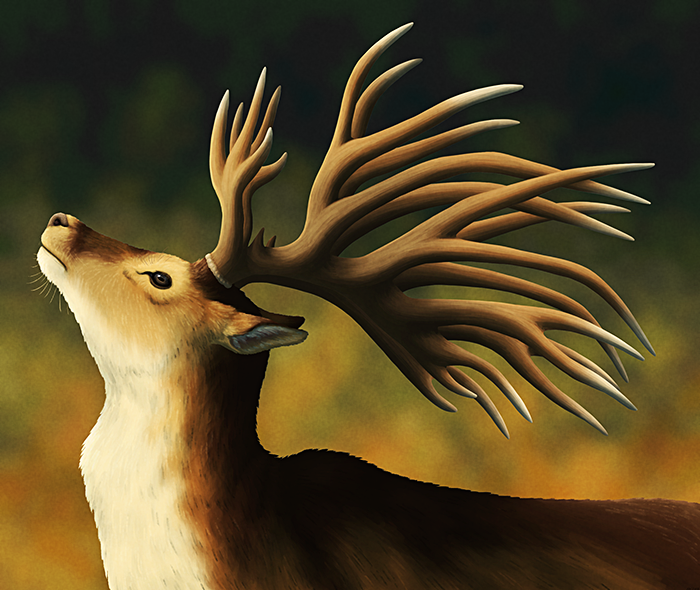
Eucladoceros

Eucladoceros dicranios, a deer from the Pliocene and Pleistocene of Europe (~3.5-1 mya). Close in size to a modern moose, standing about 1.8m tall at the shoulder (5′10″), the males of this species had a set of particularly large antlers – measuring up to 1.7 meters across (5′6″) and bristling with at least twelve prongs each – giving it the nickname of “bush-antlered deer”.

The more famous “Irish elk” (Megaloceros giganteus) would later develop even bigger antlers, but Eucladoceros was the earliest known deer to evolve this sort of extremely elaborate headgear.

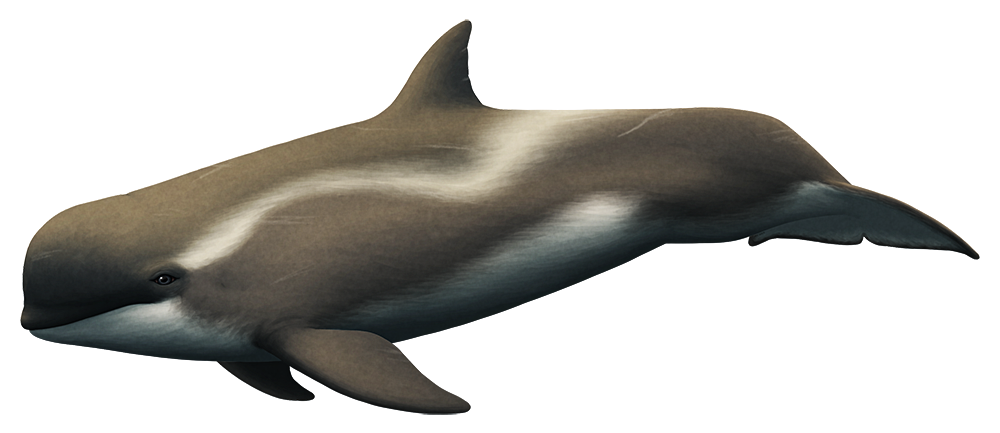
Orcinus citoniensis

Despite commonly being called “killer whales” modern orcas are actually the largest living members of the oceanic dolphin family. Their ancestors are thought to have diverged from other dolphins between 10 and 5 million years ago – and surprisingly their closest relatives are the much smaller snubfin dolphins found in Australasia.

Living during the Pliocene (5-2 mya) in the Mediterranean, Orcinus citoniensis was an early member of the orca lineage, and was probably a transitional form between their early dolphin ancestors and the modern Orcinus orca.

It was half the size of modern orcas, at about 4m long (~13′). While it had a higher tooth count than its living relatives its teeth were also proportionally smaller, suggesting it wasn’t specialized for tackling large prey and probably fed mainly on fish and squid.

Month of Mesozoic Mammals #31: The Survivors

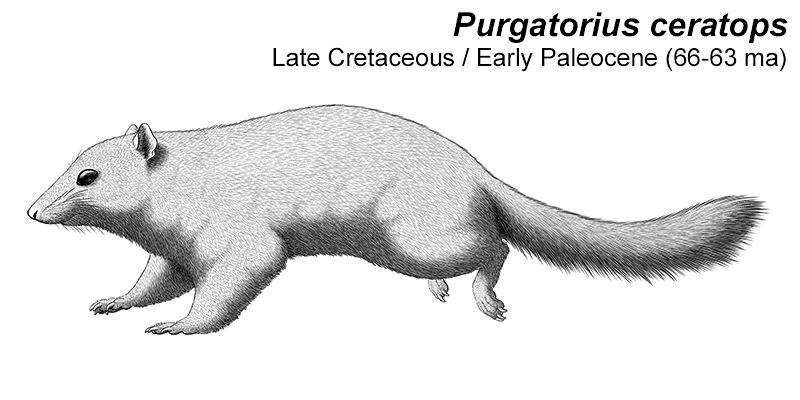
Purgatorius

Quite a few groups of Mezozoic mammals actually made it into the Cenozoic – including multituberculates, dryolestoids, various different metatherians, cimolestans, leptictidans, and possibly another unknown lineage in New Zealand – but most of them eventually declined and died out, and only monotremes, marsupials, and placentals still remain alive today.

We don’t know exactly when placentals originated. The first definitive fossils come from the start of the Cenozoic, but a few early ancestral forms probably already existed during the Late Cretaceous (estimated up to 90-75 mya) and only got their chance to rapidly diversify immediately after the mass extinction event.

One of the closest fossils we have to the earliest placentals is Purgatorius. Known mainly from teeth from the Early Paleocene of North America (66-63 mya), it’s not entirely clear whether it actually existed in the Mesozoic, but its remains have been found very close to the K-Pg boundary and one fossil might actually be from the end-Cretaceous.

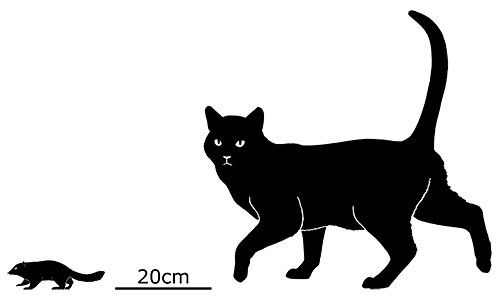
A few foot bones have been associated with some of the fossil teeth, and if they do belong to Purgatorius then they show that it had very flexible ankles, a characteristic typical of tree-climbing animals. It would likely have been a squirrel-like creature, about 15-20cm long (6-8″), eating an omnivorous mixture of insects, seeds, and fruit. It may also have been capable of burrowing similar to modern chipmunks.

It’s often been interpreted as a placental mammal, specifically a very early type of primate, but more recent studies suggest it might not even be a true placental at all  – although it was probably still a very close relative of the common ancestor of all living placentals.

Month of Mesozoic Mammals #30: Strange Relations

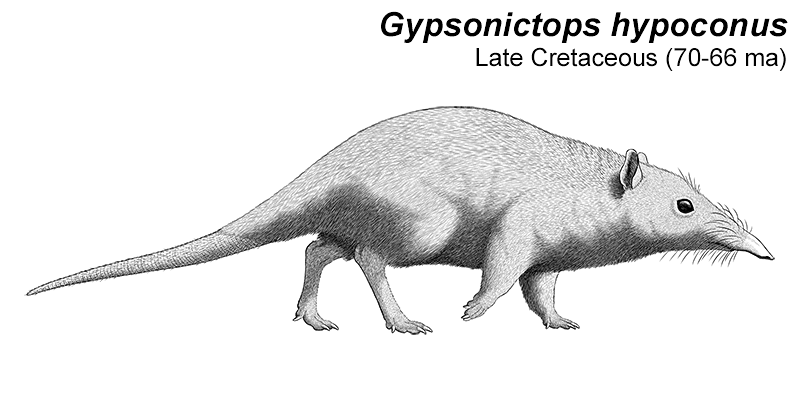
Gypsonictops

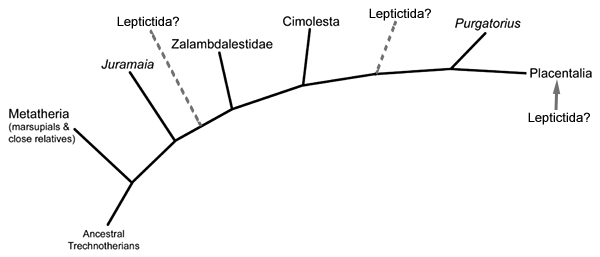
A group known as the leptictidans were probably some of the weirdest early eutherians. With their tiny forelegs, big hindlegs, and long counterbalancing tails, they somewhat resembled jerboas or small kangaroos – except they also had long slender snouts that probably ended in sengi-like proboscises, and their feet were structured more like those of running animals than jumping ones. They’re also thought to have been mainly bipedal, convergently evolving a similar posture and movement style to non-avian theropod dinosaurs.

Leptictidium (Eocene, 50-35 mya) by Tim Bertelink || CC BY-SA 4.0

First appearing in the Late Cretaceous, they made it through the end-Cretaceous extinction and survived up until the mid-Cenozoic across the northern hemisphere, going extinct around 33 million years ago. They were probably omnivores, eating a mixture of insects, small vertebrates, and soft plant matter such as fruit and leaves.

Their mix of “primitive” skull features and highly specialized skeletons makes classifying them particularly difficult. They’ve been proposed to be placentals related to primates and rodents or afrotheres, a very early branch of the eutherians, or close to placentals but not quite true members themselves. The latter interpretation currently seems most likely, but they could also be a paraphyletic group at the base of placentals (suggesting that they could even be ancestral to placentals, and therefore all placentals would technically be leptictidans).

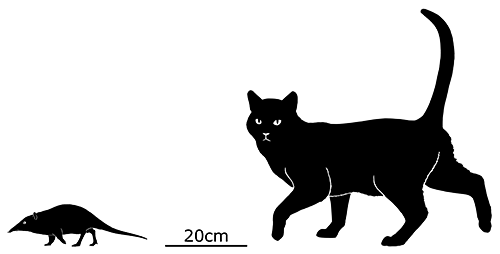
Gypsonictops was one of the earliest leptictidans, living during the Late Cretaceous of North America (70-66 mya). Known only from teeth and jaw fragments, we don’t know much about its appearance or full size – although it was probably smaller than its later relatives, perhaps about 35cm long (1′2″).

Any reconstruction of such fragmentary remains is going to be very speculative, but I’ve restored it here as a sort of transitional form, not yet quite as specialized. A more sengi-like animal, mainly quadrupedal but able to run and hop on its hind legs to flee from danger or chase after small fast-moving prey.

Month of Mesozoic Mammals #29: Rooting Around

Schowalteria

First appearing in the Late Cretaceous, a widespread and diverse group of mammals known as cimolestans were once thought to be early members of placental groups like pangolins and carnivorans. But more recent studies have shown them to be part of a different branch of the eutherian family tree altogether, more like cousins to the earliest placentals and leaving no living descendants.

However, they did make it through the end-Cretaceous mass extinction and were quite successful during the early Cenozoic, evolving into forms ranging from giant herbivores to fanged squirrel-like climbers to otter-like swimmers, with the latter surviving until about 33 million years ago.

One group of North American cimolestans, the taeniodonts, were specialized for digging up tough roots and tubers, with large claws, strong blunt jaws, and big front teeth that became ever-growing in some species.

Schowalteria was the earliest known member of this group, living during the Late Cretaceous of Canada (70-66 mya). Only represented by partial skull material, its full size is unknown – some estimates put it at a similar size to giants like Repenomamus, but it was likely closer to half that size at around 50cm in length (1′8″). Still one of the larger Mesozoic mammals around, but not nearly as big as some of the Cenozoic taeniodonts would later become.